Indignity

Life is full of indignities, small and large. I, like most people, am easily persuaded that life’s indignities have been targeted at me by some malign intent. Human beings are programmed to look for causation. It’s a key survival skill. The moment you move beyond blind instinct, learning from your mistakes and finding patterns and causes is vital. 

It is said that the first religions – pan theistic, animist and shamanic all came from the need for hunter-gatherers and early nomads to find some answer, or cause, for the indignities of storm, drought, disease and death that pre-scientific man had no other method to understand or intellectually control.

These gods brought good, but more often bad. They were quixotic and quick to anger and required regular appeasement and speaking in tongues to commune with and placate. 

Ancient philosophers were not immune to the gods whims. They always paid them homage. But they tended to live in temperate latitudes – comparatively benign environments – which left some time for building civilisations and thinking. 

I’ve recently started reading Epictetus, a famous stoic philosopher from the 2nd century AD. It seems to me he offers a window into an interesting period between ancient philosophy and organised monotheistic congregational religion. 

I’ve not read enough to be sure, but my Bayesian brain guesses that his stoicism is a response to the superficially civilised but dangerously unpredictable indignities of Roman society – from slavery to summary justice.

His stoic answer seems to be to develop a detachment which has much to commend it in ‘coping with the loss of an earthenware pot’ or being ‘splashed and jostled at the bathhouse’. But inviting us to train ourselves to ‘feel nothing’ at the loss of a wife or child (as they are human and death is inevitable) feels plain wrong. For Epictetus the sole true value is our moral character. And all else – including people – are as Oliver Reed said in Gladiator simply ‘shadows and dust’.

I like Epictetus’s advice to recognise what you control and don’t, what you assume and what is real, what is intended and what is accident. His tip to take a moment to reflect before reacting is wise too. But I’m with Aristotle not Epictetus on people we love and the importance of friends.

One such sent me a piece of research which suggests that the value of friendship doesn’t just underpin Aristotle’s vision of happiness, but also the happiness that organised religions bring:

“It is the social aspects of religion rather than theology or spirituality that leads to life satisfaction,” according to sociologist Chaeyoon Lim of the University of Wisconsin-Madison. “Friendships built in religious congregations are the secret ingredient in religion that makes people happier” his study shows.

So I go with Aristotle and the big congregational religions, not Epictetus on friends. Friends and social ties are the route to human happiness and eudaimonia. Avoiding them isn’t. 

You can’t control friends. As Epictetus rightly points out ‘the jeering of friends’ often accompanies any attempt at self improvement. There’s no doubt that friends can hurt you, and heap indignity on you too. But you can’t live happily without Friends.
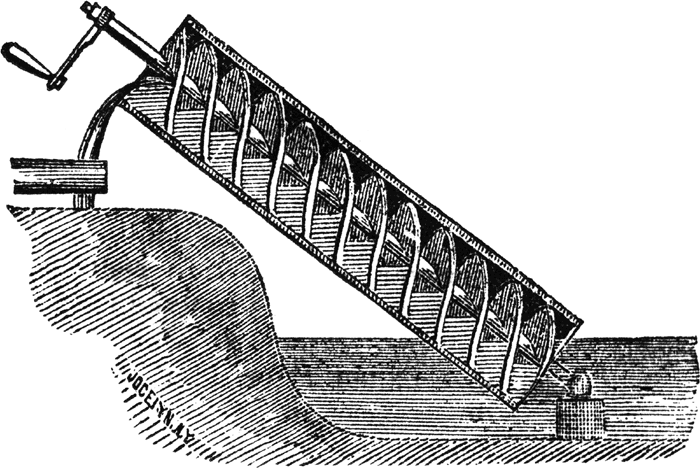
Mining

Some time ago the thought came to me that knowledge is an industrial business these days. In Aristotle’s era knowledge was lying around like coals on the fabled Newcastle beach. That’s not to say that Aristotle’s ceaseless collecting and inquiring and ordering where not great feats – and indeed arguably the invention of the scientific method. But there was plenty to go at and lots to be discovered. I consider this the era of beach coal.

Pace the Victorians and the great scientific amateurs. Named for the Latin ‘to love’, they pursued knowledge with independent means, chipping ‘curiosities’ out of geological strata, condensing chemical elements and taking care to ensure god was suitably credited in the processes they discovered. This was the age of independent mining – small entrepreneurs digging deeper and descending into specificity.

Then we enter the industrial era of knowledge. Universities, labs, great machines, competition between countries and ideologies, chemical warfare, Los Alamos, the military industrial complex, the 5 year plan, the ‘white heat’ of progress, the space race and the mindblowingly massive Large Hadron Collider. Science now sinks deep deep shafts and scours entire landscapes in the industrial pursuit of small incremental additions to the sum of what we know.

One of the downsides of this is the great discoverers of our time can generally only tell us a lot about very little. They are so deep down their shaft of knowledge – illuminated only a few feet ahead by their hi-tech miners lamps – that they sometimes struggle to interest the common man. They are also a fractious bunch. As the philosopher of science Thomas Kuhn persuaded me 20 years ago, science is a competitive business. Flying elbows, trashing of reputations, the race to publish first and good old fashioned bickering are all a commonplace. Throw in powerful lobbies and money and the truth easily disappears back down the mineshaft.

Some are frustrated by this and believe public policy makers should rise above the melee and submit to the randomised double-blind trial. Others argue that more research and evidence will lead the human race to peace, prosperity and happiness. A few capture the popular imagination: Dawkins, Hawking for example. A very few (E.O. Wilson the socio-biologist is the only one I can immediately think of) manage to retain an Aristotelian ‘holism’ in their work and advance the big picture as well as the small detail.

So where does that leave the thoughtful polymath of today? Amateurs, in the Victorian sense or ‘lovers’ of knowledge, can feel intimidated without citations, a tenure, papers, experiments, machines and a peleton of research assistants. What chance of any useful discovery? Worse any statement, or thesis advanced might easily be disproved, infirmed or dismissed by competitive, individualistic and fractious experts.

I think the answer is to give up on the search for brand new knowledge. Leave that to the deep shaft miners. And as for ideas, like in the movies all the best plots have been written, all the best ideas have been had. New syntheses are what the complexity, chaos and the pace of change in modern life demand – new takes, approaches, ways of looking at ourselves. 

There are few new discoveries which are accessible to the amateur thinker, but we all have the Bayesian brains to form a new powerful, personal synthesis which helps us and others. 

I think ecology and epidemiology – seeing the interrelations and underlying patterns – not seeking the Eureka moment is where most of us will find our intellectual fulfilment.

Corporate Punishment iii) Ducking and diving

I used to work in UK Government. Quite rightly it is the lot of government in democratic societies to be scrutinised and held to account. The negative side effect is it tends to create a climate of fear of saying anything and a tendency to obfuscate and hide things.

This is not unreasonable. Most political careers end in the 36 hour media storm of three ‘news cycles’: discovery, pursuit and resignation. “S/he has my full support” is the sure sign it’s coming to the end.

What costs UK politicians their jobs? Scandal? Affairs? Corruption? Incompetence? Bad luck? More often than not none of these, more than indirectly.

What costs most of them their jobs in modern times is ‘rapid rebuttal’. 24/7 media pressure forces a hasty and strident statement which then turns out to be factually wrong or doesn’t pass the common-sense test. Confidence in honesty and competence vanishes and the end comes in being shown to have misled or misspoken in front of parliament or the public.

Public servants always want to avoid giving precise facts and figures, not least because they are so hard to get right. So when the Minister or Political Adviser gets their Q&A on a tricky subject, invariably the killer question either has been omitted or has blather and obfuscation as the answer.

So what to do when you are asked a direct question about a difficult thing – for which you are accountable – to which you know the answer but wish you didn’t, or worse don’t know the answer but feel you should? Lie, make it up, bluster, waffle or blurt?

The answer lies in ‘ring-craft’ as the BBC’s Nick Robinson calls it. Successful politicians like boxers know how to jab, cover and move. They know how to say what they know and what they don’t in a way that makes sense, sounds in control but doesn’t overreach. It is an art not a science, involving luck and chutzpah as well as craft.

But having seen it close up (both when it goes right and wrong) I have learnt that sometimes in working life, as in politics, you just have to take a deep breath, say what you know, and what you don’t, and invite people to trust you and accept that.

As a Russian proverb says: With lies you may get ahead in the world – but you can never go back. Or the other way round: a lie may take care of the present, but it has no future.

Concealing, avoiding, dissembling, not answering, obfuscating or misleading makes things worse. And they make you feel worse.

I’ve found quite a few times in the last few years that sometimes you can’t avoid the punch. So better to stand your ground and roll with it than run away and hide.