Embodied Intelligence

20111119-181205.jpgWhy is an octopus smarter than a snail? Same family, same squishy body. Yet one is entirely predictable, the other spookily individual. Is it ‘in’ their bodies?

Having reflected on the ’embodied intelligence’ in a strawberry last week, I read that some Roboticists are moving on from the clever brain/dumb body ‘central processor’ model. Powerful chip-sets and nuts and bolts are being pushed aside by inherently ‘clever’ squishy limbs and appendages better adapted to their task.

Why pick up a fragile glass with a big clunky metal hand, when a rubber bag filled with coffee grounds, attached to a vacuum pump, morphs perfectly to the job?

Embodied intelligence is an interesting thought. Millions of years of evolution mean my leg swings naturally forward and lands in front of the other when I walk. The brain has very little to do. The ‘intelligence’ is largely designed in. Aquinas would recognise this – for him our bodies, like our emotions, are a full part of our ‘reason’.

The matter arising is, are octopuses smart because they evolved a big brain – for the joy of contemplation, communication, complex waving and changing colour? Or does an eight legged body (actually two ‘arms’ and six ‘legs’) mean high intelligence ’emerges’ as a bigger brain develops in response to increasing bodily complexity?

It’s all a bit simpler for a snail – A to B at a foot per minute. Perhaps that’s why they’re a bit simple. The surest predictor of animal brain size is body size. I wonder whether complexity of motor skills and sensory apparatus isn’t a big driver too.

20111119-181246.jpg
What does it mean for us? First our intelligence is ’embodied’ in quick fingers, rapid eyes and sharp ears. Perhaps also what it means, is we aren’t Cartesian ‘ghosts in machines’. We aren’t software and hardware. We are completely integrated ‘wetware’ – like an octopus, as much arms and legs as big brains.

So if we want to build smarter tools and helpers, and understand ourselves better, inspiration from nature – not Fritz Lang – is the answer.
Autumn Sunrise

20111116-191114.jpg

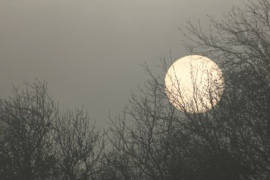
On a misty morning
With the kids in the car
Turning left
The surprise of a huge sun
Low in the sky
A silver gold blob
Just too bright to stare at
Not too bright to blind
Heralds
An emergent phenomenon
Not easily had
Coming into being
In my busy head
Happiness
More than a brain state
A life lived instead
Myriad things
In work at home at play
To bring together
Before it is found
Easily lost
A single moment can confound
But in simple pleasures
Doing the right things
Caring for people
About things
And oneself
Happiness shines
At times
Just too bright to stare at
Not too bright to blind.

I talked to a taxi driver today – an old man and a nice one. He revealed he studied art a good many years ago. Very much against the odds on a scholarship, he went to the art school at the bottom of our road – near where he was taking me.

He said other cabbies sometimes mock when he says he paints, but it brings him great peace and satisfaction. I owned up that I’ve started writing poetry too. We found ourselves kindred spirits. It’s not always the winning, it’s often the taking part with art. This poem refers to yesterday, but some of the warm glow spilled into today’s conversation.

Weekend Fun

20111113-210431.jpg

Wobbles

Bike and scooter
In the boot
Me and the boy
Off for a scoot
He’s a bit wobbly
But getting the hang
Of his shiny red bike
Until he has a prang
The distraction of pals
Takes its toll
Adverse camber
Yields a painful fall
It means a sore elbow
For my little friend
Tears and a hug
Pull him together again
He gets back on
Then pedals slowly
An ice cream pit stop
And he’s weaving home boldly.

Snap, Crackle & Pop

Scarcely awake
And a request to bake
Inspiration strikes
Rice Krispy cakes
Sweet and simple
Lots of sprinkles
Helpful daughter
A satisfied customer.

Strawberry

20111113-150850.jpgI’ve discovered Philosophy Now via Kindle. And a find it is too. This month’s edition delves into the Philosophy of Mind which I studied twenty odd years ago. What’s new? Quite a lot. But, also, quite a lot is not.

Neuroscience is the new 200lb gorilla on the scene. Is philosophy, contemplation and introspection irrelevant when you have brain scanners and MRI? The argument cuts both ways. Reductionism says its a simple case of describing something complex. I used to agree, now I’m less sure.

Before cosmology we harboured intuitive, and often mystical, beliefs to explain sun, moon and stars. Then telescopes were invented and we moved on to facts and evidence. Aristotle imagined ‘biles and humours’ drove the body, until medicine discovered intricate circulatory and nervous systems. Reductionists say we’ll get over our belief in ‘consciousness’, ‘intentions’ and ‘ideas’ once the science advances enough to describe ‘brain states’ better.

The alternate thesis – much more where Aquinas, Kierkegaard and Nietzsche might land – is that describing a TV’s wiring misses what’s on screen. The ’emergent phenomenon’ is a living feeling being, living a unique life, intimately connected to other living feeling beings, all equally unique but interdependent with each other.

It comes down to complexity in the end. A computer or iPhone full of data apparently weighs fractionally more than an empty one. But it is only fractionally more. I read the entire ‘weight’ of data contained in the Internet could easily be stored in the mass of a strawberry. But the ‘knowledge’ exists in myriad computers, data centres and browsers interlinked with myriad minds.

In one way a strawberry already contains a nearly perfect dataset to describe humans. In its DNA it describes carbon-based life, an oxygen rich atmosphere, the rise of flowering plants – and who knows, maybe, some clues to cultivation. It is already bursting with data, just of a ‘natural’ flavour.

And this is the point for me. Let’s imagine we could load the entirety of human culture, knowledge and experience into a strawberry and fire it into space. Billions of years on, when our planet has long since expired, suppose an alien civilisation finds it. From which would they learn more about living as a human being – reading the data locked in the atomic structure of the strawberry, or simply eating it?

Ouch

20111109-181708.jpg

Massed commuters
iPods on
Wave of ignorance
Marching along
Poor old cyclist
Trying to get through
Smacks into one of them
Minor to-do
Felt for both of them
Embarrassed and hurt
But the ignorant pedestrian
Should feel worst.

Not on my bike today, I observed a nasty bump as commuters spectacularly ignored a truck and a bicycle as they surged across a road. Groupthink, ‘me first’ and headphones to blame. Reasonable accommodation fell – along with the cyclist – by the wayside.