A Titian

20121115-223509.jpg

‘A Titian’ I exclaimed today at work and I didn’t need a handkerchief. Presented with two cover designs for a research publication, for me, there was a clear winner. Not the one with a complex assembly of people, the one with a bright red shipping container daubed with Tunisian freedom graffiti.

But why? Thanks to Titian. Last night I learned from the redoubtable Ernst Gombrich, that the great Venetian artist was the first to use colour as a prime ingredient in artistic ‘composition’.

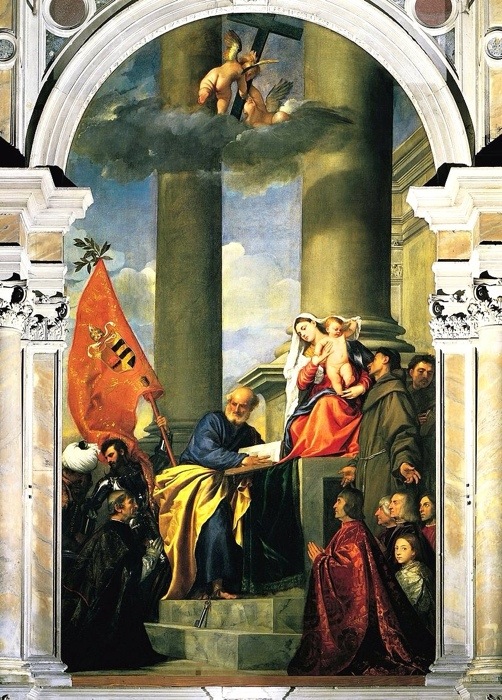
Rather than limiting himself to the beautiful symmetry and positioning of figures which Raphael had perfected, Titian allowed himself asymmetry. But he balanced it through pure, beautiful and powerful colour – a simple flag for example balances the Pesaro Madonna above.

Thanks to Titian, I could explain why ‘red shipping container’ beat ‘protesting crowd’; powerful symmetry of content and composition achieved through colour.

I do love it when a genius from the past bursts to life in the everyday of today – right under your nose.

Arts and Draughts

20121027-140045.jpg

I found myself talking Art – with a nice bloke I’ve never met before – in the pub this week. It was at a leaving do for my other half.

Neither of us look like gallery buffs. But a happy coincidence of amateur enthusiasm for the painterly arts, meant two slightly awkward men – with ostensibly nothing in common – had a surprising bond.

He told me about a couple of lectures he’d been to at the National Gallery: what’s hidden in Turner’s boats and skies, what’s interesting about (two painters neither of us usually find remotely interesting) Gainsborough and Reynolds.

I told him about ‘Barge haulers on the Volga‘ and the problems of perspective for Renaissance composition (realism can really get in the way of symbolism – see Uccello navigating the transition from Medieval to modern above).

We finished on intrigue and alchemy in Nineteenth century porcelain (him) and the challenges of making colours and the discovery of new blues (me, him and Monet).

A cracking natter. We could’ve done footy – he offered me Everton FC early on. But something about him (chair of his local synagogue, England Rugby shirt, a bald head and long grey curls) made me venture portraiture.

I’m so glad I did. Csikszentmihalyi’s ‘flow’ in action.

Sport as Life

20120624-132825.jpg

The thesis: truly great sporting skill and self-expression come best when not too structured, not too investigated, not too explored.

The counter: nearly-great performance is helped by study, stats, practice and heightened professionalism.

Stimulated by a cricket ground conversation with a good friend – and his kindness in buying me Ed Smith’s ‘What sport tells us about life’, I’m pondering the balance of thought and action, impulse and impact, standing up and standing out.

Csikszentmihalyi’s ‘Flow’ comes from matching high challenge with high skill. This suggests a linearity – progressive improvement. Perhaps for some things and some people it’s more non-linear: in life, as well as sport.

A great work, a stunning goal or a pivotal intervention – are they more likely as a ‘moment of genius’? Or perhaps as likely a moment we could potentially judge as ‘madness’, depending on the outcome. Do our greatest interventions come where we ignore risk and just ‘act’, with no conscious consideration of the chances or consequences.

There is a fate and fatalism side to these moments – whether in politics, war, life or sport. The sense that the script has already been written and destiny calls – a feeling that life stands still, the world is watching and it was meant to be.

The best goal I ever scored – volleyed low and unstoppable from a zinging cross – had that sense of time standing still. There are moments in working life too, I can recall, of almost out-of-body otherworldliness when the stakes were high, but ignored, in favour of speaking-up and speaking out.

Of course you remember the moments it came off – not when it didn’t. There’s lady luck and ‘confirmation bias’ to thank in ‘memorable’ moments too.

Perhaps what we call ‘genius’ is simply the product of a self-belief which ignores the situation and unconsidered – sometimes lucky, but often skilful – action. How many times you pull it off determines how history judges the ‘actor’.

But the ‘average’ means many must fall below, for a few to soar above. Heroes ignore the odds. Most of us consider them. But maybe we should all ignore the odds too – at least once in a while.
In the Balance

20120520-185041.jpg

Why is it we feel a little cheated by art made of everyday objects? Is it because we value the materials as well as the labour?

Talking to a Sri Lankan clothing entrepreneur this week, I discovered that in modern garments a surprisingly large part of their price is in the materials – 65% or more. This may tell us that labour is undervalued. But it might also tell us that materials still matter.

Historically pigments were immensely expensive. Some say the reason medieval art had large patches of colour – undisturbed by shading or relief – was to ‘show off’ the expense and opulence of the rare pigments; usually topped off with plenty of gold leaf.

By contrast, Damien Hirst’s dot paintings are always sneered at for ‘only’ using household emulsion. But then again his diamond encrusted sculls divide opinion too.

I’m strangely reassured to know my clothes are made of stuff of intrinsic value. Perhaps, like the ‘rag trade’, it takes the right balance of labour and materials to make a great work of Art too.

Flights of Fancy

20120519-121313.jpg

I found myself in a back room at the British Museum this week, looking at pen and ink drawings. I took a couple of photos of simple but stunning sketches by Picasso and Rembrandt.

20120519-123215.jpgAs a child, I remember being taken to see Michelangelo’s cartoons and being mightily disappointed they weren’t a patch on Hanna-Barbera. They were instead faded brown pastels. How times change.

Why the reappraisal – I’m much taken by Ernst Gombrich’s narrative that art of the Dark Ages was flat and naive because it was telling you something. The idea wasn’t to lose yourself in clouds, folds of garments or acres of flesh – but to ‘read’ a very simple and profound message. Almost always an illustration of virtue, sin or gospel truth, simplicity and directness were the point.

This takes me back to Aristotle’s Poetics – plot trumps spectacle and no more or less than is needed. Were I to embark on a painting I’d feel constrained to ‘represent’, to paint ‘well’ and show some technique.

Perhaps that’s not the point, the starting point for the artist is: ‘what am I wanting to say or explore?’ As with poetry, seen this way we are not ‘trapped’ by the fact that everything has been painted more beautifully by Titian, or precisely by the Dutch masters or bleakly by Caspar David Friedrich or vibrantly by Van Gogh.

20120519-090306.jpgThe job of the artist is simply to convey what they want to say or explore. Technique and materials come second. No need therefore to hack off our beautiful – or rudimentary – artistic wings. We can all have a go.