Sacks and Seneca


A very autumnal feel to this week; in lots of different ways. It’s back to school for all of us: big school for one; a new class for the other; and very soon a whole new place of work for me.

As the kids accelerate forwards, I’ve been mostly looking back this week; at eight years of corporate memory. I’m methodically archiving, filing and mostly deleting my electronic back catalogue. No-one else is going to be that interested. Little that has been done before works exactly the same way again. 

But what sticks – looking at the better part of a decade of pronouncements, presentations, reviews, restructures and change programmes – is that many things have got a whole lot better; but the fundamental issues have hardly changed at all. 

And perhaps that’s the lesson, as I move onto the next; and next week clock up another year closer to 50… most of the big things in human affairs stay pretty much the same over the sweep of history.

A wise associate of mine, sent me the later life and closing thoughts of Oliver Sacks yesterday, from the New York Times; here:

The joy of old age (no kidding).

And 

My own life 

I replied:

“These are incredibly moving. This is how I want to live my older years and then ‘rise, satisfied, from the banquet of life’ as Seneca had it. This is the most important and defining thing of all – how we face death and then make the most of life.”

Easier said than done of course – and shame on me; the ‘banquet of life’ is Aristotle’s quote: 

“It is best to rise from life as from a banquet, neither thirsty nor drunken.”

But Seneca’s reflections ‘on the shortness of life’, precised here, are timeless too:

 Why do we complain of Nature? She has shown herself kindly; life, if you know how to use it, is long. 

But one man is possessed by an avarice that is insatiable, another by a toilsome devotion to tasks that are useless; one man is besotted with wine, another is paralyzed by sloth; one man is exhausted by an ambition that always hangs upon the decision of others, another, driven on by the greed of the trader, is led over all lands and all seas by the hope of gain; some are tormented by a passion for war and are always either bent upon inflicting danger upon others or concerned about their own; some there are who are worn out by voluntary servitude in a thankless attendance upon the great; many are kept busy either in the pursuit of other men’s fortune or in complaining of their own; many, following no fixed aim, shifting and inconstant and dissatisfied, are plunged by their fickleness into plans that are ever new; some have no fixed principle by which to direct their course, but Fate takes them unawares while they loll and yawn—so surely does it happen that I cannot doubt the truth of that utterance which the greatest of poets delivered with all the seeming of an oracle: “The part of life we really live is small.” For all the rest of existence is not life, but merely time. 

Ask about the men whose names are known by heart, and you will see that these are the marks that distinguish them: A cultivates B and B cultivates C; no one is his own master. And then certain men show the most senseless indignation—they complain of the insolence of their superiors, because they were too busy to see them when they wished an audience! But can anyone have the hardihood to complain of the pride of another when he himself has no time to attend to himself? After all, no matter who you are, the great man does sometimes look toward you even if his face is insolent, he does sometimes condescend to listen to your words, he permits you to appear at his side; but you never deign to look upon yourself, to give ear to yourself. There is no reason, therefore, to count anyone in debt for such services, seeing that, when you performed them, you had no wish for another’s company, but could not endure your own.   

Wise words.
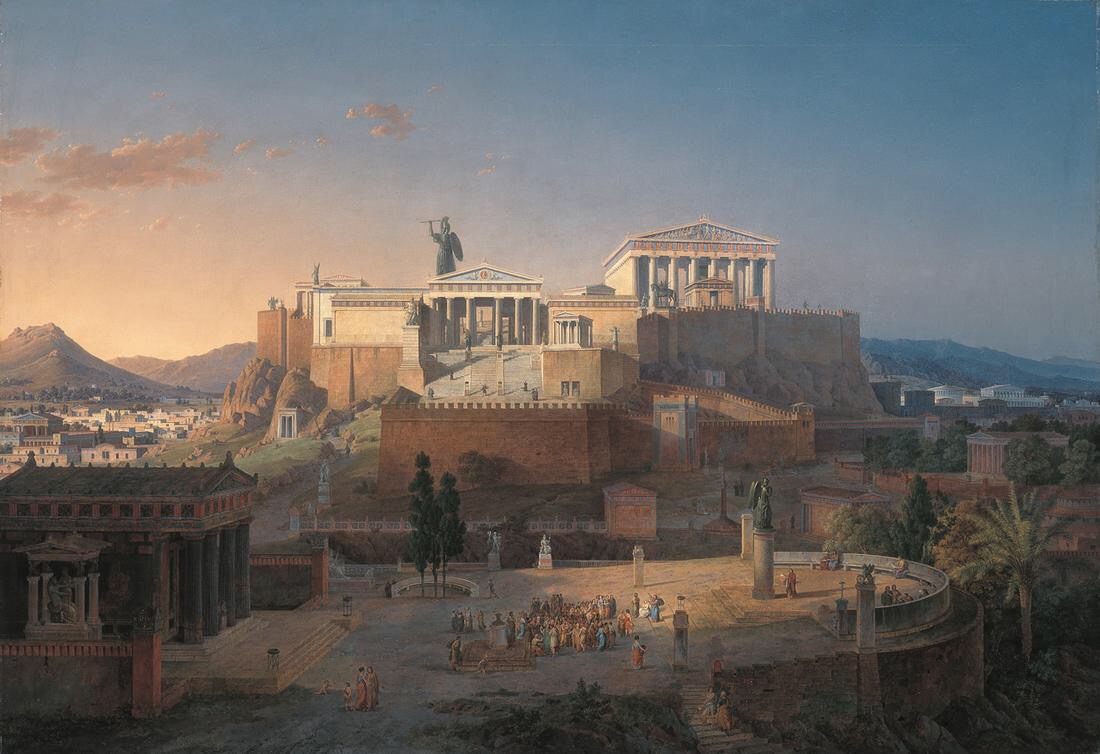
σοφία


As modern Greece struggles with its economic problems, it’s worth remembering: there isn’t a decent concept for living we don’t have the Greeks to thank for.

With help from Wikipedia, try: 

Prohairesis – προαίρεσις

The ‘moral character’ or prohairesis, was brought to the world by Aristotle in the eminently readable Nicomachean Ethics (which first inspired this blog five years ago). Prohairesis is the capacity to reflect, and not be carried away by what our senses serve up.

For the stoic Epictetus, life is all about prohairesis; separating what we experience from how we choose to feel about it:

“Remember that what is insulting is not the person who abuses or hits you, but the judgment that these things are insulting.”

“So when someone irritates you, realise that it is your own opinion that has irritated you. Try, therefore, in the first place, not to be carried away by the impression; for if you once gain time and respite, you will find it easier to control yourself.”

Prosoche – προσοχή

In the Platonic Academy, prosoche referred to the discipline of “attention” – noticing the judgements that we make about ourselves and the world. 

Once observed, the next step is observing whether or not these judgements are in ‘conformity’ with the reality of our situation; and correcting them as needed so as to maintain appropriate behaviour and equilibrium (ataraxia). 

Prosoche is broadly equivalent to the Buddhist disciplines of ‘mindfulness’ as developed through meditation.

A Greek ‘prosoche’ poem sums it up: 

Give me the Serenity to accept
the things I cannot change,
the Courage to change the things I can,
and the Wisdom to know the difference.

Areté – αρετή

For Aristotle, bravery is the first virtue. It came up at work this week. 

It is, quite simply, consciously choosing to walk the difficult tightrope between fear and courage:

“A brave man is one who faces and fears what he should for the right reason, in the right manner and at the right time. A brave man performs his actions for the sake of what is noble. Those who err by excess with regard to this virtue are called rash, but one who is exceedingly fearful is called a coward.”

“Men who show courage because they are optimistic and they think they will win are not brave, because they do not act for the right reasons, and when the situation does not turn out well, they end up being cowards.”

“Men who are ignorant of danger are also not brave, but only appear to be so because they have no knowledge of the danger.”

Prohairesis, Prosoche and Areté: character, consciousness and choice, all come together in sophia σοφία; the title above, and Greek for ‘wisdom’ – the root of philosophy φιλοσοφία philo-sophia.

Whatever the state of their οἰκονομία (economy), Greeks deserve our enduring thanks; for all they invented in the life of the mind.

A Taste of Luxury


Four days of luxe in the Balearics leaves me with mixed emotions. It cost a lot. We’ve never done anything this expensive, in the more-than-a-decade since we’ve had kids: it’s their first ever flight on a plane. 

It was absolutely lovely in the main. We didn’t pinch the pennies, and largely had and did what we all wanted. 

We also succeeded with multiple modes of transport: car, bus, plane, hire car, ferry; navigating ‘sin plomb’ with aplomb, in the obligatory last minute hire-car-drop-off-petrol-top-up-panic – arriving with fully 5 minutes to spare.

A breeze through the airport, and as I sit here with bad inflight coffee in hand, it’s all been very good. 

But you couldn’t but notice that the many kind and smiling people who served us on our hols, weren’t anywhere near as flush as we are; and back at home we feel poor enough.

The nice young man, at last night’s eye-wateringly expensive restaurant, has a small son and daughter in Spain. A need for work took him hundreds of miles away from them – to serve us unnecessarily fancy food at our boutique hotel.

On the next-to-last leg we went the wrong way round the Ibiza Port one way system; and drove past a three storey yacht. Complete with polo shirted crew and chi chi cocktail party “How much would one of those cost?” my daughter asked.

Her mother and I had no idea. But one thing is for sure, absent major criminality, venal corruption or sustained workplace psychopathy – and I don’t do those – the massive yacht will likely elude us.

At the airport, the first thing ‘free wifi’ served up, was one of my colleagues tweeting from a refugee camp in Beirut, about the everyday courage of people protecting and promoting their arts and culture in Lebanon. Puts it all in context.

Jeremy Deller’s ‘We sit starving amidst our gold‘ captures the right attitude to that super yacht for me; a giant William Morris, the great Victorian social reformer, lifts and hurls one into the sea.

We had a lovely lovely time. But luxury is expensive, intoxicating and addictive. Like all such delights, it is best tasted sparingly.

Hell in a handcart


We were burgled last weekend. Not a massive disaster, but unsettling none the less. 

As I hacked back the plant to reveal an old burglar alarm box, and then drove to the badlands of London to recycle the clippings; I was sent, en route, to buy a replacement Xbox at Argos, in order to cheer up the kids.

It set me thinking. What kind of a society do we live in, when someone is prepared to risk incarceration to nick our old out-of-date Xbox 360? Who is desperate enough to give them a bundle of notes to own it? And why am I here, perpetuating this ‘circle of life’, scrabbling with everyone else for a metal and plastic electronic narcotic, which sends healthy minds to sleep…

Hmmm. 

I’m reading Neil MacGregor’s terrific book Germany: Memories of a Nation – its history seen through the prism of fascinating lives, inventions and objects. It brings together a story of what is ‘Germany’ in images and items, from the Renaissance prints of Durer to the Bauhaus-inspired gates of despair at Buchenwald, here:


Jedem das seine: “to each his due”, as the proverbial and double-edged sign reads. 

At the top is MacGregor’s picture of one of the millions of traditional handcarts, in which even more millions of displaced people carried what little they could; across fought over and destroyed lands. When the world has literally gone to “hell in a handcart” of what value are material wealth and possessions?

MacGregor’s story makes you think about, care about and better understand Germany. It’s also a reminder that acquisitiveness and retribution are the twin roads to perdition. Happiness, for people or countries, is not found in revenge or fighting for more stuff.

Maximum Kindness

20140730-215740-79060399.jpg

My son (who is kindness personified) came downstairs, this evening, keen to finish a conversation with me. We headed back up to his bed and he expanded on his earlier thesis…

This was that ‘kind kids’, once they reach ‘maximum kindness’ can give some of their kindness to their Dads making them kinder too. We’d agreed that probably does happen, and I’d become kinder since he’d been in my life.

The development in his theory (which he wanted to discuss immediately) was if you had ‘kind kids’ and they topped you up to ‘maximum kindness’ then maybe some of your kindness might spread to other families – making them kinder – and then maybe in a month or (maximum) a year everyone in the whole world might become kind.

Given everything that’s going on in the world, it might not happen this year. But a bit of compassion and kindness goes a very long way – the Dalai Lama can give you chapter and verse on that.

And with the amount of it my son has, I couldn’t be more fortunate. A top up to ‘maximum kindness’ is always just a conversation away.