Crystallisation

At the core of Aristotle’s account of ethics and virtue is ‘Prohairesis’ – the central moral character.

I increasingly think of it like a copper sulphate crystal growing on a piece of thread. When you do the classic school experiment, knotted threads provide the core around which a copper sulphate crystal can form, from a saturated solution. But you often get several smaller crystals and imperfections in the main one.

In my thesis, the central moral character forms – like a copper sulphate crystal – when choice and actions start to cohere around a central narrative of who we are and what we stand for. The sub-crystals are alternate versions of ourselves and the imperfections are just that – out of character behaviours, foibles and failings.

Last week I gave a talk where I owned up to once having ‘presentational positions’ on most aspects of work. They were largely free floating from any common ethical foundation. I had ethics ‘in the mix’, but no core crystal.

Expedience, presentational benefit and plausible deniability were as likely to inform my public utterances as beliefs, values or virtue. Not these days. I have Prohairesis – a central moral character which, on my better days, informs and guides my choices.

But to meet Aquinas’s test of virtue I have one major challenge left – slowing down. Talking to a friend at the weekend it transpires that one of the strengths of ‘clever’ people is they are quick. This means they can quickly weigh options and decide on the best action. But the challenge to ‘capable’ people as they progress in life, and into more complicated situations, is to use this processing capability to judge more wisely – not more quickly.

Aquinas has it that a man can make ‘good’ or ‘bad’ moral choices without any guiding core moral character, but they cannot be truly ‘virtuous’ without ‘Prudentia’ – practical wisdom – as the unifying prism. As Herbert McCabe says deliberation should be long and considered, action sharp and decisive. Sometimes I am too quick to decide.

I have Prohairesis forming in a nice crystal on the thread of my life. I’m not bad on Prudentia these days either. But like copper sulphate crystals these things take time to grow, so I should take my time too.

Bureaucratic Mirroring

I was interviewed by someone this week who was desperate to find a conspiracy theory. There isn’t one. But she was frustrated. After the interview I described to her the theory of ‘Bureaucratic Mirroring’.

This is the institutional pathology that, even though rationally, people know it’s madness, they can’t escape the subconscious belief that their adversary has the same organisation and structures as they do.

Allegedly a feature of the Cold War, spoofed by Dr Strangelove, the Americans have also been accused of it post 9/11, gearing up for Al Qaeda as though Osama bin Laden had a situation room and Central Command in a bunker under Tora Bora. Bureaucratic Mirroring means you can’t imagine your enemy as other than yourself.

And this came up in conversation over lunch today. We all carry a world-view, a cultural frame of reference and our own personal form of ‘Bureaucratic Mirroring’, assuming others are as we are.

Cosmopolitanism says it ain’t so, we’re all different. Which means letting go of our prejudices and assumptions – as much of any of us can – is vital to escaping our own bunker.

The Art of Friendship

I listened to a Philosophy Bites podcast this week on the topic of ‘friendship’. It made me think afresh about the balance of ‘duties to all’ versus special treatment for a ‘selected few’ – i.e. our friends.

Alexander Nehamas’ argument is, post Immanuel Kant, many of us have come to believe that privileging our friends over others is less ‘moral’ than treating everyone the same – even strangers and people we’ll never meet. This is Kant’s Categorical Imperative, act in ways you would ‘will’ to be universal laws.

But friends are different than everyone else in our lives. For Aristotle – although he might not recognise the modern version – friends are the purpose of life and our virtue revolves around them.

Nehemas’ suggestion is we should think of friends on different plane than ethics. We should think of them more as we think of art and artists. We are interested in our friends for their ‘specialness’, what is individual and distinctive about them, not for their commonalities. We are friends to co-create distinctive, memorable, pages in our life stories.

And this is why drifting apart from friends hurts them so much. Not only do we reject them as people, we turn over – even tear out – the pages of life we created with them; in favour of new friends and new pages.

This is a very different take on friends – friends as narrative growth, not past history. Is what makes us different and how we are growing what matters most in friendship; more even than what we have in common or did together in the past?

Friends as bringers of difference, individuality and new embroidery in life’s rich tapestry, is a very different way of thinking of them. ‘Individuation’, creativity and art are very different registers from ethics, equivalence and fairness. Friends as ‘works of art’ we have a hand in creating, is a nice way of looking at each other.

Language

Re-reading a chapter of Herbert McCabe’s ‘On Aquinas’ last night, the outline of a new understanding emerged from the complex conceptual haze of the ‘philosophy of language’.

Language is the means through which we transcend individual experience and share our lives, ideas and culture with others. So far so obvious – Stephen Hawking’s is a brilliant mind but without a twitch sensor and a computer voice he’d be lost to us, alone trapped in his own head.

McCabe, following Aquinas and Wittgenstein considers language as exclusively ‘public’. It exists outside and apart from the sense perceptions of people – it has to otherwise it would not work as a means of sharing understanding.

So while my ‘red’ might look and feel different to yours (although probably not that much) as soon as we name it, it ceases to be my ‘property’ and becomes a shared one. As McCabe points out, my sense perceptions are my own, but my words ‘belong’ to the English language and are public, shared and ‘intersubjective’ – i.e. most people would agree on what they mean, otherwise they wouldn’t work.

Why is this so important? Well as Aristotle said: ‘It us the mark of an educated mind to be able to entertain a thought without accepting it’.

Similarly it is the mark of an animal with language to be able to describe, contemplate and imagine actions, not simply to feel, jump and act. Without language there is no reflection, just action and reaction.

For Aristotle, Aquinas, Wittgenstein and McCabe, language is not just a fancy tail feather or ornament on human intellect – it is human intellect. Language is the difference between pure instinct and intelligence, communication and culture.

The penny has dropped for me – something I didn’t ‘get’ when I did philosophy at University. David Hume and others persuaded me that sensations come first and language just describes them. But I now reckon it’s the other way around – language marks off and frames sensations so we can contemplate them. Language is not just communicating, it’s everything.

Language also connects us across boundaries of space and time. Herbert McCabe lives on through his limpid, lively philosophical prose. Like Montaigne, you feel you know the man when you read what McCabe has written. Shrewd, perhaps a little stubborn, quick-witted, sharp – and for a monk, disarmingly worldly and funny.

As Aristotle said, we are we repeatedly do. Perhaps, also, we are what we repeatedly write – poetry, prose or philosophy.

Shame There

Does seeing cruelty make us more or less likely to engage in it? Catalunya has just banned bullfights. But I saw one in Colombia nearly 20 years ago and felt I could see the nobility in it which Hemingway describes in ‘Death in the afternoon’.

Montaigne though thinks cruelty to animals does desensitise us:

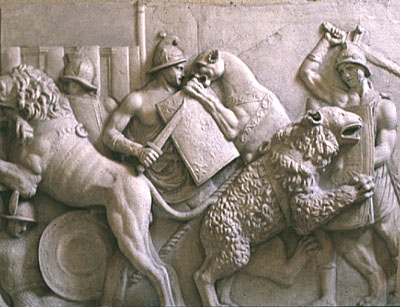
Those natures that are sanguinary towards beasts discover a natural proneness to cruelty. After they had accustomed themselves at Rome to spectacles of the slaughter of animals, they proceeded to those of the slaughter of men, of gladiators.

He also points out Karma was alive and kicking in Roman France:

The religion of our ancient Gauls maintained that souls, being eternal, never ceased to remove and shift their places from one body to another; mixing moreover with this fancy some consideration of divine justice, they said that God assigned it another body to inhabit, more or less painful, and proper for its condition:

If it had been valiant, he lodged it in the body of a lion; if voluptuous, in that of a hog; if timorous, in that of a hart or hare; if malicious, in that of a fox, and so of the rest, till having purified it by this chastisement, it again entered into the body of some other man.

But if we think animals deserve our humanity, only, to keep in check our brutality to each other, the story of Koko the Gorilla suggests they are well able to judge us too.

Koko, a 40 year old female Gorilla has mastered the American Sign Language for 2000 words. But like the Border Collie which has learnt the name of 4000 stuffed toys, it’s easy to dismiss this as trial and error ‘behaviourism’ – action for reward with nothing ‘thought’ in between.

The story told by the scientist who oversees Koko suggests differently:

“It happened by accident – someone sent a DVD about primates and I didn’t really look at it, but it was playing when I looked and saw Koko watching a graphic bushmeat scene. I hadn’t previewed it like I should have. The next day Koko picked up an insert from a newspaper and it was a supermarket ad. She held up a section full of pictures of meat and signed “Shame there.”

So simple, but so powerful as a summary of what we’re capable of. As Aristotle said we are the best and worst of animals.