Veni, Vidi, Amici

As I get on in life, I get to spend time with some interesting, clever people. But they can come with sizeable egos. And that can translate into ‘High Status Behaviours’.
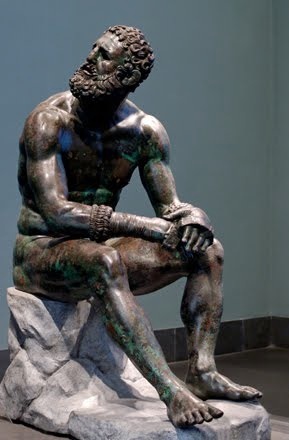
That’s not necessarily a problem. ‘Happy High Status’ is feeling good enough about yourself that you can feel relaxed and good about the success and contribution of others. But not everyone manages to keep the ‘Happy’ in High Status.

The alternative is less attractive – being so concerned with your own status that you need everyone else to recognise it. Or worse, to knock down others to assert it. I wonder if there’s a Greek term for that? Narcissism is one.

But whatever you call it, loneliness seems to me to be an inevitable by-product. I think dominant High Status behaviours are completely missing the point of life.

For Aristotle, that central point is to attract and nurture better friends. Friends care for our virtue and excellence, as we care for theirs. The best of friends are the means and end of it all.

But, as Aristotle said:

No one loves the man whom he fears.

He who hath many friends hath none.

No one would choose a friendless existence on condition of having all the other things in the world.

So why do smart, successful, powerful people sometimes behave in ways that seem to get in the way of true friendship?

Seeking power, wealth and acolytes has always been a primal driver. And on the face of it, it helps not to be too sentimental. But an instrumental view of others – that they are means to your end, hammers useful only as long as there is a nail – is missing the point I feel. As Aristotle also said:

My best friend is the man who in wishing me well wishes it for my sake.

Friendship of this type is earned, nurtured and freely given, not bought, demanded or taken. About the best thing in life, I reckon, is true Aristotelian friendship.

A contented ego is a prerequisite, but a conceited, instrumental or selfish one just gets in the way. Friendship, not conquest, is the purpose of the good life.

Five Minutes

What is time? Judging by my day today, five minutes is the difference between happy and sad, frustration, tears, pressure in the chest cavity and making it just in time – or just too late.

As Kierkegaard said, the demands of the ‘ethical phase’ of life are unlimited. And they lead ultimately to failure and despair. 

But perhaps not. Five minutes is also long enough to clear your thoughts, take a breath and change the internal weather. A smile, a shrug, a stoical thought and a moment’s reflection before marching on. 

It all gets done, and if the demands are unlimited, the rewards are too – a big hug from a small child, a smile of thanks from a good person you’ve helped and the sense of being appreciated, needed and loved.

As the philosopher king and Roman Emperor Marcus Aurelius wrote in his Meditations:

The only rewards of our existence here are an unstained character and unselfish acts.

It’s not all bad meeting the insatiable needs of others, so long as you save the odd five minutes for yourself.

Character Forming

I read an interesting article in my old favourite the New Scientist this week. I’ve been ploughing through some accumulated backnumbers, the magazine having recently been forcibly rehabilitated as a format, after the missus trod on my Kindle and bust it.

What goes around comes around, as the rustling of magazine pages and the need for more light to read newsprint disturbs her slumber at lights out. I feel a shade guilty and remember that part of the reason I bought a Kindle was to be a more considerate bedfellow – and to save my dwindling night reading vision. More carrots and a new Kindle are in order.

Back to the point. The article’s writer Samuel Barondes says ‘personality’ is best understood as a composite of: dispositional traits, troublesome patterns, character strengths and sense of identity.

I like this idea. But a trying to remember it, sat on the Tube today, mutation and evolution intervened and I came up with a subtly different variant:

1) Innate preferences
2) Experiences
3) Bad traits
4) Our internal narrative.

Similar, but not quite the same. I’ve subconsciously pulled out experiences – and therefore, implicitly, the environment. Perhaps that’s because I increasingly believe much of what we are is shaped by chance and circumstances.

But ‘bad patterns’ or traits, as a significant part of who we all are, is a discovery. When you think about it we all have them. And when it comes to bringing them to life, Theophrastus, whom the article signposts, takes some beating. Theophrastus was a pupil of Aristotle and wrote extensively on flora. He also wrote a field guide to that most variegated of fauna – the human being.

The Characters of Theophrastus – a bit like Aristotle’s ‘On Physiognomy’ – tend towards the negative in people. Perhaps both disliked extremes and preferred the ‘golden mean’ as their prescription for the ‘good’ character. For his part Barondes says every culture values self-control, kindness and a sense of one’s place in the universe.

I read Theophrastus’s thirty ‘characters’, and to my growing embarrassment recognised myself strongly in two, and a little in another one. The good news, at least based on my list, is I can forgive myself a bit.

Some of my bad patterns are innate, some the fault of my environment. But my best defence against my ‘bad traits’ is an increasingly clear narrative if who I am and what I am for. Half-way through my life, I reckon the last element of ‘character’ is the one I can do most about.

We are all basically a self-edited ‘story’ looking backwards. And, following Aristotle, we are all the sum of our actions going forward. So I conclude it’s well worth continuing to pay proper attention to both. Theophrastus is a warning to those who don’t.

The Eaves

Cycling to work every day I get a regular soaking. Decent waterproofs help. But there are days, when looking out of the kitchen window, I don’t fancy it much. A number of years ago in the book ‘Angry White Pyjamas’ I read a quote from the Hagakure – the Japanese Book of the Samurai. It advised stepping out from the eaves:

There is something to be learned from a rainstorm. When meeting with a sudden shower, you try not to get wet and run quickly along the road. But doing such things as passing under the eaves of houses, you still get wet. When you are resolved from the beginning, you will not be perplexed, though you still get the same soaking. This understanding extends to everything.

I was reminded of this, in the week, by Montaigne’s similar write-up on the Roman Legions:

Their military discipline was much ruder than ours, and accordingly produced much greater effects. The jeer that was given a Lacedaemonian soldier is marvellously pat to this purpose, who, in an expedition of war, was reproached for having been seen under the roof of a house: they were so inured to hardship that, let the weather be what it would, it was a shame to be seen under any other cover than the roof of heaven. We should not march our people very far at that rate.

I don’t mind being rained on, but I’ve often thought I’d last about five minutes on a proper Roman or Medieval battlefield. Some glum milling about before, and then probably a spirited moment of excessive unavoidable bravery early doors followed by a sharp death. That sounds about my fate. I can only assume my forebears were quick to procreate, as I don’t reckon we’d have lasted long.

But my other pet theory is we were scouts and messengers. Sharp eyed endurance runners with a precise tongue. Who knows. The Hagakure is admirably clear on the matter: ‘Bravery and cowardice are not things which can be conjectured in times of peace. They are in different categories.’

Some Hagakure quotes are positively Aristotelian, take:

‘Intelligence is nothing more than discussing things with others. Limitless wisdom comes of this.’

But like Aristotle, with his theories on biles and humours – and posture, character and beards – not everything in the Hagakure is to modern tastes. As ‘Angry White Pyjamas’ also highlighted:

When one departs for the front, he should carry rice in a bag. His underwear should be made from the skin of a badger. This way he will not have lice. In a long campaign, lice are troublesome.

I’ll step out from the eaves in GoreTex and Lycra, but I draw the line at the skin of a badger.

Font of Knowledge

I owe Steve Jobs a good deal. From early dial-up internet on my original Aqua iBook to blogging with an iPhone and iPad. Despite liberating £1000s from my wallet over the years, I am eternally grateful to him. He has opened up a world of new possibilities, knowledge and ideas to me and many millions more.

Poor guy looks like he’s on his last legs though. Emaciated and gaunt, bowing to the inevitable he stood down as Apple CEO the other day. If I were a betting man I’d reckon cancer will have him within 6 months.

A famously hot tempered perfectionist, I wonder how much cancer has changed him. Diagnosed some 6-7 years ago, reading his 2005 Stanford Commencement address – made to a hall of eager freshmen – he had a pretty ‘nailed on’ philosophy well before the ‘Big C’ properly got hold of him. Like David Servan-Schreiber, cancer will extinguish him but it didn’t beat him.

He calls life’s rich pattern ‘connecting the dots’. I think of it as a ‘Nile delta’ of possibilities. Either way, it’s a fact that life often makes sense looking backwards. But the tributaries down which we flow through life are serendipitous, random and unfathomable. Once you’ve noticed your route though, it all looks pre-ordained.

I quoted Jobs’ example of calligraphy (below) the other day. He created, from random events, the font-rich world we take for granted on every electronic device. Imagine if he’d taken technical drawing instead. It could all have been very different.

The moral I draw? Don’t waste time trying to plan life, live it. Think more about today than next year. Don’t sweat the small stuff. And finally, even the big things in life generally happen by accident, it’s how you respond and what you do next that matters.

Here’s a piece of his Stanford address:

I dropped out of Reed College after the first 6 months, but then stayed around as a drop-in for another 18 months or so before I really quit. So why did I drop out?

It started before I was born. My biological mother was a young, unwed college graduate student, and she decided to put me up for adoption. She felt very strongly that I should be adopted by college graduates, so everything was all set for me to be adopted at birth by a lawyer and his wife. Except that when I popped out they decided at the last minute that they really wanted a girl. So my parents, who were on a waiting list, got a call in the middle of the night asking: “We have an unexpected baby boy; do you want him?” They said: “Of course.” My biological mother later found out that my mother had never graduated from college and that my father had never graduated from high school. She refused to sign the final adoption papers. She only relented a few months later when my parents promised that I would someday go to college.

And 17 years later I did go to college. But I naively chose a college that was almost as expensive as Stanford, and all of my working-class parents’ savings were being spent on my college tuition. After six months, I couldn’t see the value in it. I had no idea what I wanted to do with my life and no idea how college was going to help me figure it out. And here I was spending all of the money my parents had saved their entire life. So I decided to drop out and trust that it would all work out OK. It was pretty scary at the time, but looking back it was one of the best decisions I ever made. The minute I dropped out I could stop taking the required classes that didn’t interest me, and begin dropping in on the ones that looked interesting.

It wasn’t all romantic. I didn’t have a dorm room, so I slept on the floor in friends’ rooms, I returned coke bottles for the 5¢ deposits to buy food with, and I would walk the 7 miles across town every Sunday night to get one good meal a week at the Hare Krishna temple. I loved it. And much of what I stumbled into by following my curiosity and intuition turned out to be priceless later on. Let me give you one example:

Reed College at that time offered perhaps the best calligraphy instruction in the country. Throughout the campus every poster, every label on every drawer, was beautifully hand calligraphed. Because I had dropped out and didn’t have to take the normal classes, I decided to take a calligraphy class to learn how to do this. I learned about serif and san serif typefaces, about varying the amount of space between different letter combinations, about what makes great typography great. It was beautiful, historical, artistically subtle in a way that science can’t capture, and I found it fascinating.

None of this had even a hope of any practical application in my life. But ten years later, when we were designing the first Macintosh computer, it all came back to me. And we designed it all into the Mac. It was the first computer with beautiful typography. If I had never dropped in on that single course in college, the Mac would have never had multiple typefaces or proportionally spaced fonts. And since Windows just copied the Mac, it’s likely that no personal computer would have them. If I had never dropped out, I would have never dropped in on this calligraphy class, and personal computers might not have the wonderful typography that they do. Of course it was impossible to connect the dots looking forward when I was in college. But it was very, very clear looking backwards ten years later.

Again, you can’t connect the dots looking forward; you can only connect them looking backwards. So you have to trust that the dots will somehow connect in your future. You have to trust in something — your gut, destiny, life, karma, whatever. This approach has never let me down, and it has made all the difference in my life.