Bear Necessities

20130523-233031.jpg

This picture – drawn by my daughter – melted my heart and sums up my week. It captures the beguiling mix of sleepiness, size and sheer cuddliness of the Giant Panda. Like the °0° koala, there is nothing in nature cuter than the right type of bear.

I, for my part, have been much more the sore-headed variety of bear. Plenty of reasons to be grizzly at work and robbed of the hope of weekend hibernation – by the prospect of Spring camping in the cold and rain. But a sneek peek at this picture has cheered me up on at least half a dozen occasions.

The sleepy panda adorned her school campaign poster to save the benighted black and white bear. But the latest thinking says forget ‘enigmatic species’ and save ecosystems if you want conservation – bamboo forests are the thing to focus on, not the coy, inscrutable and often unsuccessful pairings of pandas in zoos.

So perhaps the tree in the picture is as important as the adorable bear hanging off it. Whatever the truth, this picture has made me – and by sharing it – a good few other people smile this week. Perhaps now a few more.

Physics

20130317-173727.jpg

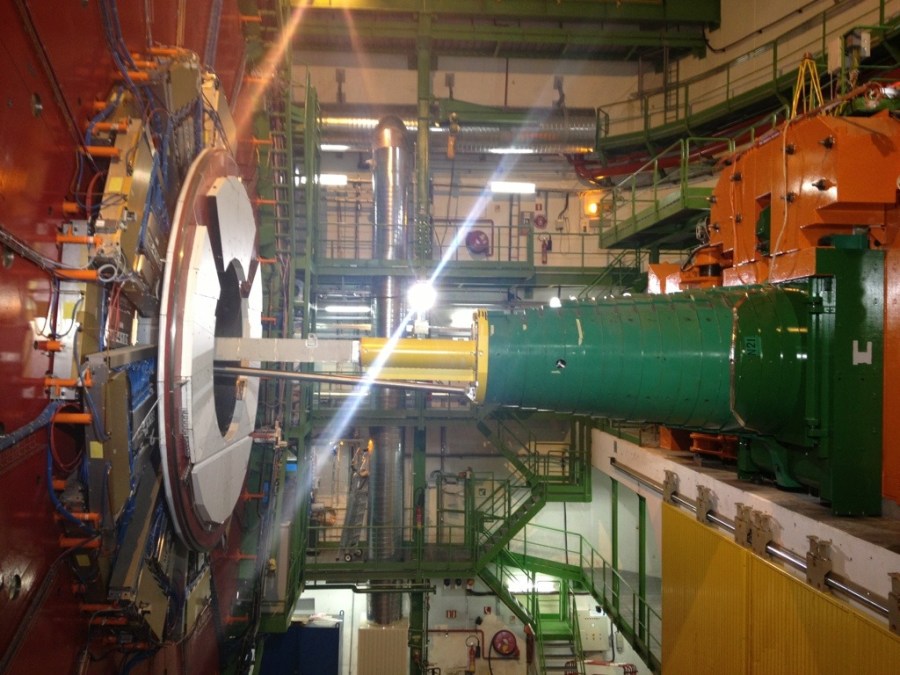
I’ve just spent the weekend at @CERN – home, among other things, to the biggest physics experiment on earth, the Large Hadron Collider (above).

It’s quite a place. Much like a campus university; a jumble of blocks and walkways, carparks, corridors and doors of many ages, styles and states of repair. But the scale and precision of what is done underground is uniformly cutting edge.

Take the equivalent in matter of one hair from your head, accelerate it to the speed of light through four vast machines built over five decades. Then inject it one hundred metres underground into the coldest most magnetic 27km circuit in the known universe.

Then do the same again. Inject it in the opposite direction. Smash the two hairs’ worth together in a beam no wider than those hairs. Catch the debris in two enormous detectors. And there you have the LHC. Simple.

CERN also produces antimatter. But at a rate which would take a billion years or so to produce one gram. And ‘paff’ each batch, painstaking produced, vaporises in an invisible ‘ping’ of energy in less than ten minutes. So no risk of annihilating the planet just yet.

But what was even more impressive than the huge tunnels, control rooms, detecters and machines, is the the people.

They visibly share a common purpose to go beyond what is known. They have nurtured a spirit of endeavour which has constantly to push technology and techniques way what’s currently thought possible. And they manifest an ethos of genuine teamwork and collaboration, uniting staff and researchers from over 100 countries.

All that underpinned by a shared respect for science and the scientific method – and it must be said some very very large public funding.

If you wanted to imagine an idealist’s world where people of all nations come together to advance the sum of human knowledge and achievement; stop imagining and go visit. It exists, on an ‘international’ patch of land between the French Jura and the Swiss Alps.

But what’s also nice is not everyone is a particle physicist – most are engineers. I met a young Danish marine engineer in the control room who explained you have to be able to fix anything on a boat – which is the ideal training for looking after a particle accelerator!

So you don’t have to be Albert Einstein to have a thrilling career in physics. And here’s a nice story I read in the New Scientist on the flight home, from the physicist Leonard Susskind, on his tussle with his father over practicality versus physics:

I did not come from an academic background. My father was a smart man, but he had a 5th-grade education. He and all his friends were plumbers. They were all born around 1905, in great poverty in New York City, and had to go to work when they were 12 or 13 years old. But sitting around the kitchen in our house, they had all sorts of interesting conversations. There was a funny intellectuality to them.

I went to college because my father thought that I should learn engineering, because he wanted to go into the heating business with me. There I realised I wanted to be a physicist. I had to tell him, which was a somewhat traumatic experience.

For months I had been trying to figure out how to tell him. One day I drove over to his house. This is emblazoned in my memory: it was a terrible, terrible feeling.

He had a plumbing shop in the basement, and was there cutting pipe for the next day’s job. I went down and said, “I’m not going to be an engineer.” He got upset. Though he almost never used bad language, he said, “What the fuck are you going to be? A ballet dancer?”

I said, “No, I want to be a physicist.” He said, “No, you ain’t gonna work in no drugstore.” I said, “No, no, a physicist, not a pharmacist.” And then I can’t remember the exact conversation, but I do remember the magic word was “Einstein”. I said I wanted to do what Einstein did. That just shocked him.

Something snapped, and he decided right then and there that that is what I had to do. That was the end of it. From then on, my father tried very hard to learn a little about physics.

Dads and their lads eh. But what a great story of a father’s love for his son conquering all. Physics, it’s a beautiful thing.

Brain Cocktail

20130210-090053.jpg

Shaken but not stirred, I spotted this fascinating diagram yesterday. It describes moods, mental states and conditions in test tube form.

So which comes first – the chemical state or the state of mind? Are we in love or just hydrogen bonded. Are we low or just low on the right hormones.

It’s complex chemistry – but it is chemistry. The brain is a wet sugary computer – but that I think is why it’s so different from silicon chips and solid state physics. Hormones diffuse and dissipate they don’t switch on and off.

Computers are yes/no. Brains are a constantly changing cocktail of ‘maybe’.

I am a Scientist

20121208-112448.jpg

Like most people I guess, I get irritated by folk who are wrong. But unlike most people, I actually don’t mind so much when I am.

Perhaps that’s because I believe in a ‘Bayesian brain’. Mash up all the facts, data and experience you have (however little) and come up with a probabilistic answer. That’s certainly how my mind works.

Of course we all live trapped in our own heads. So what seems common sense to me, absolutely may not to other people. Different experiences, different world views, different data.

As a recently deceased US Senator said:

“Sir, you are entitled your own opinions, but not your own facts.”

But what are facts anyway? Just a combination of data, theory and interpretation.

If someone says something I disagree with, generally speaking, I’ll have a quick go at saying so – and what I think. If pushed, I’ll point out the flaws in their position, if they are obvious.

But except in the most extreme or important situations, I’ll generally leave it after one or two tries. Experience tells; people don’t change their minds easily.

One of the weaknesses in a Bayesian approach is similar to the ‘ethical’ problem I used to have as a Utilitarian. The balance of probabilities, like the balance of morality, isn’t easy to explain or justify to people of principle and belief.

Most of the calls we make are analogue not digital. They are ‘probably’ not ‘binary’. So I’ve learnt, in the main, to simplify what I’m thinking when it comes to persuading. In the art of human persuasion, a single strong argument trumps several reasons.

And this cuts us to the chase. Why is it so hard to reason with people? Because most of human existence was in the pre-scientific era. Belief, superstition and commandment drove most people’s thoughts and deeds.

And a quote I read from the late great populariser of science, Carl Sagan, sums up the difference:

In science it often happens that scientists say, “You know that’s a really good argument; my position is mistaken.” And then they would actually change their minds and you would never hear that old view from them again. They really do it. It doesn’t happen as often as it should, because scientists are human and change is sometimes painful. But it happens every day. I cannot recall the last time something like that happened in politics or religion.

I am a scientist.

Crystal Ball

20121020-131406.jpg

What if the purpose of memory is not to remember things?

We generally judge our memory on accuracy and completeness – and we are generally disappointed. Memory is jumbled, retouched and unreliable as a definitive record of the past. But a recent New Scientist suggests perhaps that’s because remembering is not what it’s for.

Thinking in evolutionary terms, what use is a perfect record of your entire past on the Serengeti plains? Not much. There would have been precious little time for introspection with four-legged food to chase and four-legged death to avoid. Not to mention increasingly cunning two-legged competition alongside.

Memory must have conferred a survival advantage – so it seems reasonable to think it developed from what other mammals probably have: recall of close shaves, sources of food and – if elephants are anything to go by – key life events: births, deaths and marriages.

And this is why dates get jumbled, memories get intertwined and autobiographical narratives develop in our heads – to guide us on what to do next, not produce a perfect historical record. Memory exists to better predict and guide our future.

Memory tells us who to trust, how to act and what might happen. Yes it’s flawed by inductive logic. Past performance is stricto sensu no guide to the future. But we remember what we need to remember – what’s useful for our future.

This difference in purpose is the big difference between computer memory and ours. Ours is constantly shuffled, refined and selected for its Bayesian predictive power, not its precision.

No wonder it’s sometimes cloudy; human memory isn’t a time capsule, it’s our crystal ball.