Dismal News

20140614-152633-55593857.jpg

I was a big economics fan at school. Supply and demand, rational actors, natural monopolies and perfectly competitive markets – it made simple good sense to me.

It all got a bit more complicated at university. There, whacking great equations I couldn’t fathom, seemed the inadequate answer to real world problems.

Later in the world of work, thanks to my broad brush mastery of ‘the dismal science’ I had a brief, successful (and with hindsight massively inaccurate) career in forecasting the prospects for mobile phones worldwide. I concluded as many as one in ten people might have one – one day. Nostradamus eh!

This week I discovered from the clever people at McKinsey it’s no wonder I got it wrong by a factor of ten. I was guilty of anchoring, group think, saliency bias, confirmation bias and the halo effect, to name just five.

It turns out people simply cannot, and do not make ‘rational’ decisions. Even with the best data, the right experience and great wisdom, we are all doomed by the impossibility of escaping group biases. And the killer is the biggest bias of the lot is “self-interest bias” which we absolutely cannot escape, as it’s 100% built in.

What to do? The only conclusion is talk about it. When it comes to the really big choices in work and life, even the smartest person in the room will get the big ones wrong on their own.

But you can’t talk forever or you’ll succumb to groupthink or give in to loss aversion. Eric Schmidt of Google has a good motto: for a good decision you need discord… and a deadline.

Plus, I conclude, let go of your own ego, and at least let others showcase their prejudices before you give in to your own.

12 Common Biases

1) Affect Heuristic – a team has fallen in love with its own proposal.

2) Groupthink – we’re all in the same boat on this one.

3) Saliency Bias – overly influenced by analogy to something memorable that happened once before.

4) Confirmation Bias – no credible alternatives means “let’s do it!”

5) Availability Bias – time limited offers are disproportionately attractive, but if you had to make the decision again in a year’s time what information would you want first?

6) Anchoring Bias – a tendency to cling to the first number heard and judge everything else with reference to that starting point.

7) Halo Effect – the assumption that people and teams with past success will be successful again.

8) Sunk Cost Fallacy – we’ve spent a fortune already, so we may as well spend some more to get some of it back.

9) Overconfidence and Optimism Fallacies – nobody likes a pessimist.

10) Disaster Neglect – the worst that could happen is too horrible to think about – let alone consider in your plans.

11) Loss Aversion – humans naturally weigh losses more heavily than equivalent or even greater future gains.

12) Self Interest Bias – the one you can never escape on your own and the best reason to take your big decisions with other people.

Balance

20140517-104703.jpg

A few weeks back, a very wise friend I bumped into serendipitously mentioned this:

In the end, only three things matter:

1) How much you loved,

2) how gently you lived, and

3) how gracefully you let go of things not meant for you.

Whose words of wisdom are they? Transpires it was the Buddha.

Numbers 1) and 2) aren’t that earth shattering. And ‘living gently’ is maybe not that exciting.

I get the point; let go of hatred and anger. But like with Roman Stoicism, I’m a bit watchful that Buddhist ‘patience’ and ‘tolerance’ – good though they are – don’t turn into accepting stuff which is unacceptable or giving up on things which are important.

But number 3) is a gem. This week I ‘let go gracefully’ of something that ‘wasn’t meant for me’ and feel infinitely better for it.

Power, money and status are inviting and intoxicating, but there are are phases to life and choices to make. So this week I put my family ahead of my career and let go of seeking advancement. Not forever, but not for now.

The Buddha is bang on – by letting go of what was ‘not meant for me’, and doing it ‘gracefully’ on my own terms I have protected what matters, lost nothing and gained a great deal: a self-imposed burden removed, a lightness of spirit returned and a much readier smile on my face. Balance restored.

Hagler

20140510-113034.jpg

It ain’t always pretty; but boxing has a primal quality, which whether you like it or not, makes it one of the ‘pure’ sports.

There are sports with complex rules and sports with fancy equipment. And then there are sports which have been there ever since there have been people – who can run fastest, throw farthest or batter their opponent to submission before being battered themselves.

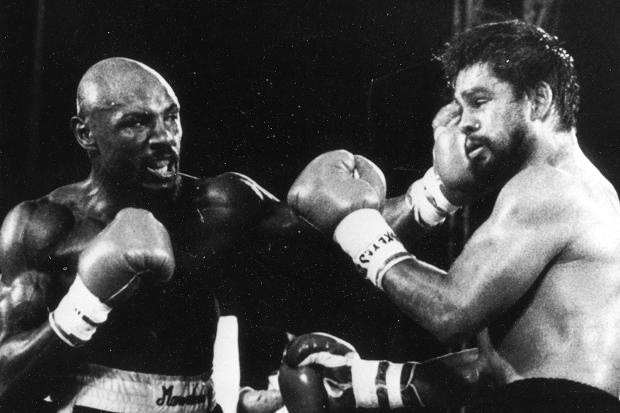
I’m no pugilist, but sometimes you have to fight for what you believe in. And in my line of business, words are sometimes punches. So after an important bout this week, I reflected to a good friend it had been like Hagler vs Durán.

For me Marvellous Marvin is pound for pound the best fighter I have seen. Less brutal than Tyson, not the showman that was Sugar Ray and I’m too young to have seen really Ali in his pomp. But when I watched Sportsnight as a kid, the precision, focus, efficiency and relentlessness of Hagler made him the best I saw.

Because he wasn’t a heavyweight he didn’t always get the profile. As a taciturn guy with a shaven head he didn’t always please the cameras. And because he didn’t dance around he wasn’t much feted. But as I fighter you wouldn’t want facing you, for me, he stood out.

Always going forward, never dominated, quick, precise, focused and hard as nails. As I often joke when people try to get me wound up ‘I’m a lover, not a fighter’. But if I have to fight Hagler is the model – not a big man, no frills, no showboating, just a precise, focused, bald head, hitting you hard; bang bang bang.

Demons

20140426-090333.jpg

I found myself facing old demons this week – in a Ministers office with less than an hour’s notice and plenty at stake. But nearly everything gets easier with experience.

Nearly a decade on from this being my day job, I wasn’t rattled at all. When my time came to speak I was oddly calm, pretty fluent, affably persuasive and perfectly good-humoured.

Later as things were getting choppy, I instinctively waded in with a tide-turning point: ‘today’s good intentions risk tomorrow’s unintended consequences’; which helped keep some important foundations from being inundated. Then smiles, handshakes and off. Job done.

A quick summary letter, to nail the key points for posterity, and home for family and food.

So what made the difference? Experience; yes. Having the right arguments in my head; yes. But most of all keeping fear at bay: fear of ridicule, fear of being bullied, fear of failing, fear of humiliation and fear of consequences.

Just writing those fears makes my breathing shorten. But these days fears don’t prey on me half as much as they once did. Perhaps the greatest dividend from philosophy is a calmer and more ordered mind. It helps put many demons to rest.

Toxic

20140215-113205.jpg

What happens when you are dealing with a toxic situation with toxic people and potentially toxic consequences? You go toxic obviously.

But I’m searching for another way. In the past when I’ve had to do this, I haven’t been able to stop myself ingesting some of the toxic waste. Less doing bad things myself, more feeling sad, bleak and dark hearted. So who better to accompany me on my latest toxic clean-up than His Holiness the Dalai Lama?

As if by magic, his face was gently radiating out from a prominently placed book at our seaside library last weekend when I took the kids.

This is why we need libraries.

It takes a human to recognise that on one of the wettest winters on record, the Dalai Lama on ‘The Art of Happiness’ would be a good book to strategically place right by the entrance. Those quietly helpful, studious folk – librarians – know what they’re doing…

So what has the Dalai Lama to say?

Simple really:

1) Promote happiness and reduce suffering – especially your own.

2) Treat others with compassion, interest and openness.

3) Welcome intimacy with many – not just a few – with a few words, a smile or a simple kindness.

Easy really.

As I started writing this, I was going to choose a toxic ‘skull and crossbones’ to illustrate the post.

Now, having written it, I shall choose a beam of sunshine. That’s the Dalai Lama difference.