Gaia 


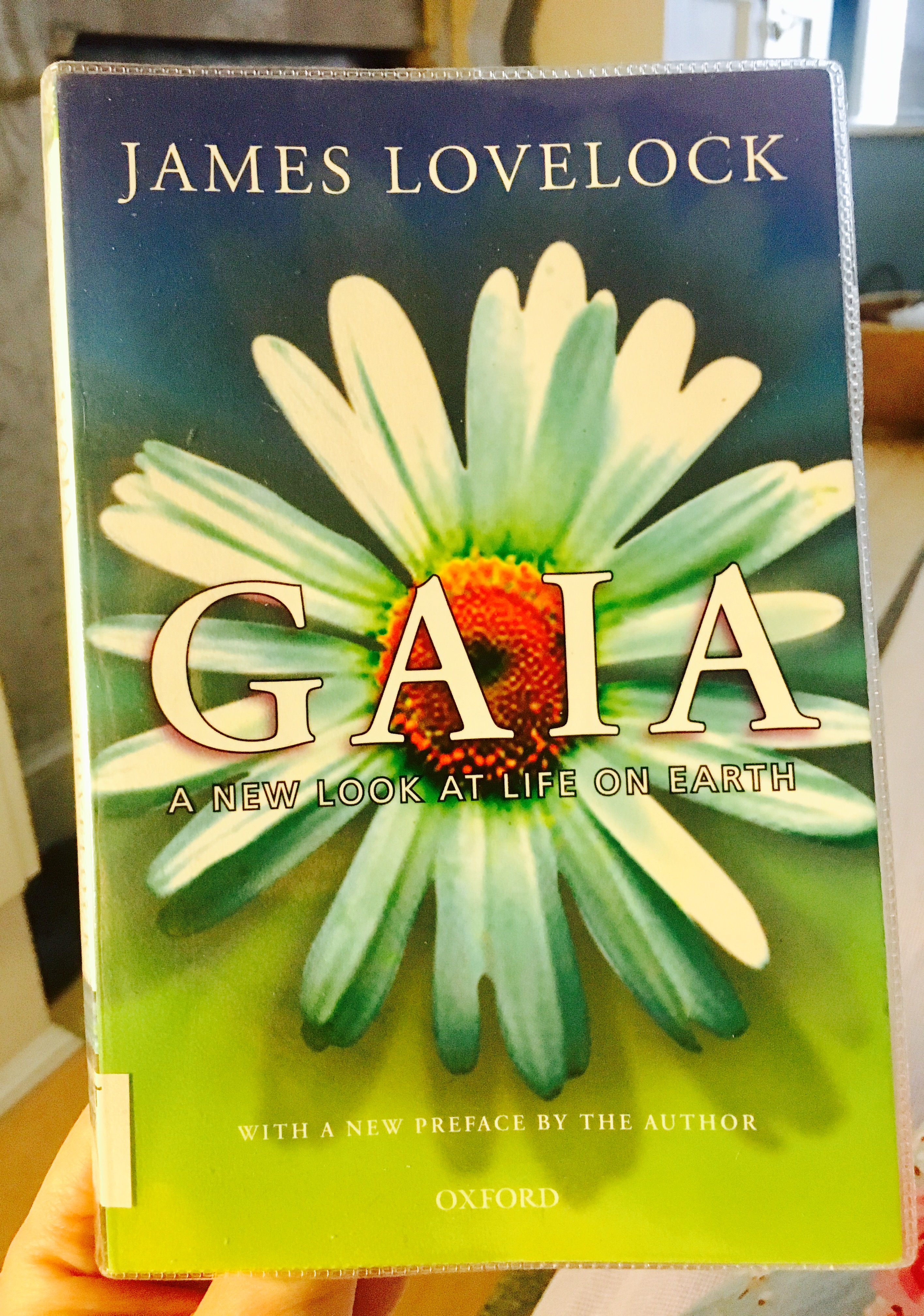
I’m reading James Lovelock’s famous ‘Gaia’ – the first airing of the hypothesis that the planet (and not just we creatures on it) is itself a self-regulating living system.

Lovelock got plenty of stick for this book. A scientist accused of straying into mysticism and anthropomorphism for personalising Gaia as a ‘being’ or a ‘living thing’; not just a bunch of chemical and physical processes.

He freely admits in the later foreword, that he had to write a much more dull and prosaic version to get anywhere with the scientific community. 

It’s one of those books like ‘On the Origin of Species’ which more people will know of than will read. But I’m glad I picked this out of an otherwise lifeless ‘Science’ shelf in the local library. 

It’s a super read. And even allowing for all that has changed in our knowledge and understanding in the 40+ years since it was written; like ‘On the Origin of Species’, you feel you are witness to a remarkable moment of synthesis. A whole array of concepts and ideas join together in one person’s mind and become a new picture on how the entire planet – and possibly the whole of creation works.

The simple facts of how the ‘perfect’ level of of the supremely reactive ‘vital’ ingredient oxygen (21%) is kept in the atmosphere are fascinating. It simply could not and would not be there without deeply interconnected living systems. 

Similarly the seas – without Gaian processes they’d get saltier and saltier within 80 million years; instead of the aeons at a stable 3.5%, which allows half the earth’s biomass to life in three-quarters of its surface.

It’s a terrific read. A moment in historic and scientific time maybe; but as important a science book as has ever struck the popular conscience. It’s also a book which reminds us that the planet we live on is so much more wonderful than we yet understand.

Habit Forming

  
Is the great Greek wrong on this one… 

I stumbled across  an interesting article in Time – (it quoted an academic from my place of work) which suggests he might be:


So what are habits, really? According to Dr. Benjamin Gardner, a psychologist focusing on habit research at King’s College London, “habit works by generating an impulse to do a behaviour with little or no conscious thought.” Habits are simply how the brain learns to do things without deliberation. These impulses can be put to good use, but only certain behaviors can become habits.

Building a habit is relatively simple — just harness the impulse. For new habits to take hold, provide a clear trigger, make the behavior easy to do, and ensure it occurs frequently. For example, by completely removing unhealthy food from my home and eating the same thing every morning, my diet became a healthy habit. I extracted the decision making process out of what I eat at home.

However, if the behavior requires a high degree of intentionality, effort, or deliberation, it is not a habit. Although proponents of habits tout them as miracle cures for doing things we’d rather not do, I’m sorry to say that’s snake oil. All sorts of tasks aren’t habits and never will be. By definition, doing things that are effortful aren’t habits.

Unfortunately, this means behaviors that require hard work and deliberate practice aren’t good candidates for habit-formation. For example, although I make time for it every day, writing is not a habit. Writing is hard work. If I waited for an “impulse” to write, I’d never do it. To get better at writing requires concentration and directed effort to make sense of the words as they go from the research to my head and then to the screen. Similarly, lifting weights isn’t a habit because getting stronger requires working harder.

So if these type of behaviors aren’t habits, what are they? They’re routines. A routine is a series of behaviors regularly practiced. Routines don’t care if you feel an urge or not, they just need to get done. When I finally realized I would never succeed at making going to the gym a habit, I began looking for how to establish a routine instead.

This makes sense, when you think about it. I’ve read elsewhere that as much of 40% of the time we are doing things which have become habitual and have no conscious deliberation – we are on Autopilot.

This suggests three things – all of which I’m trying… Make boring but useful things a habit (taking my vitamin D for example); make things which take some effort but are good for me into a routine (write a blog every Saturday); and more counterintuitively – make sure things which are supposed to be enjoyable, don’t become a habit. 

Why? Because once you stop thinking about them, you’re no longer consciously enjoying them. Not having a drink on Monday or Tuesday has become a habit (good). So sometimes sharing a bottle of prosecco with my other half on a Wednesday, has become a treat (need to be careful it doesn’t become a habit though…)

It’s worth reflecting on what you want to do without thinking, what you can’t do without thinking and what you enjoy doing – and need to think about to consciously enjoy. 

Habits aren’t conscious. They may help to make us excellent; but our best and most enjoyable work and experiences require conscious effort. 

I’m sure Aristotle would buy that.

Rainy Day


Yesterday was a rainy day. And unexpectedly so. Bad start, worse end. Trying to put it in context today (with Bach loud in my ears to block out someone else’s toddler), I googled ‘into every life a little rain must fall’ to find the source…

And the wise words of the final verse Henry Wadsworth Longfellow’s ‘Rainy Day’ seemed very wise indeed:

Be still, sad heart! and cease repining;
Behind the clouds is the sun still shining;
Thy fate is the common fate of all,
Into each life some rain must fall,
Some days must be dark and dreary.

Chin up, buck up and step up is the answer. The ‘middle years’, viewed from one perspective are one long list of unreasonable and irreconcilable demands. But that’s the price of being at the centre, and fulcrum, of so many people’s lives. 

Watching an older man limping awkwardly in front of me this morning (as I rushed from one kid’s activity to the next) was a reminder there’ll be plenty of years when I’d kill for this life. And those years will one day run out. 

I feel better for a hot chocolate, some Bach and some writing. There is no point ‘repining’; behind the clouds the sun is still shining.

Relevant Complexity

Relevant Complexity Link

Here’s to a brand new year.

And to celebrate I’ve bashed out a new blog, based on what I’ve learned about life, the world and everything since I started Achilles and Aristotle in 2010.

Time flies – or rather it doesn’t; a lot of water has passed under the bridge since then. But ‘Relevant Complexity’ was a fairly early discovery, I first wrote about it in January 2012 here.

Like all good things in the writing life, the more you write about it, the more you think about it, the more it changes you and what you do – Aristotle said as much.

I’ll plan to keep both blogs going: this one as a reminder of what I was up to in years to come; the new one to remind me to live for the day and enjoy a life full of ‘Relevant Complexity’.

Obscurantism

/home/wpcom/public_html/wp-content/blogs.dir/509/15823857/files/2014/12/img_3202.jpg

I congratulated a colleague yesterday on some lovely prose. His concise, interesting and informative writing made me happily read about 80 Moments which changed history – learning a lot in the process.

This morning, I read another piece of quasi-Academic writing; but which was much more of a slog. It was saying some important things, but in a rather portentous – even pretentious style. The few key points, could have been made a lot more simply.

Then, by happenstance I moved onto to a super article on ‘Obscurantism’ in the equally super Philosophy Now magazine. The question it poses is: when is being complex and hard to decode legitimate, useful; even necessary – and when is it plain unhelpful.

Here’s some of what Siobhan Lyons has to say:

‘Obscurantism’ can indeed be an effective manoeuvre, provoking greater thought-processes and intellectual investigation.

This couldn’t be illustrated more clearly than in Rembrandt’s The Holy Family with a Curtain (1646). I am less concerned with the religious meanings of this painting than I am about the curtain itself; a seemingly innocuous, pointless part of the work, and yet it provokes the viewer to wonder what lies behind it.

The curtain, blood red and purposefully pulled partly to the side, teases the viewer, offering not even a partial glimpse of what it completely obscures. The Virgin is plainly seen; and there is Joseph, semi-obscured in the background, near the curtain; but whatever is behind the curtain itself is left unanswered.

The painting thus features three forms of creative depiction: the Virgin’s clear visibility, Joseph’s semi-obscured form, and the curtain itself, a symbol of obscurantism, or rather, of the ability of obscurity to be creative, by emphasising the ambiguity that so often confronts us, which may however be the source of great art, and indeed philosophy.

For the greatest philosophies are aware of their own limits – aware of when they cannot answer the questions their philosophers ask. As Wittgenstein stated, language must be beset by certain limits.

So obscurity in language can be seen as not always self-defeating, but, ironically, as sometimes illuminating. Moreover, if language were a purely functional tool for communication, we would cease to have literature as we understand it.

If all curtains in all art were pulled completely aside to expose what lies behind them, then the need for imagination would deteriorate. This also explains why good writers are those who not only have a masterful grasp of language, but who also know how to pull it apart and put it back together in different ways.

Nicely put. Not everything in life, thought or Art can be expressed simply; and some things can’t be expressed at all. The art is in knowing which. But also, I think, in having a try. Only practice makes more perfect.