Rights Gone Wrong

20121215-172440.jpg

Rights are all well and good, but sometimes they lead you to the wrong places. Generally I’m with John Stuart Mill:

“Mankind are greater gainers by suffering each other to live as seems good to themselves, than by compelling each to live as seems good to the rest.”

That’s the classic case for ‘negative liberty’ – i.e. freedom from interference if you’re doing no harm. And it has travelled time well; Governments: know your limits. But what Mill says before this is important too:

“The only freedom which deserves the name is that of pursuing our own good in our own way, so long as we do not attempt to deprive others of theirs, or impede their efforts to obtain it.”

And it’s this innocuous final phrase which is the tricky one: ‘impeding their efforts to obtain it.’ Does ‘impeding’ include dodging your taxes, turning a blind eye to inequality or using ‘rights’ to justify a bad status quo? As Mill said:

“A person may cause evil to others not only by his actions but by his inaction, and in either case he is justly accountable to them for the injury.”

Not that he was a pacifist:

“War is an ugly thing, but not the ugliest of things; the decayed and degraded state of moral and patriotic feeling which thinks nothing worth a war, is worse.”

“A man who has nothing which he cares more about than his personal safety is a miserable creature who has no chance at being free, unless made and kept so by the exertions of better men than himself.”

But as America reels from another terrible school shooting, with the prospect that the 2nd Amendment will be wheeled out again to justify inaction, surely historic rights are causing contemporary wrong.

Times change. It’s the 21st century not 1791. Give Governments too many powers and they abuse them. Give citizens guns and they do too. Two wrongs don’t make a right in a modern democracy.

I can’t help quoting Mill one more time:

“I never meant to say that the Conservatives are generally stupid. I meant to say that stupid people are generally Conservative.”

Surely it’s time for change on the right to bear arms.

I am a Scientist

20121208-112448.jpg

Like most people I guess, I get irritated by folk who are wrong. But unlike most people, I actually don’t mind so much when I am.

Perhaps that’s because I believe in a ‘Bayesian brain’. Mash up all the facts, data and experience you have (however little) and come up with a probabilistic answer. That’s certainly how my mind works.

Of course we all live trapped in our own heads. So what seems common sense to me, absolutely may not to other people. Different experiences, different world views, different data.

As a recently deceased US Senator said:

“Sir, you are entitled your own opinions, but not your own facts.”

But what are facts anyway? Just a combination of data, theory and interpretation.

If someone says something I disagree with, generally speaking, I’ll have a quick go at saying so – and what I think. If pushed, I’ll point out the flaws in their position, if they are obvious.

But except in the most extreme or important situations, I’ll generally leave it after one or two tries. Experience tells; people don’t change their minds easily.

One of the weaknesses in a Bayesian approach is similar to the ‘ethical’ problem I used to have as a Utilitarian. The balance of probabilities, like the balance of morality, isn’t easy to explain or justify to people of principle and belief.

Most of the calls we make are analogue not digital. They are ‘probably’ not ‘binary’. So I’ve learnt, in the main, to simplify what I’m thinking when it comes to persuading. In the art of human persuasion, a single strong argument trumps several reasons.

And this cuts us to the chase. Why is it so hard to reason with people? Because most of human existence was in the pre-scientific era. Belief, superstition and commandment drove most people’s thoughts and deeds.

And a quote I read from the late great populariser of science, Carl Sagan, sums up the difference:

In science it often happens that scientists say, “You know that’s a really good argument; my position is mistaken.” And then they would actually change their minds and you would never hear that old view from them again. They really do it. It doesn’t happen as often as it should, because scientists are human and change is sometimes painful. But it happens every day. I cannot recall the last time something like that happened in politics or religion.

I am a scientist.

spEak You’re bRanes

20121201-195905.jpg

I retweeted someone’s prescription for modern times a few months ago:

‘Dance like the photo isn’t being tagged, love like you’ve never been unfriended and tweet like nobody is following.’

My basic social media motto is write what’s right for me and worry not (too much) about the reception. It’s my own form of spEak You’re bRanes, the website dedicated to bizarre ranting.

And on the topic of ranting, I got my first ever proper negative comment last week. Someone wrote “What a load of old B……….s!!!” under one of my posts.

When I read it, I laughed – it was funny. Looked at through a more sceptical eye, my blog was indeed a bit earnest. But it made me think…

There is something about Twitter and blogs which – absent a real person – can make us feel like ranting. It’s a bit like shouting at the telly. But as recent lawsuits in the UK have shown, tweeting what you wouldn’t dare shout at the person in real life, can now cost you big.

A healthy disregard for insults is perhaps the carrying cost of a ‘social’ life. I’m still working on being less thin-skinned. A life’s work I suspect. Good old Montaigne to the rescue, with a motto from 400 odd years ago. And not a bad one for for the modern day:

‘I write my book for few men and for few years.’

Before taking myself and any rude comments too seriously, it’s worth remembering – as Montaigne suggests – that almost all of what’s written will soon mulch into the digital biosphere. Maybe digital rantings – like writings – find the audience they deserve.

Ground Control to Major Tom

20121124-172353.jpg

This week’s song is Bowie’s Space Oddity. Having had to take to the airwaves – and take on the national news media – at times I’ve felt a bit like Major Tom.

Small stuff really – Monocle 24 a boutique radio station, a few letters to the papers and the Huffington Post an Internet newspaper. But high enough stakes for me.

On Wednesday, as I sat staring through the glass into a radio studio control room, there was a pang of what Bowie sang. “Here am I sitting in my tin can, far above the world. Planet Earth is blue. And there’s nothing I can do.”

Earlier, ‘Ground Control’ had contacted Major Tom. “You’ve [nearly] made the grade”, I learned on the back of my rapid letter and blog writing endeavours. Then Ground Control moved swiftly on to another far bigger beast: “the papers want[ing] to know whose shirts [he] wears”.

But the weirdest experience for me, was taking part in a four way radio debate. To my surprise it was fun. I enjoyed it and I came out feeling less tired than when I went in – the opposite of what I’d assumed.

I’d certainly found myself “floating in a most peculiar way.” But as for Major Tom, “the stars look very different today”. A thing I have often feared, turns out to be fine – even fun.

Perhaps – like Major Tom my “spaceship knows which way to go” better than I do. Could this be lift-off for a bit more self-confidence in ‘fronting-up’ on the media? I might even enjoy it.

Only time will tell.

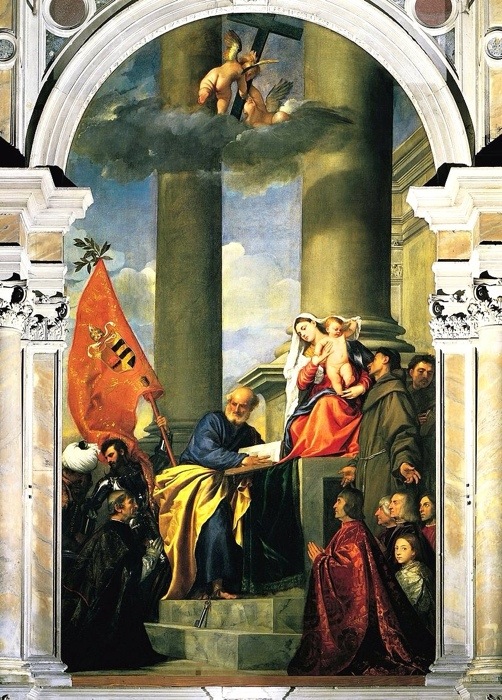
A Titian

20121115-223509.jpg

‘A Titian’ I exclaimed today at work and I didn’t need a handkerchief. Presented with two cover designs for a research publication, for me, there was a clear winner. Not the one with a complex assembly of people, the one with a bright red shipping container daubed with Tunisian freedom graffiti.

But why? Thanks to Titian. Last night I learned from the redoubtable Ernst Gombrich, that the great Venetian artist was the first to use colour as a prime ingredient in artistic ‘composition’.

Rather than limiting himself to the beautiful symmetry and positioning of figures which Raphael had perfected, Titian allowed himself asymmetry. But he balanced it through pure, beautiful and powerful colour – a simple flag for example balances the Pesaro Madonna above.

Thanks to Titian, I could explain why ‘red shipping container’ beat ‘protesting crowd’; powerful symmetry of content and composition achieved through colour.

I do love it when a genius from the past bursts to life in the everyday of today – right under your nose.