Ham Fisted

20120129-140209.jpg

Man handling
Pipe fitting
Wire stripping
Fuse popping
Floor slopping
Finger trapping
Pushing and shoving
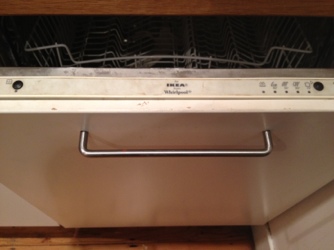
Dishwasher in
Knackered out

Why is it most ‘manly’ installation tasks come round so infrequently that you make all the mistakes in the book? Having wrestled and heaved the new dishwasher into service, I look back on several now obvious errors of approach. If this one busts I’m laughing – I now know exactly what’s what behind the sink. But it’ll probably be another 10 years before I get to do it again, by which time I’ll have forgotten. A sense of relief but not much ‘flow’ – except all over the kitchen floor.

Never Mind the B%llocks

20120128-190635.jpgI found myself swearing a lot this week – a sure sign I’ve been depleting my modest ego. Self-control carries a cognitive cost: the more you soak up the more you get p155ed off.

There were good bits, but also plenty of b%llocks. According to the Broadcasting Standards Commission the relative severity of the various profanities, as perceived by the British public in 2000, placed “b%llocks” in eighth position in terms of its perceived severity, between “pr1ck” (seventh) and “ar5ehole” (ninth). Enough said.

A lot of angst in life comes from the need to be in control. People seek position and status in the hope of controlling more – and controlling others more. But the definition of larger roles is in fact that you control less: you directly do less, precisely determine less and very often control less of your immediate environment or your time.

As someone said to me of a senior absentee a few months back: “Well he’s obviously at the level where he can’t control his own time”. Wherever you work, whatever level, there is always someone who can jerk your strings.

But as I said to a colleague, and later the missus, if a meteor hit London we’d be scrapping for tinned food not worrying about being jostled at work. The Stoics knew this in Ancient Rome. If a senator could be ‘offed’ for offending a fickle Emperor, what refuge is there in status, money or power.

Life also throws constant spanners in the works. Last week the dishwasher broke – B%llocks! Rushing, I forgot key elements of my daughter’s school gear on two separate school runs – B%llocks, B%llocks. And my bike back wheel literally exploded, scaring pedestrians, as the rim buckled from too much wear – B$LLOCKS! All three made a mess of my best laid plans. Just as you fancy you have things under control, life intervenes.

So control is illusory, power is perverse and life is capricious. What to do? Curl up in a ball? Nope, I think aiming for ‘mastery’ not control is the answer. Mastery means being alive to context, alive to the environment, staying in shape, investing in good friends and support networks, developing resilience and sometimes stoicism and not letting the b@stards – or the botherations – get you down.

A little bit of mastery can go a long way. Giving up on control allows bigger things to become manageable and smaller ones to be less irksome. There will always be days where ‘B%llocks’ is the politest way of saying it. But giving up on the illusion of control means the next impulse is to laugh, not cry.

A Much Loved Friend

20120128-191348.jpg

A much loved friend
Has come to the end
The dishwasher, tired
Has finally expired
I’m left bereft
And swabbing mop handed
The hours I’ve spent
Hunched and bent
Playing messy chess
With cups, plates and dishes
But now it stands idly
Lights out and silent
It shared my pain
But could no longer drain
A decade of suds
Cut off at the mains.

We take for granted labour-saving devices. But you sure notice them when they’re not there. It has only been bust for a day, but the dishwasher is sorely missed. According to a book the missus is reading, it takes less than a second today to earn an hour’s worth of artificial light. In the 1950s it took three seconds. In 2000 BC it took 9 months – the only oil was olive.

Our modern lives are remarkably free of fetching, carrying, scrubbing and cleaning – which has come to pass in less than a lifetime. As I don rubber gloves and squirt washing up liquid, I am briefly (I hope) reacquainted with the drudgery of pot washing.

I will miss my reliable old friend and the three dimensional chess which was packing a family’s pots, pans and dishes into its slightly too small space. A flashy new one should arrive in a week – fingers crossed – but this one has earned its place in white goods heaven.

Relevant Complexity 2) Hobbies

20120129-213404.jpg

Until last year I absolutely didn’t get ‘hobbies’. Now I am persuaded hobbies maketh the man. The big mistake in life, I reckon – observing overwork, depression and recession hitting even the most high powered of my friends – is to have your work completely define who you are.

As Aristotle said: All paid jobs absorb and degrade the mind.

Sure we all have to earn a living. And if a trick of fate and a twist of ability take us to major responsibility, so be it. But a wider reading of Aristotle suggests no man can be ‘excellent’ who only works; much less ‘happy’.

Who we really are is often better indicated by what we do for leisure and pleasure. Of course being a ‘wage slave’ doesn’t always leave much space or time – and in antiquity, for most, there’d have been no time for leisure or pleasure at all.

But what we ‘freely’ do is a window to a person’s soul. Or perhaps better – as a typing mistake just suggested – a window to a persons ‘souk’: the bazaar of stuff we do and like.

A lot of hobbies are conventional: sports, music, walking, reading and none-the-worse for that. Some are apparently bonkers. I know a man who has laboriously constructed a scale railway in his back garden which his own daughter is forbidden to touch.

Some hobbies are sociable – choirs, ensembles, ramblers. Some are quite solitary – stamps and the myriad forms of collecting. Some border on sociopathic – travelling football fans notably. But what they all have in common is they endlessly fascinate the aficionado and generally bemuse the disinterested onlooker.

Of course once you spot it, the driver is ‘complexity’. Hobbies enable us to collect deep knowledge, unique complex skills and relevant (at least to obsessive) complexity. Hobbies are Csikszentmihalyi’s ‘flow’ par excellence – high challenge met with high skill.

“Who scored the winner against Scunthorpe in 1974?”, “What was the printing error in the 4d Commonwealth Games commemorative stamp?”, “What’s the winter plumage of that bird?”, “Can you play Schubert?”, “Is that a class 47 locomotive?”, “Is that a Bordeaux or a Burgundy?”

All of of these bring ‘flow’ to the expert. They are validated, either, by one’s personal appreciation of oneself or the appreciation of the ‘community’ of expert practitioners, fruitcakes and obsessives who share our particular interest.

But the art of life – and hobbies – I think is to weave together our passions with the other things we care about: family, friends, communities. There is joy to be had in literally any hobby – with practice we progress and develop mastery of its complexity.

As Aristotle said: ‘Excellence is an art won by training and habituation. Excellence, then, is not an act but a habit. [Or maybe a hobby?].

But there is also a trap – eccentricity and sheer oddness. The trick is in making at least some of our hobbies cohere into ‘relevant complexity’ so they define and develop us as much as our work does.

A friend described how he and his teenage son seek the ultimate ‘fried breakfast butty’ every Saturday. It’s about the only thing which always brings them together; relevant complexity. Building a garden railway, for me at least; irrelevant complexity. Writing for pleasure, relevant; long stints staring at the telly, irrelevant.

Albeit, as Aristotle said: different men seek after happiness in different ways, I think sewing (or knitting for my other half) ‘relevantly complex’ hobbies into the fabric of our lives is essential to properly embroidering life’s rich tapestry.

As Aristotle said of education, but might have said of hobbies if he’d read Csikszentmihalyi:

Education is [Hobbies are?] an ornament in prosperity and a refuge in adversity.

And

Education is [Hobbies are?] the best provision for old age.

But, of course, who am I to say. As the great Greek also points out:

Happiness depends upon ourselves.

And the fact I am secretly proud that I know what a Class 47 locomotive is, shows the perils and pleasures of hobbies. Keep it relevant.

Surprise!

20120116-214314.jpg

Guilty dad
Feeling bad
Leaving son
To party ‘fun’
Two hours later
The flushed victor
Allays my cares
He’s only the winner of musical chairs.

Kids eh. There’s always more to them than meets the eye. Much like particle physics, if you’re there to observe them you become quantum entangled and affect what they do. Left to his own devices in a roomful of strangers, the boy done just fine.