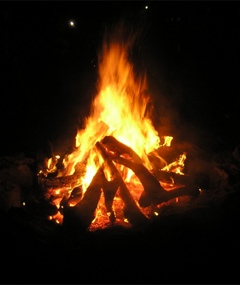
Bonfire night
Kids delight
Fireworks popping
Rockets whooshing
People mingling
Sausages sizzling
Bonfire crackling
Children racing
Sparklers sputtering
Embers glowing
Kiddies tiring
Heading home
Hands holding
Philosophy for life
Bonfire night
Kids delight
Fireworks popping
Rockets whooshing
People mingling
Sausages sizzling
Bonfire crackling
Children racing
Sparklers sputtering
Embers glowing
Kiddies tiring
Heading home
Hands holding
 Smarting from the accusation I seldom read the source, I’m wading through Aquinas at present. Corblimey he’s obsessed with some things well beyond my interest. But that’s because I’m reading him for his ethics, and he’s writing a science book as far as he’s concerned.
Summae Theologica is, I come to realise, describing Aquinas’ views on how the world, universe, animals, minds, substance and energy all work – the lot.
Not surprising then he spends considerable time on causation – what causes what, what is primary, what is secondary and what is ‘higher’ and ‘lower’, what is an ‘operation’ what is a ‘state’.
His method is famously rigorous: three or four well sourced views on a theme, his own judgement and an answer to the opening views.
I think he quite carefully integrates a humanist perspective with a religious one. At times he acknowledges tantalisingly what ‘would’ be the case if there was no God – Aristotle ‘would’ be right on human happiness for instance he says.
After Aristotle, he concurs that our ‘end’ is indeed happiness. But we achieve happiness imperfectly in our mortal lives. We achieve it most in contemplation. In contemplation of what though?
For Aquinas, of course, that would be God. But contemplation of God is, he acknowledges, tricky. Not least as He is infinite and Our reason is finite. We’re snookered from the off.
What to do? It could be worse. Animals are even further from God than we are. They lack our intellect and capacity for reason and thought and so can’t contemplate God at all.
Aquinas explicitly acknowledges that nature has fitted us and animals with desires and emotions to further our own survival and that of our species – positively Darwinian. But they are ‘beneath’ us and we are a rung down from – you guessed it – Angels.
God tops Angels of course, but each in the chain comes closer to ‘perfection’ and achieves ‘happiness’ most by ‘touching’ the one above.
I’m not sure how many farm animals would agree they are ‘perfected’ and happier ‘touching’ humans. Perhaps a well trained sheepdog. But we humans can attain greater happiness in the use of our more ‘perfect’ power, namely contemplation. And among the things we can happily contemplate are Angels.
Now this is a thought I can honestly say I have never had. Beyond the one on top of the Christmas Tree and my daughter in the school nativity, I have never spent any time contemplating Angels. Perhaps I should?
But the point I take from Aquinas and Angels is this: contemplation, seeing beauty around us and perfecting and developing our human capacities, skills and aptitudes is where Earthly happiness lies.
Csikszentmihalyi comes to mind. As I said to someone last weekend it’s all about adding ‘relevant complexity’ to our lives and personalities.
And I think this is what Aquinas is getting at too. A life of virtue, self-improvement and integration of the body, soul and mind might mean at the end of it all, the ‘bottled essence’ of us – probably in frail and wizened form – is a shimmering soul ‘touching’ that of an Angel.

(Best sung to the ‘Raindrops on Roses’
Sound of Music melody)
Poised, sharp and twinkling,
So adult when speaking.
Bright as a button,
Self-confidence building.
Doing her homework
And passing her tests;
Flying at her new school
And giving her best.
List making, potions
And outraged-faced poses.
Climbing and hanging
And landing on noses.
Chess, stamps and boredom
And driving up walls;
These are a few of her favourite things.
When the pen drops,
When the door slams,
When her tea goes cold,
I simply remember she’s seven years old
And then I can’t be, but awed.
 Someone sent me a cartoon of one dog commenting to another dog ‘I had my own blog for a while, but I decided to go back to just pointless incessant barking.’ Social media is a bit like that – one hand clapping. Which is why it’s so nice to get the odd comment and ‘Like’.
Another dog woofing back makes all the difference. So many thanks to to those who have.

Gridlock this morning
Bin lorries too
White van drivers
Turning the air blue
Navigating back roads
Chugging along
Calming my heart-rate
To avoid a prang
Stayed the course
At five miles an hour
My genetic packages delivered
Time for work now.
 Achilles & Aristotle