Sacre Bleu

A splendid weekend en famille à Paris was marred only by two extraordinarily slooowly served meals. I’d write Zzzzz. But with four children, from 4 to 8 years old, over an hour of waiting – each time – for any food was more @!&£.

I was less bothered than the people I was with. Perhaps because having lived in Paris, I find surly service strangely reassuring. As a Parisien taxi driver told me on my last visit:

God, he is deciding to make a very beautiful country. He is making it very big and putting beautiful countryside and animals in it. He is giving it very good food and very good drink. But then he is realising every-body will want to live here. Merde. So he has an ideé! He puts French people there, so nobody else will want to stay!

In fact once you get the hang of French ‘pipple’ they are quite straightforward. First contact is often brusque – borderline rude – to a British taste (or Australian since we were with Aussies). But give as good as you get and add a bit of humour and you’re ‘best mates’ in no time. It’s as if there’s a threshold of rudeness, which you have to meet, to join ‘Le club français’. Too polite and you’re not worth the bother.

An inscription on the pillared back of Versailles shouts out in capital letters ‘To all the glories of France’. You can’t beat Paris: the Tour Eiffel, the Champs Élysées, crazy driving, le hot dog, le steak frites et le petit café to finish.

Add to that the people. Splendidly rude. But often warm, once the ‘first joust’ is done. It wouldn’t be la belle France without them.

Character Forming

I read an interesting article in my old favourite the New Scientist this week. I’ve been ploughing through some accumulated backnumbers, the magazine having recently been forcibly rehabilitated as a format, after the missus trod on my Kindle and bust it.

What goes around comes around, as the rustling of magazine pages and the need for more light to read newsprint disturbs her slumber at lights out. I feel a shade guilty and remember that part of the reason I bought a Kindle was to be a more considerate bedfellow – and to save my dwindling night reading vision. More carrots and a new Kindle are in order.

Back to the point. The article’s writer Samuel Barondes says ‘personality’ is best understood as a composite of: dispositional traits, troublesome patterns, character strengths and sense of identity.

I like this idea. But a trying to remember it, sat on the Tube today, mutation and evolution intervened and I came up with a subtly different variant:

1) Innate preferences
2) Experiences
3) Bad traits
4) Our internal narrative.

Similar, but not quite the same. I’ve subconsciously pulled out experiences – and therefore, implicitly, the environment. Perhaps that’s because I increasingly believe much of what we are is shaped by chance and circumstances.

But ‘bad patterns’ or traits, as a significant part of who we all are, is a discovery. When you think about it we all have them. And when it comes to bringing them to life, Theophrastus, whom the article signposts, takes some beating. Theophrastus was a pupil of Aristotle and wrote extensively on flora. He also wrote a field guide to that most variegated of fauna – the human being.

The Characters of Theophrastus – a bit like Aristotle’s ‘On Physiognomy’ – tend towards the negative in people. Perhaps both disliked extremes and preferred the ‘golden mean’ as their prescription for the ‘good’ character. For his part Barondes says every culture values self-control, kindness and a sense of one’s place in the universe.

I read Theophrastus’s thirty ‘characters’, and to my growing embarrassment recognised myself strongly in two, and a little in another one. The good news, at least based on my list, is I can forgive myself a bit.

Some of my bad patterns are innate, some the fault of my environment. But my best defence against my ‘bad traits’ is an increasingly clear narrative if who I am and what I am for. Half-way through my life, I reckon the last element of ‘character’ is the one I can do most about.

We are all basically a self-edited ‘story’ looking backwards. And, following Aristotle, we are all the sum of our actions going forward. So I conclude it’s well worth continuing to pay proper attention to both. Theophrastus is a warning to those who don’t.

The Eaves

Cycling to work every day I get a regular soaking. Decent waterproofs help. But there are days, when looking out of the kitchen window, I don’t fancy it much. A number of years ago in the book ‘Angry White Pyjamas’ I read a quote from the Hagakure – the Japanese Book of the Samurai. It advised stepping out from the eaves:

There is something to be learned from a rainstorm. When meeting with a sudden shower, you try not to get wet and run quickly along the road. But doing such things as passing under the eaves of houses, you still get wet. When you are resolved from the beginning, you will not be perplexed, though you still get the same soaking. This understanding extends to everything.

I was reminded of this, in the week, by Montaigne’s similar write-up on the Roman Legions:

Their military discipline was much ruder than ours, and accordingly produced much greater effects. The jeer that was given a Lacedaemonian soldier is marvellously pat to this purpose, who, in an expedition of war, was reproached for having been seen under the roof of a house: they were so inured to hardship that, let the weather be what it would, it was a shame to be seen under any other cover than the roof of heaven. We should not march our people very far at that rate.

I don’t mind being rained on, but I’ve often thought I’d last about five minutes on a proper Roman or Medieval battlefield. Some glum milling about before, and then probably a spirited moment of excessive unavoidable bravery early doors followed by a sharp death. That sounds about my fate. I can only assume my forebears were quick to procreate, as I don’t reckon we’d have lasted long.

But my other pet theory is we were scouts and messengers. Sharp eyed endurance runners with a precise tongue. Who knows. The Hagakure is admirably clear on the matter: ‘Bravery and cowardice are not things which can be conjectured in times of peace. They are in different categories.’

Some Hagakure quotes are positively Aristotelian, take:

‘Intelligence is nothing more than discussing things with others. Limitless wisdom comes of this.’

But like Aristotle, with his theories on biles and humours – and posture, character and beards – not everything in the Hagakure is to modern tastes. As ‘Angry White Pyjamas’ also highlighted:

When one departs for the front, he should carry rice in a bag. His underwear should be made from the skin of a badger. This way he will not have lice. In a long campaign, lice are troublesome.

I’ll step out from the eaves in GoreTex and Lycra, but I draw the line at the skin of a badger.

Sock Drawer

In a brief moment of peace this morning – as newly shod children ran from the house with their mother – I wedged in a bit of Aristotle. Via dailylit.com, I opened a couple of chapters of ‘On Poetics’, including the famous line: ‘Poetry is finer than history, as it describes the universal, while history describes only the particular.’

Aristotle is fascinating on ‘plot’, beginnings and endings and the ideal length. Most of all though his point is that plot makes poetry – not verse or the central character. The poet’s prime job is to say something transcendent and universal about the human condition, in a length which contains no more and no less than is needed.

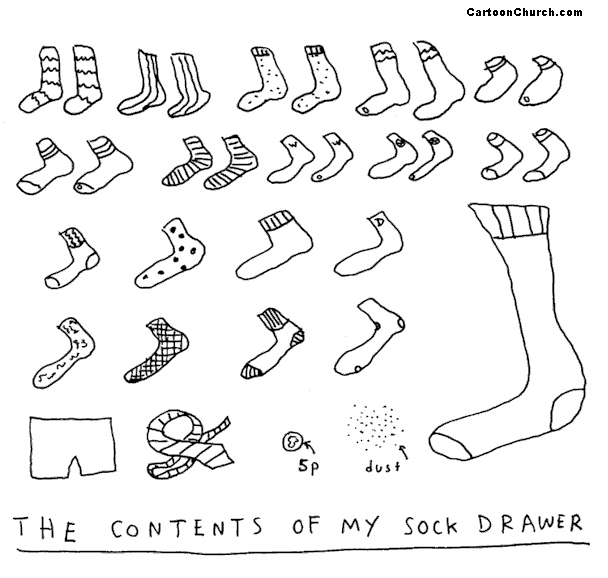
Reading Aristotle is like having your intellectual sock drawer sorted for you. Concepts ordered, ideas reconnected. Then everything neatly paired and placed just so. Not showy nor rhetorical, bombastic nor florid. No more and no less than is needed. And, without fuss, a tidy drawer of knowledge and ideas added to your head. Marvellous.

Luke Skywalker

I read a survey in the week which said 70% of grandparents think their children are too soft in disciplining their kids. I spoke to a grandmother at work about it and she laughed but agreed. She said her grandson behaves (marginally) better with her, but is a real tearaway with his parents.

Too much choice and negotiation these days we agreed. But she coughed one clue to her tricks of the trade: ‘It’s a grandparent’s right to treat their grandkids”… Hmmm where have I heard that before?

The ‘force’ is strong with my son at the moment. Smiling and ignoring instructions has given way to running off laughing and disagreeing with everything. Cheeky monkey.

In the literature this looks like early onset ‘oppositional behaviour’. For which, the prescription is unconditional love and non-negotiable boundaries enforced reasonably – not cajoled with treats. No problem with the unconditional love, but treats have become a bad habit through these long summer holidays. Still he’s starting school next week. That’ll knock him into shape.

All the attention this week has been on his sister starting her new school. That has been an aggravator. Picking her up, with him, he decided to act up. First, running in circles round the climbing frame evading me. Then running around his sister’s rather stern new headmistress. All this, needless to say, against my very explicit instructions.

Back in the car, with controlled fury, I found myself quoting the daddy of daddies – Darth Vader. I gave him a right old talking to. In response to his red-faced “I’m not your friend anymore”, I boomed “I am your father.” Reminding him my job is to set the rules and bring him up properly, I closed with every parent’s classic “You don’t know it now, but one day you’ll thank me for this.”

With both my kids at around this age, I’ve been reminded of the scene in the first Star Wars trilogy when Luke attempts to lift an X-wing fighter from a swamp using only the power of the force. His tutor Yoda looks on quietly amazed.

So it is with pre-school children in my experience. They are intrigued by clumsily smacking large slabs of behaviour into their parents – just to see what happens. Like Luke with the X-wing they dimly understand how, but they move their parents about and get a reaction.

As my mum, and his grandmother, said to me once “Our job is not to be your friend, it’s to be your parents”. Wise words. My son is bright as a button, but he is not a Jedi yet. ‘Teach him I will’ as Yoda would say.