Font of Knowledge

I owe Steve Jobs a good deal. From early dial-up internet on my original Aqua iBook to blogging with an iPhone and iPad. Despite liberating £1000s from my wallet over the years, I am eternally grateful to him. He has opened up a world of new possibilities, knowledge and ideas to me and many millions more.

Poor guy looks like he’s on his last legs though. Emaciated and gaunt, bowing to the inevitable he stood down as Apple CEO the other day. If I were a betting man I’d reckon cancer will have him within 6 months.

A famously hot tempered perfectionist, I wonder how much cancer has changed him. Diagnosed some 6-7 years ago, reading his 2005 Stanford Commencement address – made to a hall of eager freshmen – he had a pretty ‘nailed on’ philosophy well before the ‘Big C’ properly got hold of him. Like David Servan-Schreiber, cancer will extinguish him but it didn’t beat him.

He calls life’s rich pattern ‘connecting the dots’. I think of it as a ‘Nile delta’ of possibilities. Either way, it’s a fact that life often makes sense looking backwards. But the tributaries down which we flow through life are serendipitous, random and unfathomable. Once you’ve noticed your route though, it all looks pre-ordained.

I quoted Jobs’ example of calligraphy (below) the other day. He created, from random events, the font-rich world we take for granted on every electronic device. Imagine if he’d taken technical drawing instead. It could all have been very different.

The moral I draw? Don’t waste time trying to plan life, live it. Think more about today than next year. Don’t sweat the small stuff. And finally, even the big things in life generally happen by accident, it’s how you respond and what you do next that matters.

Here’s a piece of his Stanford address:

I dropped out of Reed College after the first 6 months, but then stayed around as a drop-in for another 18 months or so before I really quit. So why did I drop out?

It started before I was born. My biological mother was a young, unwed college graduate student, and she decided to put me up for adoption. She felt very strongly that I should be adopted by college graduates, so everything was all set for me to be adopted at birth by a lawyer and his wife. Except that when I popped out they decided at the last minute that they really wanted a girl. So my parents, who were on a waiting list, got a call in the middle of the night asking: “We have an unexpected baby boy; do you want him?” They said: “Of course.” My biological mother later found out that my mother had never graduated from college and that my father had never graduated from high school. She refused to sign the final adoption papers. She only relented a few months later when my parents promised that I would someday go to college.

And 17 years later I did go to college. But I naively chose a college that was almost as expensive as Stanford, and all of my working-class parents’ savings were being spent on my college tuition. After six months, I couldn’t see the value in it. I had no idea what I wanted to do with my life and no idea how college was going to help me figure it out. And here I was spending all of the money my parents had saved their entire life. So I decided to drop out and trust that it would all work out OK. It was pretty scary at the time, but looking back it was one of the best decisions I ever made. The minute I dropped out I could stop taking the required classes that didn’t interest me, and begin dropping in on the ones that looked interesting.

It wasn’t all romantic. I didn’t have a dorm room, so I slept on the floor in friends’ rooms, I returned coke bottles for the 5¢ deposits to buy food with, and I would walk the 7 miles across town every Sunday night to get one good meal a week at the Hare Krishna temple. I loved it. And much of what I stumbled into by following my curiosity and intuition turned out to be priceless later on. Let me give you one example:

Reed College at that time offered perhaps the best calligraphy instruction in the country. Throughout the campus every poster, every label on every drawer, was beautifully hand calligraphed. Because I had dropped out and didn’t have to take the normal classes, I decided to take a calligraphy class to learn how to do this. I learned about serif and san serif typefaces, about varying the amount of space between different letter combinations, about what makes great typography great. It was beautiful, historical, artistically subtle in a way that science can’t capture, and I found it fascinating.

None of this had even a hope of any practical application in my life. But ten years later, when we were designing the first Macintosh computer, it all came back to me. And we designed it all into the Mac. It was the first computer with beautiful typography. If I had never dropped in on that single course in college, the Mac would have never had multiple typefaces or proportionally spaced fonts. And since Windows just copied the Mac, it’s likely that no personal computer would have them. If I had never dropped out, I would have never dropped in on this calligraphy class, and personal computers might not have the wonderful typography that they do. Of course it was impossible to connect the dots looking forward when I was in college. But it was very, very clear looking backwards ten years later.

Again, you can’t connect the dots looking forward; you can only connect them looking backwards. So you have to trust that the dots will somehow connect in your future. You have to trust in something — your gut, destiny, life, karma, whatever. This approach has never let me down, and it has made all the difference in my life.

Bayesian Ethics

As I’ve written before, one of my past wrestles is with Utilitarianism: that the moral act is the one with the best consequences regardless of what rules it breaks. I’m now firmly Aristotelian – aka a ‘virtue ethicist’ – we are what we repeatedly do.

But Anthony Appiah the Princeton Philosopher has some challenging things to say about virtue ethics in a Philosophy Bites podcast – including some experiments. And I’m inclined to listen. I like a bit of scientific method.

I like Appiah’s ‘Cosmopolitanism’ too which has helped me articulate my ‘live and let live’ theory of internationalism at work. Humans value culture. Different cultures value different things. And Cosmopolitanism says, short of harm, we should let them. Which I think is about right.

Appiah challenges virtue with ‘experimental ethics’ – seeing what people actually do, rather than what we theorise, and looking inside people’s heads in brain scanners. He finds, for example, nearly everyone gets more generous to strangers if they find a suitably planted $10 note on the floor.

His conclusion is that the idea of a ‘moral’ person in the Aristotelian sense is not borne out by the experimental reality. For him, we make moral choices based on context, stimulus and ‘in the moment’ not based on ‘character’. I don’t entirely agree, but it’s interesting stuff.

Learning to use the head to override the instinctive ‘yuk’ response or being over-influenced by the situation is one of the things he advocates. But only sparingly. Here’s where rules, norms and culture – plus a moral education – might help. But he’s not for becoming too calculating.

He disagrees with Utilitarianism for example. First, because it doesn’t capture the experimental reality of how we respond to moral situations. Second, because were to implement calculating ‘consequentialism’ wide-scale it would dramatically impoverish human existence. Largely because promoting purely rational calculation would tend to demote difference and different views.

Cultural Cosmopolitanism makes life interesting and liveable. And if you’re going to accept difference in culture you have to accept it in worldview and ethics too. That people care about different things is what makes people interesting – and maddening.

I personally think virtue and ‘outlying’ single instances of behaviour are not incompatible. I don’t doubt that you can get very good and very bad moral choices and behaviours out of me if you significantly change my conditions and stimuli.

I also think that the prospects of me making better or worse choices are determined, yes, by the context and circumstances – but crucially, combined with who I am. And who I am is the product of a life lived, previous choices made, data, concepts and theories within and Bayesian probability mashing all that together in a nano-second every time I act.

I think there is ‘virtue’ and I have a ‘character’. It’s just that the complexity of the probabilistic calculations – all done subconsciously by that marvel of existence, a human brain – mean Utilitarianism is too crude and individual ethical experiments are too simple to anything like capture them. I return to my own dictum – if the human brain were simple enough to understand, we’d be too simple to understand it.

So I like Appiah’s ethical experiments – they deserve a well signposted place in my Bayesian brain’s data set – and I’ve shared then with others too to influence them. But virtue, character and Aristotle’s ‘I am what I repeatedly do’ still work best for me. Thanks to Appiah though, I’m also a Cosmopolitan. So I’m delighted to weigh a well-wrought difference of opinion in the Bayesian ethical balance. It all goes in the mix.

Change the Record

At lunch with a good friend today, we got talking about people and politics. We both admitted to getting cross, as we get older, at having to spend time with people whose views never change and who keep chewing the same cud. We concluded that people – even friends – who repetitively complain about things, moan about politics and never do anything about anything, are to be frequented with caution.

Later, I found myself writing a speech about society and citizenship for work. Where else to turn than Aristotle and Aquinas. Looking for inspiration, I stumbled across the reason my friend and I had been so grumpy about the monotonous tunes of stuck records. They are missing the point. Here (shortened) is what the Internet Encyclopaedia of Philosophy has to say on politics and society:

Following Aristotle, Aquinas believes that political society (civitas) emerges from the needs and aspirations of human nature itself. Thus understood, it is not an invention of human ingenuity nor an artificial construction designed to make up for human nature’s shortcomings. It is, rather, a prompting of nature itself that sets humans apart from all other natural creatures.

To be sure, political society is not simply given by nature. It is rather something to which human beings naturally aspire and which is necessary for the full perfection of their existence. The capacity for political society is not natural to man, therefore, in the same way as the five senses are natural.

The naturalness of politics is more appropriately compared to the naturalness of moral virtue. Even though human beings are inclined to moral virtue, acquiring the virtues nonetheless requires both education and habituation. In the same way, even though human beings are inclined to live in political societies, such societies must still be established, built, and maintained by human industry.

Both Aquinas and Aristotle write about how, and why, families, the household, villages and clusters of villages come together – basic biological needs and division of labour. But ‘society’ only emerges beyond a certain threshold. And why? Because:

In addition to yielding greater protection and economic benefits, it also enhances the moral and intellectual lives of human beings. By identifying with a political community, human beings begin to see the world in broader terms than the mere satisfaction of their bodily desires and physical needs. Whereas the residents of the village better serve their individual interests, the goal of the political community becomes the good of the whole, or the common good

The political community is thus understood as the first community (larger than the family) for which the individual makes great sacrifices, since it is not merely a larger cooperative venture for mutual economic benefit. It is, rather, the social setting in which man truly finds his highest natural fulfillment. It is in this context that Aquinas argues (again following Aristotle) that although political society originally comes into being for the sake of living, it exists for the sake of “living well.”

And this is what we were scratching at today. Friendship, communities, politics and society all require some form of constructive engagement, contribution and participation to reap the rewards of an ‘enhanced moral and intellectual life’ and “living well”. So we voted with Franklin D. Roosevelt, don’t waste time our time blaming the system, other people or society. As Roosevelt famously said ‘Do what you can, with what you have, where you are.’ Or change the record.

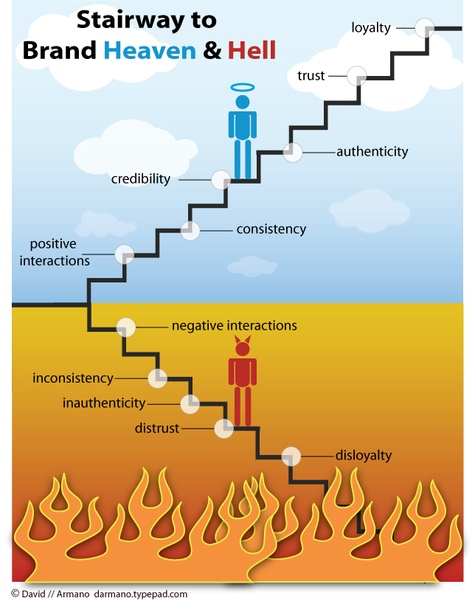
Heaven and Hell

I read in the New Scientist a while back that people who’ve suffered near death experiences commonly have a sense of drifting out of their bodies, floating above themselves and being drawn towards brightness above them.

Sounds heavenly. But according to the scientists there may be a simpler neurological explanation – the action of oxygen depletion on the brain.

My theory of Hell draws on Montaigne’s description of his near death experience falling off and being crushed by his horse. His delirium made time stand still, pain an irrelevance and his life pass before him scrambled in time and place by hallucination.

A troubled conscience taken into that context must be a special kind of torment. And stripped of all sense of time, it meets many of the classic criteria of Hell.

I watched the film ‘Source Code’ at the weekend. The hero is a massively injured soldier kept alive, artificially, so his brain can be deployed in a virtual timeshift to stop a ‘dirty bomb’. He saves the day. And his brain comes to a stop at a perfect moment – kissing the virtual ‘girl next door’ having saved millions of lives. Heaven.

We could all check out any minute. In olden times often with no warning in a brutal instant. Spartans sought glorious death on the battlefield – not much time to contemplate your sins in that kind of death. But there were plenty of other ways to go.

Montaigne, like the ancient philosophers he drew on, writes a lot about death. He points out:

We call that only a natural death; as if it were contrary to nature to see a man break his neck with a fall, be drowned in shipwreck, be snatched away with a pleurisy or the plague, and as if our ordinary condition did not expose us to these inconveniences… To die of old age is a death rare, extraordinary, and singular, and, therefore, so much less natural than the others; ’tis the last and extremest sort of dying: and the more remote, the less to be hoped for.

These days many of us will go slower and with plenty of time for delirium – troubled or ecstatic. Even in an accident there’s a fighting chance of oxygen, crash teams and intubation keeping you going long enough for a few timeless hallucinations. All the more reason to live well, without regret or a troubled conscience.

As Montaigne observes:

As an ill conscience fills us with fear, so a good one gives us greater confidence and assurance; and I can truly say that I have gone through several hazards with a more steady pace in consideration of the secret knowledge I had of my own will and the innocence of my intentions.

And quoting Ovid:

“As a man’s conscience is, so within hope or fear prevails.”

A clean conscience is a good principle for life. And, although I’m in no hurry to test it, I suspect also for death. If you buy my theory, bad deeds and a bad conscience could last an eternity in our final moments. Good ones potentially shimmer with ethereal light. Whatever you think comes next, a happy ending is another reason to invest in a good life in the here and now.

Subway Sceptic

In amongst the standard issue ‘New York stylie’ graffiti I walked past yesterday was a quality thought. ‘Question everything’. This struck me as rather profound for a coastal Cornwall underpass. But who inspired the phantom sprayer? Was it:

1) The Sex Pistols – a call for ‘Anarchy in the UK’.
2) David Hume – there are absolute limits to what we can know.
3) Pyrrho – hold back on your judgements for a less troubled existence

I reckon a mix of 1) and 3). Two fingers to authority and a nod to the inalienable right to your own freedom to escape society’s preconceptions.

I read Wilhelm von Humbolt quoted by John Stuart Mill in his seminal ‘On Liberty’ yesterday:

From the union of ‘freedom’ and ‘a variety of situations’ arise ‘individual vigour and manifold diversity’ in society.

Mill himself goes on to say:

Human nature is not a machine to be built after a model and set to do exactly the work prescribed for it, but a tree which requires to grow and develop itself on all sides according to the tendency of the inward forces which make it a living thing.

Graffiti is vandalism. And if we buy this weeks analysis that the cause of the UK’s ills is gangsta rap and consensual policing then the callow youth who sprayed his question (lots of assumptions here…) deserves his head cracking with a ‘zero tolerance’ truncheon.

But ‘epoché’. After Pyrrho, this week ‘I hold back’. I’ll suspend judgement and ignore Hesiod. Some questions are worth asking – and some liberties worth defending.