Poetry in Motion

I’ve just finished Csikszentmihalyi’s ‘Flow’. There are things to criticise. Some points – the time we waste in front of TV notably – are right but he makes them repetitively. His style occasionally grates. But, in my humble opinion, it is an outstanding book. My Bayesian brain infers he is likely a pretty outstanding man.

There are many themes to pull out, ideas to take forward, good advice and thought provoking evidence. My simple summary is – just read it. I’ve given ‘Flow’ its own link in the sidebar to the right.

Two personal things I’ll draw out. First Csikszentmihilyi’s advice to read a piece of poetry every day. I’ve never much cared for poetry. But, as he says, I’ve discovered a poem is a simple and rewarding pleasure. It doesn’t take much. Just five minutes and two or three poems at bedtime and mood and life are subtlety and magically enhanced. I told my partner. She’s taken with it too. And now we both have books of poetry on the go. My advice – just do it.

The second personal thing was my curious desire to get the book over with. Mainly, I think, so I could get on with all the things I now want to read as a result of reading the book. But also because I ever-so-slightly feared Csikszentmihalyi might barrel off the rails and disappoint me at the end.

Many potentially great books have been marred by a lame ending. I worried about this one. Tantalisingly the penultimate chapter was pretty good – synthesis, some emergent structure and integration of themes. So, as I said to to a particular friend, I was anxious that the last chapter would be a major disappointment. He said ‘Don’t read it, write your own final chapter’. Good advice, but a somewhat daunting challenge, so I read it instead, and I’m glad I did.

No easy answers therein, but a validation of my own thesis, that the good life requires both thought and action – Aristotle and Achilles. Csikszentmihilyi also recommends the thinkers and writers of history and antiquity as invaluable guides. I increasingly agree. But his final challenge is a tough one: to learn to master oneself and then get beyond the self to find an overarching meaning for our lives and tune into and live vividly in the full ‘flow’ of the real world. Easy then.

Discussing this on Monday with another friend, we concluded life takes the balance of a Nureyev: to balance internal with external, self with others, the world within with the world without, skill with challenge, what we achieve in life with what we would want to be remembered for.

Stoic, Sceptic, Epicurean, Existentialist, pick your school of philosophy, they are all scratching the same basic itch: how much to stick your neck out and risk your mental and physical health in the hurly burly of the real world.

Finding ‘meaning’ for Csikszentmihalyi or a ‘telos’ for Aristotle is the tough one. For Aristotle’s harp player it’s playing the harp well. For me the meaning of life is getting clearer, but it’s reassuring to know there are philosophers and poets to help me on my way.

The Good Life

I used to be a strict Act Utilitarian – the moral act is the one that produces the most overall happiness or least harm. The undergraduate philosophy case studies all seemed clear cut to me.

Knowing what we know now, would I have assassinated Hitler in 1934? Sure would. If a sadistic Generalissimo passed me a gun to kill an innocent in exchange for the lives of several others, would I pull the trigger? Under duress and with no alternatives, reluctantly, yes.

To my untrained late-teen moral mind, rational calculations seemed to provide a better framework than the rules of religions and imperfect man-made moral codes. Undergraduate philosophy taught me how to ‘reductio ad absurdam’ any nuance or shade of grey. Life was black and white. Add it up, make the call, don’t expect to be understood, live with the consequences.

But the pointer on my my moral compass started twitching in my mid-thirties. Act Utilitarianism can feel calculating, look immoral and set bad precedents. A good outcome is a bad justification for a rotten process. Some things shouldn’t go under the wheels as we drive hard to a destination. We have to stand for some things, or we stand for nothing. Sometimes what the head can justify sickens the heart.

Enter Aristotle in my Forties. Eudaimonia, arete and telos – flourishing, excellence and fulfilling our innate potential – they feel like the ingredients of a good life to me. There are some rules and a handful of prohibitions in Aristotle’s Ethics. But ‘moderation in all things’ is the basic gist. Thinking and talking about Aristotle this week, I have a clearer idea why I prefer the life’s work of ‘eudaimonia’, to the instant gratification of ‘happiness’, as a moral end.

Happiness is a mental ‘state’. In eras where life was nasty, brutish and short it must have been pretty rare. Perhaps no surprise then that ‘happiness’ bubbled to the surface with Bentham and Mill as the ‘Dark Satanic Mills’ were robbing people of eudaimonia and the ‘telos’ of crafts and village life. William Blake, whose poems I’m reading at the moment, gives a flavour of this in ‘Songs of Innocence and Experience’.

But in the affluent, materialist, 21st century Western world, I fear happiness is a false god. Sex, drugs and rock ‘n’ roll put transitory hedonistic pleasure on an altar. Thinking about this, I was reminded of another undergraduate philosophy ‘thought experiment’ – the brain in a vat. What if all my sensations are fed me by a mad scientist thorough electrodes plugged into my brain?

Here in the ‘real’ world we are closer and closer to being able to live purely for audio-visual, digital and chemical pleasures without needing a mad scientist. People need to participate in their lives not plug in, switch off and get high. This is substantially Csikszentmihalyi’s case for embroidering our lives with varied challenges, new skills and personal growth.

Aristotle gives life an achievable and worthwhile end – to be the best of who we are. It is an optimistic, forgiving, perfectible, self-improving and thoroughly ‘open system’ – in his nutshell: ‘we are what we repeatedly do’.

Virtues and excellence grow with our actions, a little reflection and lots of practice. There’s plenty of room in Aristotle for happiness – especially through friends. There’s an explicit acknowledgement of ‘flow’ – the work of the harp player is to play the harp, and of the good harp player to play the harp well. But above all the good life is the one we lead every day by growing, improving, refining, learning, reflecting and acting.

I think Aristotle trains core moral strength better than the rational calculation of Utilitarianism. Better to act, learn, feel and constantly improve than use intellectual brute force to calculate the answers. Life is more Bayesian than arithmetic, more non-linear than deterministic. It’s a life’s work to work on the answers for myself – and to enjoy the journey.

Broadband

Our home broadband has been on the blink this week. You really miss it when it’s not there. Perhaps worse is when it comes and goes – one minute you’re surfing gaily, the next you’re beached with a ‘no network’ message.

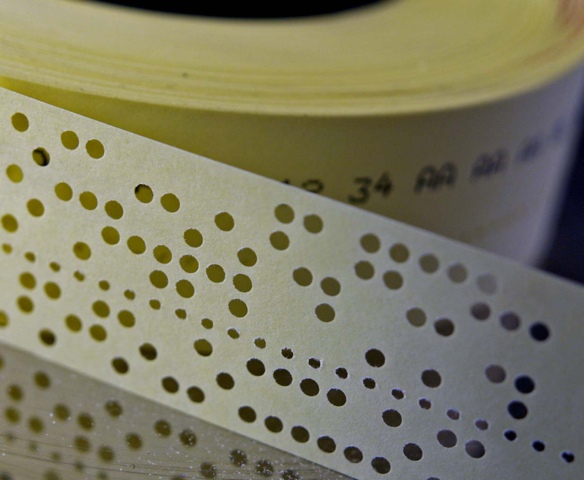
Csikszentmihalyi points out that, although impressive by electronic standards, the amount of data our minds can process simultaneously is surprisingly small. More punched tape than broadband. Two people talking to us at once or, say, riding a bike and whistling a song, just about exhausts our real time mental processing capacity. Any more and we lose attention and get distracted, flustered or confused.

I noticed it one day this week in the office. One minute I was churning out flowing prose, the next someone started talking in my earshot and I was distracted. I slowed to trickle – like someone was hogging my wifi. The talker left, bandwidth returned, and so did flowing prose. It was like flipping a switch.

Things, events, people and basic navigation are all basically different data and signals crowding in or cluttering up our cognitive bandwidth. This makes directing our consciousness and limited mental energy hard.

And it’s especially hard because life can easily just happen to us. Events and other people can readily soak up all the bandwidth we have. And if we do decide to use that precious resource on directed thought and action, we do so against a background of almost overwhelming distraction and diversions.

All life is, is the continual stream of sensory data, words, pictures, thoughts and ideas streaming through that narrow mental bandwidth. All we are, is the accumulated store of that data in the limited hard drives of our brains and to some extent those of others. It makes you think – until someone starts talking in your earshot and the mental connection is interrupted.

But given mental broadband is always there I’ve discovered I can redirect it when I catch myself wasting or underusing it. At work this week while being gently bored by a presenter on pan-European data collection standards, I contemplated the extraordinary beauty of a large tree – spare broadband successfully redeployed into joyful contemplation.

More experimental was testing optimising ‘flow’ by doing two different things simultaneously, and well. Combining loudly whistling the Marseillaise with cycling to work smoothly and safely through London traffic perfectly occupied my mental broadband. And in a heartily enjoyable way. Vive la France.

Our mental broadband has surprisingly limited peak capacity. But the compensation is it is ‘always on’. You can waste it or have it used for you, but you can also use it well. I found this week being more careful in how I deploy my personal ‘punched tape’ makes a big difference. Focusing its use on doing one or two things at a time really well – and exploiting every minute of it – whether I’m on my own, or with others, has removed a good deal of routine boredom and irritation from my week. Replacing that with moments of joy, satisfaction and genuine happiness is broadband well spent.

Waste not, want not.

Cross Stitches

I’ve subscribed to Montaigne’s Essais on dailylit.com which breaks him up into comparatively bitesized chunks. Still the discovery that there are 426 daily episodes to look forward to sometimes feels a long haul. I’m up to episode 62.

Some days I skim him, some days I ignore him completely. But sometimes he discusses something with himself, in his meandering way, which speaks to my own day. Whenever I’m close to cancelling my daily dose of Montaigne, something crops up which piques my interest.

The other day I was tickled in Chapter XXV by his discourse on copying, citing and stealing the ideas and expressions of others. He describes the occasion he spotted a piece of stolen intellectual treasure in an otherwise dull read:

…After a long and tedious travel, I came at last to meet with a piece that was lofty, rich, and elevated to the very clouds… and so wholly cut off from the rest of the work, that by the first six words, I found myself flying into the other world, and thence discovered the vale whence I came so deep and low, that I have never had since the heart to descend into it any more.

In some ages quoting and embroidering ones own words with those of others has been considered scholarly. In others a sin. Montaigne is ambivalent, but on balance feels – properly cited – it is good to draw on others: 

…I myself… attempt to equal myself to my thefts, and to make my style go hand in hand with them, not without a temerarious hope of deceiving the eyes of my reader from discerning the difference… Besides, I do not offer to contend with the whole body of these champions, nor hand to hand with anyone of them: ’tis only by flights and little light attempts that I engage them; I do not grapple with them, but try their strength only. 

When I first read Aristotle and indeed almost any of the thinkers I’ve ‘tried the strength of’, it is easy to feel – at least for ethics – that it has all been thought and said. But an insight from Csikszentmihilyi reassures me that it’s still well worth thinking for myself. Like Aristotle, he maintains that there is no reliable guide or recipe for ‘the good life’. There are, at best, principles and then it is the work of every individual to create our own virtuous circle of thought and action. As Aristotle says: we are, what we habitually do.

That we each have a personal Odyssey to navigate, is reason enough to embroider our thoughts with the golden threads of others from all the ages. But Csikszentmihalyi’s further point is, even where great thinkers have distilled the essence of the good life for their age – Aristotle for the Ancients, Epictetus and Seneca for the random cruelty of the Romans, the Apostles for the tough early years Anno Domini, yogis, Confucius, the Buddha and others for their times and places – the times they are a constantly changin’. 

So not only is living ‘the good life’ a personal challenge, but it is a fresh generational challenge for every epoch given our vastly different social, technological and interpersonal contexts. 

It is almost impossible to imagine the scale of the technological difference between me typing on an Apple bluetooth keyboard in 2011 and Montaigne scratching on parchment in 16th Century France. And yet a decent proportion of what drops electronically into my inbox from his pen is in some way pertinent and relevant. I find it remarkable that both Aristotle and Montaigne travel the ages so well. 

And so to my handy consolation from Montaigne for this week. I’ve spent the last couple of days wrestling with the interaction between my two ‘lovely’ children and two other ‘lovely’ children. Of course they are each individually and collectively lovely, and the interactions between them have been mainly delightful. But they have also been occasionally loud, wearing and late one afternoon briefly teetered towards ‘The Lord of the Flies’. Who was it who said other people are hell? They were wrong – it’s children.

Overall though it was lovely – and with no qualifying speech marks. But yesterday morning as temperatures and tempers warmed, it was nice to enjoy a moment of Montaigne on the iPhone, reassuring me that 400+ years ago, Renaissance parents struggled with many of the same challenges: 

We often take very great pains, and consume a good part of our time in training up children to things, for which, by their natural constitution, they are totally unfit.

Nevertheless, I am clearly of opinion, that they ought to be elemented in the best and most advantageous studies, without taking too much notice of, or being too superstitious in those light prognostics they give of themselves in their tender years.

But, in truth, all I understand as to that particular is only this, that the greatest and most important difficulty of human science is the education of children.

Reassuringly parenting down the ages seems much like John Wanamaker’s view of advertising: everyone knows half of it doesn’t work, the problem is no-one knows which half. Much like ‘the good life’, ‘good parenting’ is a fresh challenge for every parent and every age. It is indeed the greatest and most important difficulty of the human sciences, but also – at least most of the time – the most rewarding.

Marseillaise

Reading Csikszentmihalyi on a family Bank Holiday in sunny France, I was reminded of the tyranny of progress and performance. 

Not that it was Csikszentmihalyi’s fault. We’d been talking with friends the night before going away about learning musical instruments and the merits of lessons and regular practice. 

Now I firmly believe that the best way to improve at anything is to practice regularly – the action of water on a stone is gradual, but inexorable. I have also learnt that the best way to practice anything regularly is to integrate it your daily routine. The problem is there are only so many hours in the day. What to do? More, less often?

I remember from my time working in advertising in France in the 1990s that people have predictable daily and weekly habits. But we do not generally form monthly habits and signally fail to form fortnightly habits. This gave rise to the unspoken rule, never buy an an Ad next to a monthly or worse a fortnightly TV show – they never pull in a regular audience and generally fail. Even if they are well liked once, people forget to tune in ever again. We are creatures of routine.

So where does that leave us with practice, hobbies and busy lives. My conclusion is the only practical options are dedicating daily or weekly slots. My daily slots are all pretty much full: kids, work, kids, eat, dishwasher, potter briefly, bed. 

The brief evening pottering – which recently was when I walked our ageing dog – is the remaining ‘purposeable’ slot. But a few minutes spinning the wheels, albeit aimlessly, seems a very small concession to relaxation. It’d take something ‘light’ and ‘fun’ to fit in edgeways in that small nook in a way that didn’t feel like a chore. 

The ukulele used to be that thing. And for nearly a year I played five songs nearly every night and went from hopeless and tuneless to strumming comparatively competently. Then the dog got incontinent and the habit got broken. So I could go back to the uke. But here’s where the tyranny of progress kicks in. Our friends feel I should have lessons, improve, look to play publicly or at least in private duets and preferably drop the four strings and migrate to a proper six string guitar. 

Phew. Where’s the eudaimonia in all that – the pressure to rapidly improve my skill to meet the challenge of musical excellence feels most unappealing. I said ‘no thanks’. They looked at me like I was mad – what’s the point of strumming the same five songs and never playing them with, or for, someone. Where’s the progress, where’s the performance. The point though – I think – is I quite enjoy it as a personal exercise for me, for ten minutes at night. The simple challenge I set myself is met by my rudimentary and very slowly improving strumming skill: producing modest, low-impact, private, musical ‘flow’.

Separately, on hols I was congratulated twice on my French – one woman said “Vous parlez très très bien Monsieur”. Another asked me if I was a French teacher in England. 

I had given up keeping up my French. I’d given up listening to ‘intermediate French’ audio magazines I subscribed to when I first came back from France. There were no opportunities to match my once reasonable skill with any worthwhile challenge at home. Talking about nothing much in French, just to speak French, seemed pretty pointless. And over time I felt myself going backwards which made matters worse.

But ‘flow’ in French has returned. Family holidays now provide me the perfect opportunity to navigate the modest but important challenges of travelling, accommodating, feeding and entertaining my little family. And they seem quietly impressed and genuinely grateful for my efforts. Now I have a stage on which to perform, some modest (daily?) investment in progress and improvement suddenly seems worthwhile – I’ll be looking at what the web has to offer for ‘intermediate French’ these days.

‘Flow’, progress and performance are closely intertwined, so much Csikszentmihalyi amply demonstrates. But I conclude the recipe and mix aren’t always the same. There are things we do well, some we may do very well and many we could do better. I believe good day-to-day ‘flow’ lies in accepting that not everything we do has to be excelled at. Sometimes the only audience that matters is ourselves.