Adults and Children

All adults are big kids sometimes, but often the wrong kind. We keep the petty, squabbling, thin-skinnedness of children but often lose the curiosity, spontaneity and sense of fun.

It’s a bit hackneyed but I still have a lot of time for Transactional Analysis. The simple insight that a lot of our interactions are marred by deliberately or carelessly behaving like a domineering ‘parent’, lecturing or judging an errant ‘child’, describes a lot of what happens at work.

I was congratulated this week for doing an hour-long ‘all staff’ talk without once descending into parent-child. Apparently I was ‘adult to adult’ throughout. But the funny thing is, I wasn’t conscious of it. It was simply a case of being open, honest, respectful and genuinely answering the questions people asked. I used to be quick, slick and evasive. Now I’m slower and straighter – a good thing I think.

But I’ve also learnt that there’s still a space for the ‘free child’ at work. That’s when someone comes over all reproving or domineering and you prick their ‘parental bubble’ with a nifty joke at their expense. It’s risky, but done right it doesn’t half work. A bit of ‘free child’ brings some fun too, some laughter, a feeling things are ok and makes for a happier day. As Aristotle would advise it’s all about finding the golden mean between ‘boor’ and ‘buffoon’. He generally gets these things about right.

To finish, a happy chapter on our local community. I write on return from a public meeting, where we overcame some spirited and sustained resistance to more play equipment, in our once bleak – but now thriving – community park. People overlooking feared noise and teenagers and graffiti. Not unreasonable, but there’s a wider community to serve.

I said a few words in favour, but the Chair – a volunteer of course as all the best people are – managed the meeting with great dignity and some skill. I wrote to him just now to say:

You managed that really really well. Inviting everyone to speak – individually – but not allowing ding dongs was the genius of your chairmanship. It kept it civil, kept us from polarising and allowed people to be heard without hijacking. In the end defeat was calm and dignified not angry and litigious.

His skill was helping us to stay adult, as we discussed children. Being the best of both is what I’m working on.
Shower

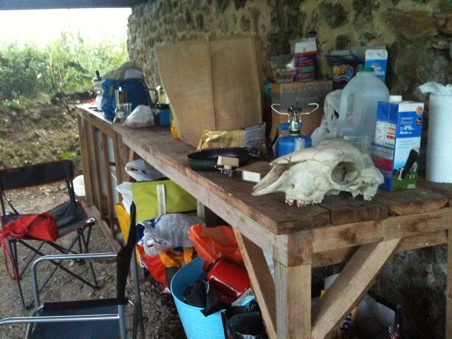
20110718-105113.jpgMan – and woman – in the state of nature is not a pretty sight. Obsessed with feeding and drinking, scavenging for firewood, alternately soaked then sweating. Feral children career about, bumping and thumping each other. Sleep snatched fitfully as the elements do their worst. Not much contemplation here.

What, I ask myself, is the purpose of camping? I may never know. Csikszentmihalyi might posit a ‘rude’ form of ‘flow’. But I’m pretty sure Aristotle wouldn’t have rated it. Certainly not in England’s all too green, and, for much of this weekend, not very pleasant lands. Apparently there was a moment where the entire land surface of Great Britain was simultaneously being rained on. Certainly we were.

I found myself short of temper and shorter of humour. Only Dionysius with his warming grapes and a crackling campfire lifted my spirits. An extra thick sleeping bag and two angelic faces snoring next to me helped too. The family unit held together.

The high point was packing the tent. Both for the manly ‘flow’ I achieved as I dismantled, folded and rolled it and the several nods of recognition for getting it into its bag in one go. More though for what it signified – going home to civilisation.

Stamps

I’ve written before on the topic of ‘flow’, children and embroidering life with rich experience – large and small. And we managed all four this morning, thanks to a cheap packet of world stamps.

The agile, and occasionally restless, mind of my now seven-year old daughter was completely and delightfully absorbed in sifting stamps from España, Nederland, Polski and the long forgotten Deutsche Democratik Republik.

Some of these stamps were around when I was her age. And the fiddly licky hinges haven’t changed either. Throw in a cheap album and she was completely absorbed in finding countries, licking hinges and sticking in stamps – despite her brother’s periodic attentions.

We learnt some geopolitics – there are 200 odd countries to find, different political systems from democracies to dictatorships and some memorable symbols and landmarks – from the Statue of Liberty, to St Martin from Czechoslovakia on his snowy white horse.

And all for a tenner. Stamps trumped her Nintendo for prolonged attention and ‘flow’ and we learned some things too. Cards, chess, stamps, books – the old favourites are still the best for kids sometimes.

Immersion

Concentrating on boiling a ham on the hob yesterday, I was reminded of a key aspect of ‘flow’ – immersion. ‘Flow’ is ceasing to be self-conscious or unduly conscious of others and becoming thoroughly immersed in the task or activity.

When you look at it this way, a number of things we usually consider important in enjoyable achievement turn out not to be – notably the immediate judgement and appreciation of others. Also, a variety of things we consider dull can suddenly become a joy.

Take hoovering the house. Usually a chore, and one I resent. I enter into it – if at all – with little a priori enthusiasm. I have, however, discovered it passes more easily with an iPod, headphones and music.

Surprising then to discover last weekend during a particularly energetic and virtuoso vacuum – as I removed the ‘T head’ to more precisely target the skirting boards in the kitchen – I was in full ‘flow’. It was an absorbing task, in which my goal was evident, feedback clear (disappearing crumbs and detritus) and my mental energy was fully absorbed (in music and coordinated physical effort). Stone me, it’s that simple I realised.

I was talking to another parent yesterday about how this applies to kids, sports and music. The art is perhaps in helping a child to become completely immersed in the ‘process’ of playing football or the piano to the point they cease to be self-conscious or unduly conscious of you and your anxiety/impatience/projection of your own hopes and fears (delete as applicable).

A lot of what we do with children and activities is the opposite. We make them concentrate on us, keep pushing them on – before they’ve had time to master or enjoy developing skills – and most of all we distract them with incentives and threats. The art of ‘flow’ is to let them lose themselves in what they are doing and forget we’re there – not focus them on extrinsic rewards or punishments.

More immersion perhaps means less coercion. And letting go a bit and getting lost in what they’re doing makes parenting ‘flow’ more easily too.