Of Angels

20111105-201745.jpgSmarting from the accusation I seldom read the source, I’m wading through Aquinas at present. Corblimey he’s obsessed with some things well beyond my interest. But that’s because I’m reading him for his ethics, and he’s writing a science book as far as he’s concerned.

Summae Theologica is, I come to realise, describing Aquinas’ views on how the world, universe, animals, minds, substance and energy all work – the lot.

Not surprising then he spends considerable time on causation – what causes what, what is primary, what is secondary and what is ‘higher’ and ‘lower’, what is an ‘operation’ what is a ‘state’.

His method is famously rigorous: three or four well sourced views on a theme, his own judgement and an answer to the opening views.

I think he quite carefully integrates a humanist perspective with a religious one. At times he acknowledges tantalisingly what ‘would’ be the case if there was no God – Aristotle ‘would’ be right on human happiness for instance he says.

After Aristotle, he concurs that our ‘end’ is indeed happiness. But we achieve happiness imperfectly in our mortal lives. We achieve it most in contemplation. In contemplation of what though?

For Aquinas, of course, that would be God. But contemplation of God is, he acknowledges, tricky. Not least as He is infinite and Our reason is finite. We’re snookered from the off.

What to do? It could be worse. Animals are even further from God than we are. They lack our intellect and capacity for reason and thought and so can’t contemplate God at all.

Aquinas explicitly acknowledges that nature has fitted us and animals with desires and emotions to further our own survival and that of our species – positively Darwinian. But they are ‘beneath’ us and we are a rung down from – you guessed it – Angels.

God tops Angels of course, but each in the chain comes closer to ‘perfection’ and achieves ‘happiness’ most by ‘touching’ the one above.

I’m not sure how many farm animals would agree they are ‘perfected’ and happier ‘touching’ humans. Perhaps a well trained sheepdog. But we humans can attain greater happiness in the use of our more ‘perfect’ power, namely contemplation. And among the things we can happily contemplate are Angels.

Now this is a thought I can honestly say I have never had. Beyond the one on top of the Christmas Tree and my daughter in the school nativity, I have never spent any time contemplating Angels. Perhaps I should?

But the point I take from Aquinas and Angels is this: contemplation, seeing beauty around us and perfecting and developing our human capacities, skills and aptitudes is where Earthly happiness lies.

Csikszentmihalyi comes to mind. As I said to someone last weekend it’s all about adding ‘relevant complexity’ to our lives and personalities.

And I think this is what Aquinas is getting at too. A life of virtue, self-improvement and integration of the body, soul and mind might mean at the end of it all, the ‘bottled essence’ of us – probably in frail and wizened form – is a shimmering soul ‘touching’ that of an Angel.

Font of Knowledge

I owe Steve Jobs a good deal. From early dial-up internet on my original Aqua iBook to blogging with an iPhone and iPad. Despite liberating £1000s from my wallet over the years, I am eternally grateful to him. He has opened up a world of new possibilities, knowledge and ideas to me and many millions more.

Poor guy looks like he’s on his last legs though. Emaciated and gaunt, bowing to the inevitable he stood down as Apple CEO the other day. If I were a betting man I’d reckon cancer will have him within 6 months.

A famously hot tempered perfectionist, I wonder how much cancer has changed him. Diagnosed some 6-7 years ago, reading his 2005 Stanford Commencement address – made to a hall of eager freshmen – he had a pretty ‘nailed on’ philosophy well before the ‘Big C’ properly got hold of him. Like David Servan-Schreiber, cancer will extinguish him but it didn’t beat him.

He calls life’s rich pattern ‘connecting the dots’. I think of it as a ‘Nile delta’ of possibilities. Either way, it’s a fact that life often makes sense looking backwards. But the tributaries down which we flow through life are serendipitous, random and unfathomable. Once you’ve noticed your route though, it all looks pre-ordained.

I quoted Jobs’ example of calligraphy (below) the other day. He created, from random events, the font-rich world we take for granted on every electronic device. Imagine if he’d taken technical drawing instead. It could all have been very different.

The moral I draw? Don’t waste time trying to plan life, live it. Think more about today than next year. Don’t sweat the small stuff. And finally, even the big things in life generally happen by accident, it’s how you respond and what you do next that matters.

Here’s a piece of his Stanford address:

I dropped out of Reed College after the first 6 months, but then stayed around as a drop-in for another 18 months or so before I really quit. So why did I drop out?

It started before I was born. My biological mother was a young, unwed college graduate student, and she decided to put me up for adoption. She felt very strongly that I should be adopted by college graduates, so everything was all set for me to be adopted at birth by a lawyer and his wife. Except that when I popped out they decided at the last minute that they really wanted a girl. So my parents, who were on a waiting list, got a call in the middle of the night asking: “We have an unexpected baby boy; do you want him?” They said: “Of course.” My biological mother later found out that my mother had never graduated from college and that my father had never graduated from high school. She refused to sign the final adoption papers. She only relented a few months later when my parents promised that I would someday go to college.

And 17 years later I did go to college. But I naively chose a college that was almost as expensive as Stanford, and all of my working-class parents’ savings were being spent on my college tuition. After six months, I couldn’t see the value in it. I had no idea what I wanted to do with my life and no idea how college was going to help me figure it out. And here I was spending all of the money my parents had saved their entire life. So I decided to drop out and trust that it would all work out OK. It was pretty scary at the time, but looking back it was one of the best decisions I ever made. The minute I dropped out I could stop taking the required classes that didn’t interest me, and begin dropping in on the ones that looked interesting.

It wasn’t all romantic. I didn’t have a dorm room, so I slept on the floor in friends’ rooms, I returned coke bottles for the 5¢ deposits to buy food with, and I would walk the 7 miles across town every Sunday night to get one good meal a week at the Hare Krishna temple. I loved it. And much of what I stumbled into by following my curiosity and intuition turned out to be priceless later on. Let me give you one example:

Reed College at that time offered perhaps the best calligraphy instruction in the country. Throughout the campus every poster, every label on every drawer, was beautifully hand calligraphed. Because I had dropped out and didn’t have to take the normal classes, I decided to take a calligraphy class to learn how to do this. I learned about serif and san serif typefaces, about varying the amount of space between different letter combinations, about what makes great typography great. It was beautiful, historical, artistically subtle in a way that science can’t capture, and I found it fascinating.

None of this had even a hope of any practical application in my life. But ten years later, when we were designing the first Macintosh computer, it all came back to me. And we designed it all into the Mac. It was the first computer with beautiful typography. If I had never dropped in on that single course in college, the Mac would have never had multiple typefaces or proportionally spaced fonts. And since Windows just copied the Mac, it’s likely that no personal computer would have them. If I had never dropped out, I would have never dropped in on this calligraphy class, and personal computers might not have the wonderful typography that they do. Of course it was impossible to connect the dots looking forward when I was in college. But it was very, very clear looking backwards ten years later.

Again, you can’t connect the dots looking forward; you can only connect them looking backwards. So you have to trust that the dots will somehow connect in your future. You have to trust in something — your gut, destiny, life, karma, whatever. This approach has never let me down, and it has made all the difference in my life.

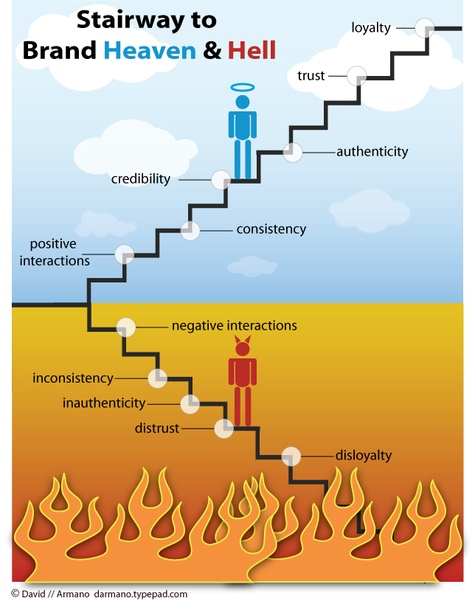
Heaven and Hell

I read in the New Scientist a while back that people who’ve suffered near death experiences commonly have a sense of drifting out of their bodies, floating above themselves and being drawn towards brightness above them.

Sounds heavenly. But according to the scientists there may be a simpler neurological explanation – the action of oxygen depletion on the brain.

My theory of Hell draws on Montaigne’s description of his near death experience falling off and being crushed by his horse. His delirium made time stand still, pain an irrelevance and his life pass before him scrambled in time and place by hallucination.

A troubled conscience taken into that context must be a special kind of torment. And stripped of all sense of time, it meets many of the classic criteria of Hell.

I watched the film ‘Source Code’ at the weekend. The hero is a massively injured soldier kept alive, artificially, so his brain can be deployed in a virtual timeshift to stop a ‘dirty bomb’. He saves the day. And his brain comes to a stop at a perfect moment – kissing the virtual ‘girl next door’ having saved millions of lives. Heaven.

We could all check out any minute. In olden times often with no warning in a brutal instant. Spartans sought glorious death on the battlefield – not much time to contemplate your sins in that kind of death. But there were plenty of other ways to go.

Montaigne, like the ancient philosophers he drew on, writes a lot about death. He points out:

We call that only a natural death; as if it were contrary to nature to see a man break his neck with a fall, be drowned in shipwreck, be snatched away with a pleurisy or the plague, and as if our ordinary condition did not expose us to these inconveniences… To die of old age is a death rare, extraordinary, and singular, and, therefore, so much less natural than the others; ’tis the last and extremest sort of dying: and the more remote, the less to be hoped for.

These days many of us will go slower and with plenty of time for delirium – troubled or ecstatic. Even in an accident there’s a fighting chance of oxygen, crash teams and intubation keeping you going long enough for a few timeless hallucinations. All the more reason to live well, without regret or a troubled conscience.

As Montaigne observes:

As an ill conscience fills us with fear, so a good one gives us greater confidence and assurance; and I can truly say that I have gone through several hazards with a more steady pace in consideration of the secret knowledge I had of my own will and the innocence of my intentions.

And quoting Ovid:

“As a man’s conscience is, so within hope or fear prevails.”

A clean conscience is a good principle for life. And, although I’m in no hurry to test it, I suspect also for death. If you buy my theory, bad deeds and a bad conscience could last an eternity in our final moments. Good ones potentially shimmer with ethereal light. Whatever you think comes next, a happy ending is another reason to invest in a good life in the here and now.

Man’s Best Friend

Unprecedentedly, I’m home alone this weekend. I’ve cooked some tasty meals, listened to some absorbing cricket, cleaned the fish tank, sunk a few beers, watched some great films, done some washing, tidied up, been late to bed, lied in. And now I’m out for a walk.

It’s a lovely sunny day. But it’s a solitary business walking without a child. No-one to hassle me for sweets or ice cream. No scooters, wobbling bikes, tripping up, tears, bruises or grumbles about being bored… And so my mind wanders to my erstwhile furry companion.

Poor old Mr Tumnus. His ashes in a box and his spirit in the sky in a red jacket, lapping powerfully just behind an electric bunny. I miss the old boy today. My kids have more than replaced him. But when they get older and need me less, I think I’ll need another hound to accompany me. Around about my 50th birthday I reckon. Watch this space.

Servan-Schreiber

I was sad to read today that David Servan-Schrieber lost his battle against cancer the other day. But although he lost the battle, I think he won the war. He lived nearly twenty full and vivid years post diagnosis of a brain tumour. His cancer spurred him to develop as a human being and to write. Reading his books and fearing the big ‘C’ did the same for me.

His writing combined a rock solid scientific foundation with an interest in the whole person. As someone wrote in an obituary, he was tete, coeur et corps – head, heart and body. All I have to say is read his books: ‘Healing without Freud or Prozac’ for the head and the heart and ‘Anticancer’ for the body.

A good man, who it is tempting to say died too young. But reading about his full medical, research, writing, speaking, travelling and sporting life, perhaps at 50 he managed as Aristotle recommends: ‘to rise from life as from a banquet, neither thirsty nor drunken.’ I hope so.