The Emperor’s Questions 


I think I increasingly knew this; but sometimes you need someone to express it clearly for you. Thich Nhat Hahn quoting Tolstoy does the job: 

“One day it occurred to a certain emperor that if he only knew the answers to three questions, he would never stray in any matter.

  1. What is the best time to do each thing? 
  2. Who are the most important people to work with?
  3. What is the most important thing to do at all times?

The emperor issued a decree throughout his kingdom announcing that whoever could answer the questions would receive a great reward. 

Many who read the decree made their way to the palace at once, each person with a different answer.

In reply to the first question, one person advised that the emperor make up a thorough time schedule, consecrating every hour, day, month, and year for certain tasks and then follow the schedule to the letter. Only then could he hope to do every task at the right time.

Another person replied that it was impossible to plan in advance and that the emperor should put all vain amusements aside and remain attentive to everything in order to know what to do at what time.

Someone else insisted that, by himself, the emperor could never hope to have all the foresight and competence necessary to decide when to do each and every task and what he really needed was to set up a Council of the Wise and then to act according to their advice. 

Someone else said that certain matters required immediate decision and could not wait for consultation, but if he wanted to know in advance what was going to happen he should consult magicians and soothsayers.

The responses to the second question also lacked accord. One person said that the emperor needed to place all his trust in administrators, another urged reliance on priests and monks, while others recommended physicians. Still others put their faith in warriors.

The third question drew a similar variety of answers. Some said science was the most important pursuit. Others insisted on religion. Yet others claimed the most important thing was military skill.

The emperor was not pleased with any of the answers, and no reward was given.”

It took a life and death experience with a hermit (here) to reveal the answer to the emperor, which Tolstoy says quite simply is this: 

“The present moment is the only time over which we have dominion. 

The most important person is always the person you are with, who is right before you.

The most important pursuit is making the person standing at your side happy, for that alone is the pursuit of life.”

As Thich Nhat Hahn goes on to say: 

“Tolstoy’s story is like a story out of scripture: it doesn’t fall short of any sacred text. 

We talk about social service, service to the people, service to humanity, service for others who are far away, helping to bring peace to the world-but often we forget that it is the very people around us that we must live for first of all. 

If you cannot serve your wife or husband or child or parent – how are you going to serve society? 

If you cannot make your own child happy, how do you expect to be able to make anyone else happy? If all our friends in the peace movement or of service communities of any kind do not love and help one another, whom can we love and help? 

Are we working for other humans, or are we just working for the name of an organization?”

As I’m increasingly finding – here, now and by paying attention to the person in front of me is where kindness, a feeling of connectedness and a happy life is found.

Ain’t that the truth

“From the moment in our lives at which we learn to speak we are taught that what we say must be true. What is meant by “telling the truth”? What does it demand of us?

In the first place it is our parents who regulate our relation to themselves by this demand for truthfulness; but this demand cannot simply be reversed. The life of the small child lies open before the parents, and what the child says should reveal to them everything that is hidden and secret, but in the converse relationship this cannot possibly be the case. In the matter of truthfulness, the parents’ claim on the child is different from the child’s claim on the parents.

From this it emerges that “telling the truth” means something different according to the particular situation in which one stands. Account must be taken of one’s relationships at each particular time. The question must be asked whether and in what way a man is entitled to demand truthful speech in others. Speech between parents and children is, in the nature of the case, different from speech between man and wife, between friends, between teacher and pupil, government and subject, friend and foe.

“Telling the truth,” therefore, is not solely a matter of moral character; it is also a correct appreciation of real situations and of serious reflection upon them. The more complex the actual situations of a man’s life, the more responsible and the more difficult will be his task of “telling the truth.” 

Telling the truth is, therefore, something which must be learnt. This will sound very shocking to anyone who thinks that it must all depend on moral character and that if this is blameless, the rest is child’s play. But the simple fact is that the ethical cannot be detached from reality, and consequently continual progress in learning to appreciate reality is a necessary ingredient in ethical action.

It is only the cynic who claims to “speak the truth” at all times and in all places to all men in the same way. Every utterance or word lives and has its home in a particular environment. The word in the family is different from the word in business or in public. The word which has come to life in the warmth of personal relationships is frozen to death in the cold air of public existence. The word of command, which has its place in public service, would sever the bonds of mutual confidence if it was spoken in the family. Each word must have its own place and keep to it.”

This final chapter of Bonhoeffer’s Ethics (my edits) came as a surprise indeed, given the absolute absolutism of his Christianity. I’d have had him down for advocating eye-watering honesty in every encounter…

But perhaps I shouldn’t have. Throughout the book there are limpid, concise, practical and very worldly takes on ethics; alongside pages and pages of dense, impenetrable and almost ranting theology. 

When it comes to “the truth” this is about the best account I’ve read of how I’ve intuitively ‘felt’ about it for years – with work being the hardest place of all to strike the right balance.

Many people in the public service workplaces I’ve worked in for the last fifteen years feel they are owed – and regularly demand – a full account of everything which is known and under consideration by the senior management. I’ve often felt I couldn’t, in good conscience, give them that. Some truths have to be held tightly to oneself, however uncomfortable that feels.

Bonhoeffer has eloquently put into words for me why.

War and Peace


Two good books came to my aid this week – ‘Fierce Conversations’ and ‘The Anatomy of Peace’.

The first argues persuasively that there isn’t a relationship you can’t improve (or set back) with your next conversation. 

The thesis is that the conversation is the relationship – and you’re relationship only as good as the conversation you’re having. Stop talking and your relationship is automatically going backwards; start talking and you’re in with a shout of improving things.

The further argument is; some conversations need having – even if you really don’t want to have them. I had one like that this week. 

The second book ‘Anatomy of Peace’ and the related ‘Outward Mindset’ are very simple too. But being simple doesn’t make them easy. These say that what’s happening around us (and to us) is often far more of our own making than any of us would like to recognise. 

The thesis of both: is that the essence of what we create around us flows from whether we are seeing and treating people as people. Most of our problems are caused by our heart subtly and quietly hardening against people – and consequently seeing individuals and groups (even whole countries) as obstacles or vehicles. 

Stop seeing the person, or start focusing more on your own needs – and we start the self-reinforcing process of pushing, shoving and self-justification.

This week I stopped pushing on the cusp of starting shoving, and had a frank and open ‘fierce conversation’ instead. An important work relationship is improved; I’m much happier and a whole slew of future problems feel suddenly more tractable – we will tackle them together not push them at each other.

Going to war with people is always easier than making peace; but the consequences rip and ripple out, and are endless either way. 

Separately, coming somewhat ‘shell shocked’ from a downbeat meeting on problems with a major building project, someone kindly asked if was alright. I stopped a moment and said: “Yes, I was quiet because I was thinking.” A white lie, but partially true.

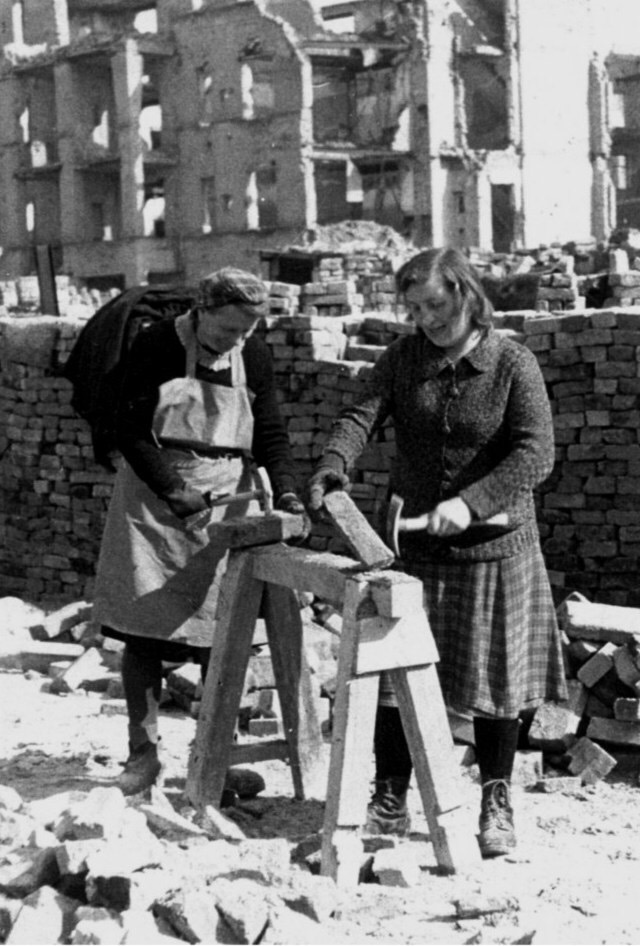
And then I mentioned the stoicism of Germany’s ‘brick women’ after WWII whom I’d read about in Neil MacGregor’s Germany: Memories of a Nation’

As Wikipedia has it, the Trümmerfrau (literally ruins woman or rubble woman) helped clear and reconstruct bombed cities where 4 million homes had been destroyed and another 4 million damaged – half of all homes – plus half of all schools and 40% of all infrastructure; they collectively tackled 400 million cubic metres of ruins.

Puts a few of my work ‘infrastructure problems’ in perspective. But it also speaks to the power of people to objectify, justify, hate, fight and destroy each other – and very often the same people to come together in a testament to the indomitable human spirit: to restore, recover, rebuild and recreate. 

We have the capacity for both in us all.

Public Virtue

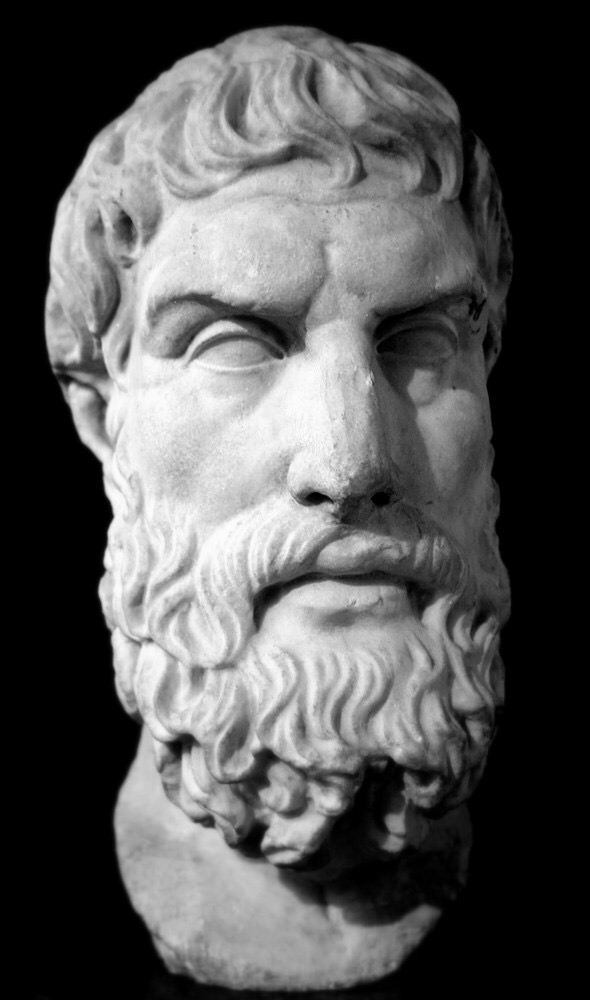
By temperament I’d probably prefer an Epicurean life. As Wikipedia has it:

For Epicurus, the purpose of philosophy was to attain the happy, tranquil life, characterized by ataraxia: peace and freedom from fear and aponia: the absence of pain and by living a self-sufficient life surrounded by friends. 

Following Alain de Botton’s lead, I think of this as seeking ‘The Garden’; an idealised  Mediterranean retreat surrounded by carefully selected friends, passing days in contemplation -with occasional breaks for olives, bread, jamon y queso and other light delights… 

But working and family life – especially the middle years – aren’t quite like that are they.

And given I’ve taken Aristotle as my guide, his ‘good life’ comes with a much higher bar; what I’ve come to think of as a life of ‘public virtue’.

Here’s a list of 11 things an Aristotelian life of public virtue requires, in a blend of my words and his; re-found last week looking at those ‘to do’ lists from 2010:

A life of Public Virtue

Courage: does my courage suitably balance fear and confidence?

Temperance: am I self-indulgent or unduly ascetic?

Liberality: am I generous, profligate or mean?

Magnificence: do I visibly give my time and money to good causes?

Pride: am I vain or unduly humble; do I step forward or stand back from noble actions and undertakings?

Honour: am I sufficiently ambitious or am I too unambitious?

Good Temper: am I good tempered, irascible or too meek?

Friendliness: am I friendly, obsequious, a flatterer or quarrelsome?

Truthfulness: am I boastful or mock-modest about my achievements?

Wit: do I sparkle or am I dull?

Friendship: am I generous in my friendship, a loner or spreading myself too thinly?

Tough tests these. 

Based on this higher Aristotelian standard, I’ve pushed myself this week: more courage, less obsequiousness and ‘mock-modesty’ – and a spot of irascibility too; telling a couple of people to b#%%€r off. 

In sum: standing for, standing against; and not just standing by on some things which need to be better.

Public virtue requires a bit of courage and a bit of oomph; a public life can’t always be a peaceful one free of fear and pain.

Good also to remember, this week of all weeks, what US ‘Founding Father’ John Adams had to say on the importance of public virtue:

Concrete or Casuistry?

img_1472

casuistry (kazjʊɪstri) noun: the resolving of moral problems by the application of theoretical rules.

As I continue my voyage through Dietrich Bonhoeffer’s Ethics, I also continue to be astonished by the man. Limpid paragraphs of dense and pure meaning, sweeping historical context – and tub thumping Christianity. A heady mix.

But the page which stuck with me this week describes the challenges of Christian ethics; but also the constant challenge of modern organisational life:

“The attempt to define that which is good once and for all has always ended in failure. Either the proposition was asserted in such general and formal terms that it retained no significance as regards its contents, or else one tried to include in it and elaborate the whole immense range of conceivable contents, and thus say in advance what would be good in every single case; this led to a casuistic system so unmanageable that it could satisfy the demands neither of general validity nor of concreteness.”

Pretty much every strategy exercise or major organisational change programme I’ve ever worked on has wrestled with this. As Bonhoeffer puts it, the conflict between the ‘good’ and the ‘real’.

Bonhoeffer argues for concrete not casuistry. Not a bad place to go, not least given how bad things were in his times. But I go with Aristotle’s ‘golden mean’; the ‘good’ is always somewhere in the difficult and constantly contested place in between.