Showtime

A night to remember last evening, at surely the greatest musical of our times – ‘Hamilton’.

We’ve been humming it and singing it all day (as we have for the last two years). But apart from the lesser known Founding Father’s tale of the (once) almost unlimited possibilities of America (as his final words bill it “that great unfinished symphony…”) Hamilton’s other message is the transcendent importance of time.

Alexander Hamilton lives like he’s running out of it; the other main protagonist, Aaron Burr ‘waits and he waits’.

As for me, absolutely shattered at the end of last week, I returned to “The Big Book of Happiness: 87 Practical Ideas” for solace and some new impetus.

Good old Chris Croft reminds us the external world is fickle (As George Washington cautions twice in Hamilton, no one decides ‘who lives, who dies, who tells our story), so the only resources we really have are money and time.

Separately, another excellent post from Eric Barker slam dunks the idea that anyone can multi-task well. I’d persuaded myself I can. But no… Multi-tasking Barker highlights, is just a rather ineffective and inefficient ‘dopamine rush’.

So, balancing the choice between work, money and time, my conclusion is: I’m working too hard and somewhat ineffectively; disproportionately meeting the needs of others, and not my own.

My Easter epiphany is to realise time is my most precious resource – and I’ve been being pretty careless with it. Looking on the bright side, it’s good to clock it.

The magic of Hamilton helped.

Friends for Life

Initially idly, and then increasingly avidly watching Crufts last night, I was delighted to see a whippet from Scotland win the Best Hound group.

Of course she’s not a patch on our handsome hound (who another whippet owner kindly described a few weeks back as having ‘Supermodel looks’) but hey.

Still the most wonderful part of last night’s viewing wasn’t the pedigrees or the agility – or even the fabulous ‘Warrington Wizards’ in the ‘Flyball’…

It was the wonderful Assistance Dogs helping people with dementia:

And with disability:

There are committed people running amazing projects like Dogs for Good’s heart-warming Dementia Dog Project which has Scottish prisoners training dogs to help people with Alzheimer’s.

I was chatting to a friend on the street (returning muddily from this morning’s walk with a very mucky pup) and we talked happily about the joy of dogs.

And on reflection of course, I wouldn’t even have been there if we didn’t have a hound.

For all the mud, mess, commitment, time, food, poop and getting rained on; dogs make life better – and for some people they quite simply make their lives worth living.

I’m glad we have a dog again.

The dishwasher

I read an interesting quote last week:

“The way you do anything, is the way you do everything.”

On one level it seems a little harsh; we can’t be perfect all the time… But looked at another way it’s an invitation to find meaning in the mundane.

Historically, I have sought to rush through as many daily tasks as possible. Always seeking ‘a solid roster of achievement’; hoping for pleasure in the sheer volume of tasks completed.

But there’s a good insight from endurance sports: sometimes doing something fractionally less energetically costs you little on time, but everything in energy depletion.

So, rather than rushing through packing and unpacking my old friend the dishwasher – why not savour the daily puzzle of getting as much as possible in?

Why not admire the gleam and sparkle of every item coming out, and enjoy placing them a little more carefully in their rightful place?

It turns out the cost in time is almost identical, but the cost in ‘huff and puff’ is much much less. And remarkably a routine task becomes a thing to notice and pay attention to; five minutes of being alive, not dead set on just getting it done.

It’s the same with brushing my teeth, putting away clothes and more. Taking a moment longer and doing it with a fraction more care brings more pleasure than rattling off task after task.

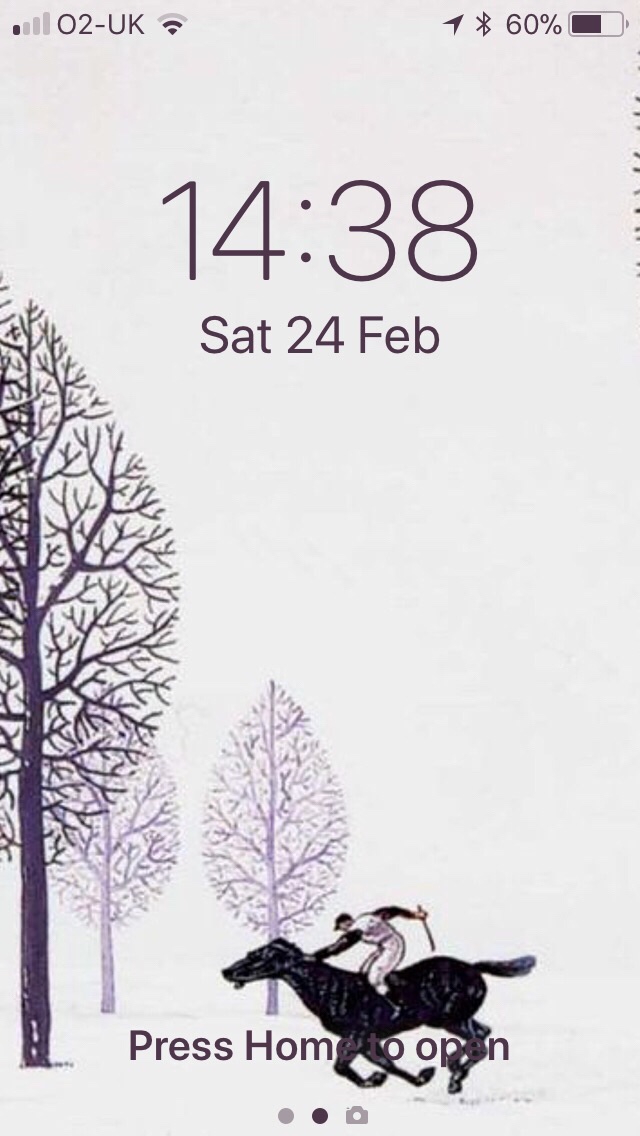
Maybe the dashing jockey on my screensaver is learning to enjoy the ride.

The Midlife Crisis

Of course we’re all ultimately barrelling towards the abyss; but there’s something about the middle of life that starts you thinking about it…

The ancients, the Stoics, the Buddhists; even the most whacko Californians all agree: at least half of the purpose of philosophy is to cope with our own mortality. And that need kicks-in big time around half-way through.

Elliot Jacques coined the phrase ‘midlife crisis’ in his 1965 paper Death And The Midlife Crisis. And MIT philosopher Kieran Setiya has had a proper go at really thinking about what it is and what to do about it, in this terrific podcast from the ever wonderful series Philosophy Bites.

The essence of his advice lies in giving up ‘telic’ living: the life focused on ‘projects’ and achievements. Defined by their completion: projects, achievements and ‘bucket lists’ are either constantly being consumed or are eluding you – increasing the feeling of time running out.

Instead the focus needs to be on ‘atelic’ living; enjoying ‘categories’ of activity and the process of doing them. It’s about enjoying philosophy, not ticking off the great philosophers; listening to classical music, not methodically completing the works of Beethoven; enjoying really looking at Art not consuming, categorising and collating it…

One approach endlessly pursues endpoints; of which and there is an infinite supply versus a finite amount of time. The other enjoys the time there is, in the doing of enjoyable things; not just the completing of them.

It’s a subtle thing; often the identical activities, but with a slightly different mental approach – enjoying the journey, not racing to complete as much as possible before the end.

What I’d spend a $billion on…

There is so much that is shocking about this book; I almost can’t begin…

West Coast life is a million miles from South-East London; but there’s something in the heady mix of crazy diets, dotcom startups and whopping egos which makes Tools of Titans a veritable page turner… albeit I have it on Kindle so no one can see I’m reading it!

In fairness, author Tim Ferriss says right up the front that not all of it is for everyone. But I have to say I’ve picked up five or six things from the lists, watchwords and obsessions of the featured folk which are actually rather transformational.

Five rep weights, Kettlebells, cracking down on carbs, single ‘golden’ rules and (in an otherwise toxic chapter featuring a right old narcissist) a moment of clarity on the thing I’d spend a $billion on – if someone gave me $1bn to change the world… I’d promote Learned Optimism à la Martin Seligman.

Optimism – and crucially the fact you can indeed ‘learn’ it – is perhaps the single most important thing I’ve discovered in my adult life. Shame I didn’t find that out until just under two years ago!

Everything improves with optimism. Well worth remembering given the state of the world in 2017.

So here’s to 2018; a shiny new optimistic year. And thanks to Tim Ferriss for reminding me.