Concrete or Casuistry?

img_1472

casuistry (kazjʊɪstri) noun: the resolving of moral problems by the application of theoretical rules.

As I continue my voyage through Dietrich Bonhoeffer’s Ethics, I also continue to be astonished by the man. Limpid paragraphs of dense and pure meaning, sweeping historical context – and tub thumping Christianity. A heady mix.

But the page which stuck with me this week describes the challenges of Christian ethics; but also the constant challenge of modern organisational life:

“The attempt to define that which is good once and for all has always ended in failure. Either the proposition was asserted in such general and formal terms that it retained no significance as regards its contents, or else one tried to include in it and elaborate the whole immense range of conceivable contents, and thus say in advance what would be good in every single case; this led to a casuistic system so unmanageable that it could satisfy the demands neither of general validity nor of concreteness.”

Pretty much every strategy exercise or major organisational change programme I’ve ever worked on has wrestled with this. As Bonhoeffer puts it, the conflict between the ‘good’ and the ‘real’.

Bonhoeffer argues for concrete not casuistry. Not a bad place to go, not least given how bad things were in his times. But I go with Aristotle’s ‘golden mean’; the ‘good’ is always somewhere in the difficult and constantly contested place in between.


Nostalgia

img_1923

Turns out Nostalgia ain’t what it used to be…

Traditionally associated with wallowing in a rose or even sepia-tinted past; nostalgia has a bad reputation for losing us in misty-eyed escapism to a lost time that never really was.

I’ve always believed nostalgia was a thing to avoid; at best a source of melancholy and at worst downright sadness. But not so according to the New Scientist:

First described by Johannes Hofer in 1688, the word nostalgia comes from the Greek nostros, to return home, and algos, meaning pain. Hofer observed it as a disorder of homesick Swiss mercenaries stationed in Italy and France… a disease which whose symptoms included weeping, fainting, fever and heart palpitations. He advised treatment with laxatives, narcotics, bloodletting or if nothing else worked sending the soldiers home.

As recently as 1938 the New Scientist continues:

It was described in the British Journal of Psychiatry as “immigrant psychosis”: a condition marked by a combination of homesickness, exhaustion and loneliness.

However, in the last two decades nostalgia has been recognised as an emotion found in all cultures; a mix of happiness and longing. Its bittersweet nature is apparently “unique but universal” – and most of us experience it at least once a week!

Why?

One theory the New Scientist offers is that nostalgia gives us a sense of continuity in life: “Nostalgia reminds us we are the same person we were on our seventh birthday party as on our wedding day and at our retirement celebration.” 

It turns out nostalgia is an antidote to loneliness; not its cause. It lifts us when we are feeling down and boosts well-being. 

And it helps you cope… less nostalgic people feel less connected to others, that life has less meaning, are less likely to seek help from others and deal with loneliness less effectively.

Whereas: “reflecting on nostalgic memories boosts optimism and leaves people more inspired to pursue their goals.” Wow! What’s not to like?

Music is a particularly effective summoner of nostalgia by all accounts (explains my blog about Teddy Mac, Alzheimer’s and Sinatra’s: “You make me feel so good”).

So yesterday I tuned into Absolute 80s on the radio for some teenage kicks, and sent my folks some BFI black and white archive videos of our home town. I used to think that sort of thing might drive them to melancholy; not now.

I’m embracing and prescribing a regular dose of nostalgia – rose tinted spectacles all round!

Unforgettable

Thinking back to my youth, I remember the sounds and smells of a steam-filled Sunday Roast kitchen at a great pal of mine’s house. Lamb, gravy, two types of potatoes and usually two pudding pies; fit for a King. 

And always in the background there’d be Nat King Cole, Sinatra and Louis Armstrong on the radio. 25 years on and that era of music always transports me back to a Lancashire kitchen.

Bittersweet then to hear of Teddy Mac (above) the ‘Songaminute man’ who at 80 has advanced Alzheimers, but still belts out a show tune in the car with his son, like in his holiday-camp pomp as a Butlin’s redcoat. 

Terry Jones the former Python has gone the same way we learn this week. And there but for the grace of God go us all.

But the uplifting story of Teddy Mac – whilst clearly no fairytale for his family – at least reminds us that the best memories and probably the most durable are often the simplest: a great tune, a tasty meal, a happy moment.

I’ve bought his rendition of “You make me feel so young” on iTunes; it makes me smile, and the proceeds go to Alzheimers research. I’ve also bought a copy for my pal, whose mum’s kitchen I’m sure I heard it in – it brings back happy memories.

Listen to You Make Me Feel So Young – Single by Teddy Mac – The Songaminute Man on @AppleMusic.


Water, Work and Eels 

Crossing Waterloo Bridge – against a tide of people walking to work – the thought came to me: how much in food, cars, goods and services have I and each of these people consumed so far in our lives?

And how much would that all add up to (by volume) if you piled it all together? 

And further; would it be greater or lesser in size than some of the buildings and landmarks, which make Waterloo Bridge the best view in London?

How many people’s piles of lifetime consumption would it take to fill a flat in the block on the south-west approach to Waterloo Bridge? 

How much to fill one of the South Bank theatres or galleries? How many people’s piles to fill County Hall or The Shard?

Then if you think about it in terms of the elixir of life itself – water – from which all that consumption is derived: either directly, or through steam turbines and factory processes; what would all that stuff we’ve each consumed translate into, by volume of water? It’d be huge.

And that’s just the thirty, forty, fifty odd people walking towards me on the bridge. What about all 30,000 or so in the university I help run? Or the city I live in? Would the 10-13m people of London be greater or lesser, by volume of water consumed, than the volume of all the buildings we all inhabit in London? 

And how much water directly or indirectly went into the power, people and materials that built all those buildings..?

But then I’m over the bridge, and into yet another meeting, and working life kicks in… The benefit of a job which makes you walk though, is the frequent gift of time to contemplate. 

And the benefit of a job which is about ‘keeping the show on the road’, is you don’t have time to worry about stuff too much – I’m incessantly busy: fixing and sorting and organising; and walking!

All of this adds to the growing sense that much water has now passed under the bridge of my life. 

And talking to people who are older than me, there’s a lot to be said for letting go of some of the things which have subtly driven me hitherto. That inner need to be ‘the youngest to do things’, ‘the hardest working’, ‘the best regarded’, ‘the most senior’; albeit I gave up on being ‘the best paid’ at least a decade ago.

Consumption and chasing more consumption; money and chasing more money, status and chasing more status – these are traps for the middle aged mind, soul and body.

So nice to have lunch this week with a splendid person I know, who is drawing, debating, walking and contemplating – and counting eels in the salty transitional waters of the Thames – a philosopher, cartographer, artist and citizen scientist in his first year of proper retirement. 

The river of life is long. Perhaps all those struggles to be ‘going places’ fractionally faster than the natural flow of things is – at this stage in life’s course – a genuine mugs game or maybe an eel’s.

Peace in our times


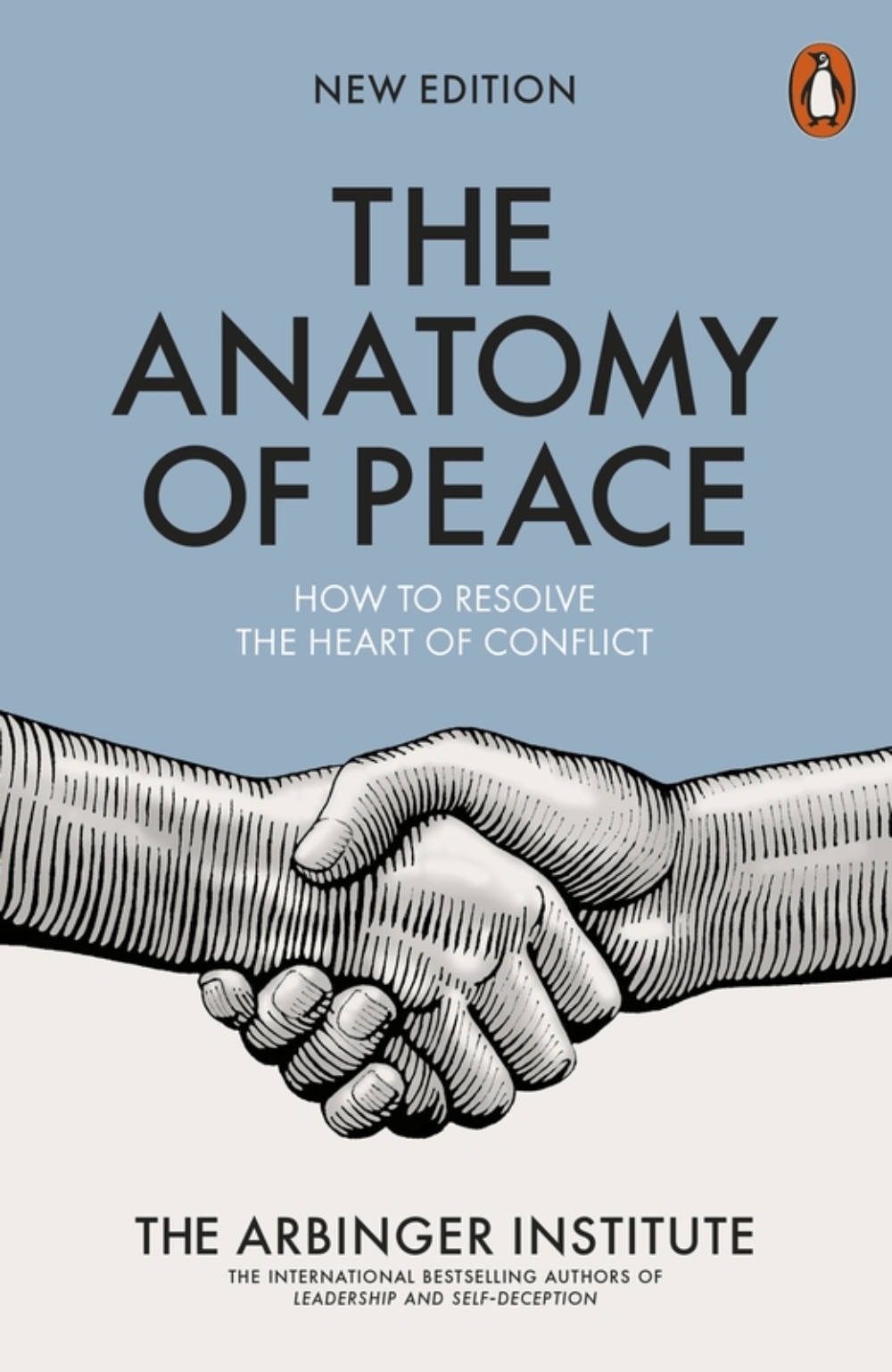
The Anatomy of Peace’ sounds a heavy read; and the fact it comes from the cultlike-sounding  ‘Arbinger Institute’ put me a little on edge… But I’d promised someone I’d buy it, so I did.

In essence it’s a simple thesis: 

1) We all spend far more of our time tackling things that are going wrong, than doing things to make them go better.

2) When people: co-workers, children, family members etc, resist our attempts to correct them, we combine increased coerciveness with talking them down – first in our heads, then increasingly out loud.

3) Once we start to coerce people and start talking them down, three things happen: 

a) they resist us all the more;

b) we demonise them in our minds and with other people to justify ourselves and our actions;

c) we increase our attempts to coerce them and talk them down further.

This focus on correcting, and the cycle of attempted coercion, self-justification, resistance, demonising and a hardening heart is everywhere, all around and at all levels – all the way up to nation states.

Heavy stuff.

What to do? There’s plenty that’s common-sense: listen more, build enabling relationships etc. But it all starts with the heart and stopping yourself getting into – and learning how to get out of – the downward cycle of correcting, coercing, hot and cold conflict and going to interpersonal war. 

I’ve tackled three difficult work situations with these new techniques this week; pitched battles, either in full-blown standoff or seething with cold professional anger. 

Tricky stuff. But acknowledging people as just that: flawed, frightened, angry and frequently frustrating; but first and foremost people, is the trick to developing a ‘heart at peace’ in the Arbinger jargon. 

And who doesn’t want a workplace, a home and a heart at peace?