Non Toxic

  
It’s hard work, but I feel like I’m making progress in my new job. And although I’m working flat out, people I’ve seen recently say I look well on it.

Of course people always say that. It’s pretty rare for someone to come out and say: “You look terrible”. But most of the people I’ve met from my old work, do say I look a lot happier now than I did there.

Which – given the large, in some cases huge and always myriad practical challenges in my new job – seems, on the face of it, quite surprising.

But, I as I said to someone this week; I think this simple chart explains it all:
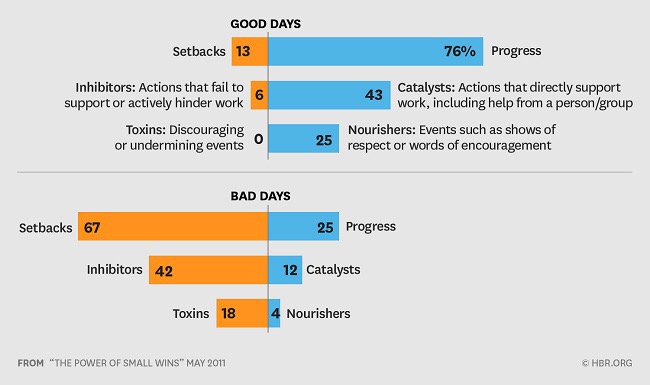
  

Albeit they happen, my current job is dogged by far fewer ‘toxins’ than my old one. 

It’s not all progress. Not everyone is a catalyst; there are plenty of inhibitors around.  But the big difference is there are far fewer ‘deliberately discouraging or undermining events’. 

What a relief – as another Harvard Business Review article pointed out this week, organisations should worry less about hiring ‘superstars’ and more about avoiding hiring ‘toxic people’. The benefits of stars are more than eclipsed by the cost of toxic folk.

But the problem in my old job was as much structural as personal; it’s hard work being close to government. All organisations have politics, but stating the obvious, government is all about politics – and that means ‘deliberately discouraging or undermining events’ are part and parcel of working in or with it. 

I discovered this week that for all the moans and grumbles, universities have one of the highest job satisfaction scores of all sectors of the UK economy. 88% of people who work in universities say: “this is a good place to work”; only 56% do in government.

Less toxins, more progress – that’s all it takes to keep me happy at work.

Office 2016


Further proof this week (were it needed) that not thinking about things, actually helps you think about things…

After ten days off for Christmas; scarcely thinking at all about work, I arrived in the office on Monday a little dazed and confused. A colleague asked with a smile if I had any blinding new insights to share? I could only answer slightly sheepishly “Nope”

But then, thanks to the miracle of the empty mind, I scribbled with a scratchy pen, on a couple of discarded misprinted sheets of A3 off the printer: the entire scope of my job; and the purpose for me at work for 2016. 

It had all became clear, because I hadn’t been thinking about it…

Later that same day (at bedtime to be precise) the few remaining work-related knots in my head, were smoothed out by a simple but super article in ‘Philosopy Now‘ by Peter Adamson. 

Adamson reminds us that Aristotle gave us the clinching argument against “the proposition that the good life lies acquisition of wealth.” 

He continues: 

Whatever else we say about the happy life, happiness is surely something we deserve for its own sake. You don’t seek to become happy for some further goal. 

Money by contrast, is not something that can sensibly be desired simply for itself. It is valued only for what we can acquire with it, such as security, pleasures and the opportunity to show virtue. 

Therefore a life that seeks to pile up wealth with no other end in view is incoherent.

He continues 

Aristotle has a similarly persuasive case to make against the life devoted to honor: we wish to be honored not just for any old reason, but because we deserve to be honored. 

At most, then, honour comes as a kind of bonus on top of what we really want, which is to be or to have achieved something worthy of the honour.  

Out of the contenders for a happy life, that leaves the life of virtue. And virtue is complemented by pleasure, because the virtuous person takes pleasure in being virtuous; and by honor too, at least if one’s fellow citizens apportion honor rightly.

Of course Aristotle was nothing if not also practical: 

Although Aristotle insisted that the good life is the virtuous life, he cautioned that we need money as well. You can hardly hope to be virtuous without money, if only because generosity is a virtue: you need wealth to give it away.

Common sense also tells you that such things as health, a flourishing family, and friends, belong to the good life, and Aristotle wasn’t against common sense on this score. 

But it’s Adamson’s conclusion which is the clincher:

In these days, when whole countries are faced by economic disaster, ancient advice remains useful: accept money and use it wisely when it comes, but do not sacrifice virtue to get it – and remember that there are things in life compared to which money, in any currency, has zero value.

In sum, don’t seek money or honour for their own sakes; and if they come as a by-product of hard work and a good character, use them wisely.

A timely reminder for 2016 from Adamson that Aristotle’s Ethics are a more than decent guide to working (as well as wider) life.


Amiet, Bruegel and Christmas

An unprecedentedly mild December set me searching for snowy scenes… in the lull between the twin peaks of festive excess, which are Christmas and New Year’s Eve.

The chance to spin my wheels is a rare one; but I have put it to good use: a splendid Lego Millennium Falcon is built for my son, turkey soup has been slurped by all and I have a birthday jigsaw belatedly on the go. 

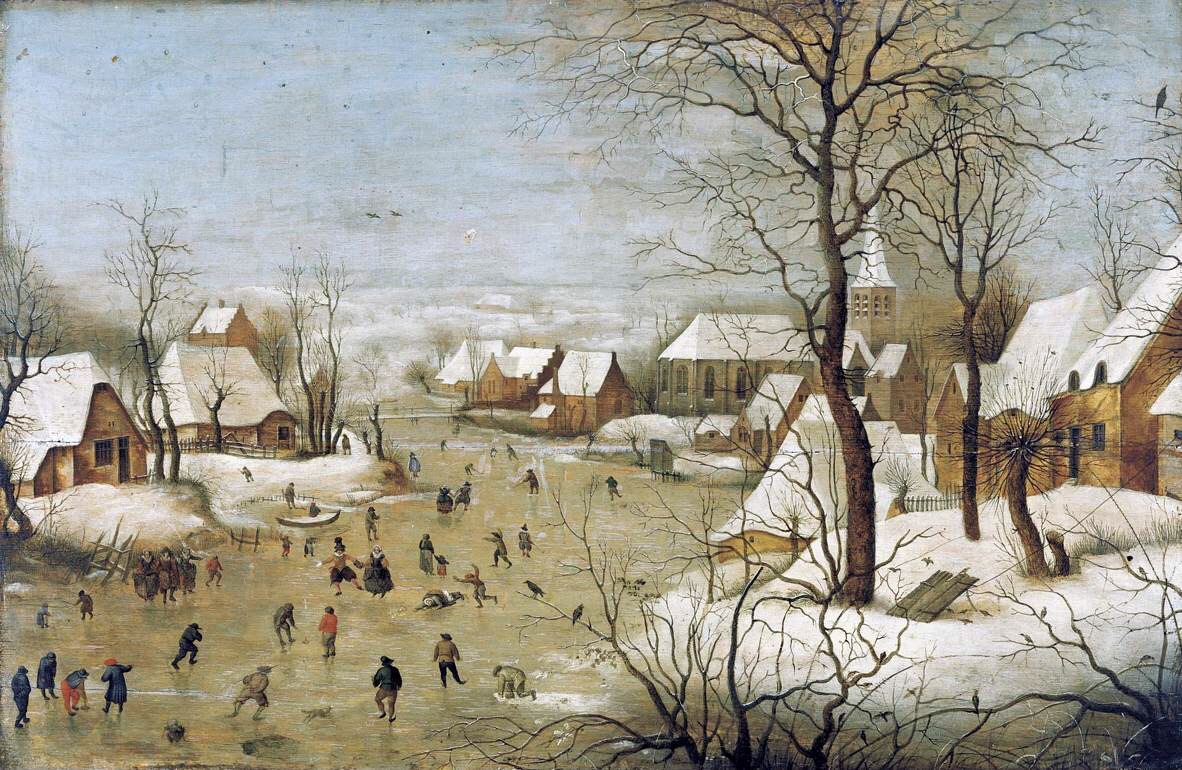
But the post-Christmas peace will be short lived. Soon I will be pressed into activity and jollity, like the skaters in the younger Bruegel’s “Bird Trap”.

   
And once that is done, it will be back to work, fitting more people into less space in the manner of his father’s “Census at Bethlehem”.

  
So I’m enjoying my rare day of solitude. This expanse of white is by Swiss painter Cuno Amiet. It’s his 1904 “Snowy Landscape” discovered on the ever wonderful DailyArt App

  
The tiny figure looks lost. But on closer inspection he (although it could be a she) seems to have a sense of purpose about them. 

The chance to have a mind as blank as Amiet’s snows is a treat indeed – as is cooking up leftovers and piecing together my New York skyline jigsaw in glorious, if temporary solitude.

Still, returning to Brueghel’s “Bird Trap”, no-one would choose an entirely solitary life… As Aristotle famously said.

  
The thin string to the tiny dark window is a reminder that neither poor nor alone, I’m very lucky to have food, friends and family all around at Christmas.

Warp Speed

  
I have been working at a zillion miles an hour this week. An 11 hour day thrown in on Wednesday and still in the office well past 7pm on Friday. 

Loads of people work long hours but it’s about intensity too; emotional and mental effort. And I gave it all this week. 

It can be exhilarating – you feel like you’re zooming along. But smart it ain’t. There’s nothing like working at ‘warp speed’ for making small errors, big mistakes and cocking things up. 

Note to self: I need to turn off the hyperdrive this weekend, and choose a different tempo next week… Too much exhilaration leads to rapid exhaustion; steady as she goes.

Wood for Trees

click for the detail

I’m not a huge one for detail. Not that I don’t notice things; just that I’m more interested in the bigger picture and the human dynamic these days.

It turns out my psychometric profile (in the jargon) always has one big question in mind: 

Will this work?

So I’m mostly only interested in the details which guide the answer to that question: is this a good idea, is it do-able, are people likely to go for it, can I get my bit of it done?

That means I tend to want to break big problems down into smaller ones; ‘chunking up’ (also in the jargon). 

So what is murderous for me?  

Impractical idealists, detail-minded questioners and incessant talkers… I need time and space to think and I like people who take the time to listen – as my finest friend did this week.

As the old song goeseverybody’s talkin at me’ at the moment. But the good news is, I cope better with it these days than I once did. I’m better at seeing what matters; and what I just need live with.

Which brings me onto my remarkable factiod of this week – why is the night sky dark? 

If the universe is infinite and full of an infinite number of stars, the night sky should be saturated with starlight. But it isn’t…  Roger Barlow explains all on The Conversation

Imagine you are deep in a forest. All around you there are trees. Wherever you look, you are looking at a tree. Maybe a big tree close up or a bunch of small trees further away. 

Surely it should be the same with stars. We’re deep in the universe and whatever direction we look in, there ought to be stars there – billions and billions and billions of them. You would have thought that they’d fill the whole night sky, with the more distant ones fainter but more numerous.

The reason the night sky isn’t just a blaze of light is because the universe isn’t infinite and static. If it were, if the stars went on forever, and if they had been there forever in time, we would see a bright night sky. The fact that we don’t tells us something very fundamental about the universe we live in.

A limit to the universe may seem a natural explanation – if you were in a forest and you could see a gap in the trees, for example, you might surmise that you were near the edge. But it’s dark on all sides of us, which would mean not just that the universe is bounded, but that we’re in the middle of it, which is pretty implausible.

Alternatively, the universe could be limited in time, meaning that light from far-away stars hasn’t had time to reach us yet.

But actually the explanation is neither of these. Light from the far-away stars gets fainter because the universe is expanding.

Edwin Hubble discovered in 1929 that distant galaxies and stars are travelling away from us. He also found that the furthest galaxies are travelling away from us at the fastest rate – which does make sense: over the lifespan of the universe, faster galaxies will have travelled further.

And this affects how we see them. Light from these distant, fast-moving galaxies and stars is shifted to longer wavelengths by the Doppler effect. In the case of these stars, the effect shifts visible light into invisible (to the human eye) infra-red and radio waves, essentially making them disappear. 

The blackness of the night sky is direct evidence of an expanding universe.

Fascinating – a fine example of seeing the wood for the trees.