Optimism Epiphany


I’ve had an epiphany. It all comes down to three Ps; and avoiding learned helplessness

First discovered in dogs and then in humans, Wikipedia takes up the strain here:

Research has found that human reactions to a lack of control differ both between individuals and between situations. For example, learned helplessness sometimes remains specific to one situation but at other times generalizes across situations.

An influential view is that such variations depend on an individual’s attributional or explanatory style. According to this view, how someone interprets or explains adverse events affects their likelihood of acquiring learned helplessness and subsequent depression. 

For example, people with pessimistic explanatory style tend to see negative events as permanent (“it will never change”), personal (“it’s my fault”), and pervasive (“I can’t do anything correctly”), are likely to suffer from learned helplessness and depression.

If you want to bounce back fast from setbacks and beat the blues, Martin Seligman’s book and the thesis of learned optimism are well worth a read. It’s certainly working for me. 

I’m ruminating less, and actively breaking up permanent, pervasive and personal interpretations of bad situations when I hit them…

I’m regularly reminding myself: 

“It’ll pass”, “it’s just one part of my life”, “it’s not me that’s causing this.”

And directing myself – and others – toward action, not helplessness: 

“Ok but what can we do about it right now”,  “OK if we can’t fix that, what else can we fix” and “if anyone is going to make this better we can, so let’s have a go.” 

I feel a lot better, and people around me do too. It transpires the main benefit of pessimism is you predict the future better. 

Optimism might help change it.

Habit Forming

  
Is the great Greek wrong on this one… 

I stumbled across  an interesting article in Time – (it quoted an academic from my place of work) which suggests he might be:


So what are habits, really? According to Dr. Benjamin Gardner, a psychologist focusing on habit research at King’s College London, “habit works by generating an impulse to do a behaviour with little or no conscious thought.” Habits are simply how the brain learns to do things without deliberation. These impulses can be put to good use, but only certain behaviors can become habits.

Building a habit is relatively simple — just harness the impulse. For new habits to take hold, provide a clear trigger, make the behavior easy to do, and ensure it occurs frequently. For example, by completely removing unhealthy food from my home and eating the same thing every morning, my diet became a healthy habit. I extracted the decision making process out of what I eat at home.

However, if the behavior requires a high degree of intentionality, effort, or deliberation, it is not a habit. Although proponents of habits tout them as miracle cures for doing things we’d rather not do, I’m sorry to say that’s snake oil. All sorts of tasks aren’t habits and never will be. By definition, doing things that are effortful aren’t habits.

Unfortunately, this means behaviors that require hard work and deliberate practice aren’t good candidates for habit-formation. For example, although I make time for it every day, writing is not a habit. Writing is hard work. If I waited for an “impulse” to write, I’d never do it. To get better at writing requires concentration and directed effort to make sense of the words as they go from the research to my head and then to the screen. Similarly, lifting weights isn’t a habit because getting stronger requires working harder.

So if these type of behaviors aren’t habits, what are they? They’re routines. A routine is a series of behaviors regularly practiced. Routines don’t care if you feel an urge or not, they just need to get done. When I finally realized I would never succeed at making going to the gym a habit, I began looking for how to establish a routine instead.

This makes sense, when you think about it. I’ve read elsewhere that as much of 40% of the time we are doing things which have become habitual and have no conscious deliberation – we are on Autopilot.

This suggests three things – all of which I’m trying… Make boring but useful things a habit (taking my vitamin D for example); make things which take some effort but are good for me into a routine (write a blog every Saturday); and more counterintuitively – make sure things which are supposed to be enjoyable, don’t become a habit. 

Why? Because once you stop thinking about them, you’re no longer consciously enjoying them. Not having a drink on Monday or Tuesday has become a habit (good). So sometimes sharing a bottle of prosecco with my other half on a Wednesday, has become a treat (need to be careful it doesn’t become a habit though…)

It’s worth reflecting on what you want to do without thinking, what you can’t do without thinking and what you enjoy doing – and need to think about to consciously enjoy. 

Habits aren’t conscious. They may help to make us excellent; but our best and most enjoyable work and experiences require conscious effort. 

I’m sure Aristotle would buy that.

Joy


I’m not big on joy – more steady progress, appreciation, a bit of peace… Joy is one of those ‘hot’ emotions, which can feel like it’ll just cause me bother or be too much like hard work.

So imagine my surprise (having been dreading it for weeks) to be utterly joyful last evening, at a work event. 

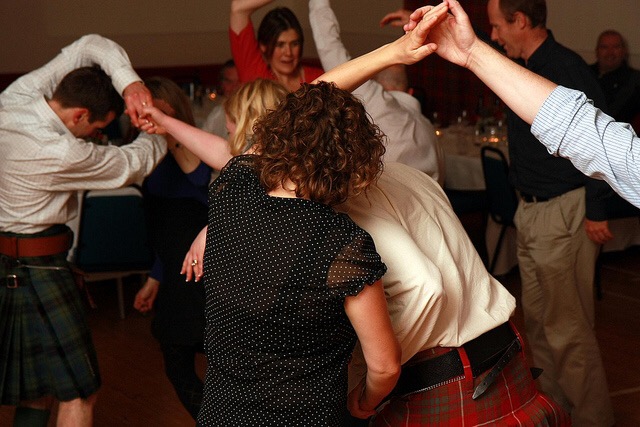
We had a ceilidh which involved 90 minutes of lung-busting jigging around bumping into each other; swinging folk you hardly know around, ‘stripping the willow’ and prancing like the ‘gay Gordons’. 

I had a spill and hit the deck, as we sought to spin our foursome fast enough, for the two ladies to take off and fly with centrifugal force. I then nearly re-enacted the Large Hadron Collider with a Greek particle physicist in some poorly-coordinated galloping. What a laugh. Everyone finished hot, flushed, sweating and beaming. 

The last time I remember everyone beaming like this at my work, was at an awards night when the staff choir brought the room to life. And this has set me thinking…

I’ve been listening to Bach’s passions this week – and perhaps there’s something to be said for a bit more joy. Singing, dancing, music, performance; they’re as old as the hills. But they still make life feel worth living. Here’s to joy.

Warp Speed

  
I have been working at a zillion miles an hour this week. An 11 hour day thrown in on Wednesday and still in the office well past 7pm on Friday. 

Loads of people work long hours but it’s about intensity too; emotional and mental effort. And I gave it all this week. 

It can be exhilarating – you feel like you’re zooming along. But smart it ain’t. There’s nothing like working at ‘warp speed’ for making small errors, big mistakes and cocking things up. 

Note to self: I need to turn off the hyperdrive this weekend, and choose a different tempo next week… Too much exhilaration leads to rapid exhaustion; steady as she goes.

Wood for Trees

click for the detail

I’m not a huge one for detail. Not that I don’t notice things; just that I’m more interested in the bigger picture and the human dynamic these days.

It turns out my psychometric profile (in the jargon) always has one big question in mind: 

Will this work?

So I’m mostly only interested in the details which guide the answer to that question: is this a good idea, is it do-able, are people likely to go for it, can I get my bit of it done?

That means I tend to want to break big problems down into smaller ones; ‘chunking up’ (also in the jargon). 

So what is murderous for me?  

Impractical idealists, detail-minded questioners and incessant talkers… I need time and space to think and I like people who take the time to listen – as my finest friend did this week.

As the old song goeseverybody’s talkin at me’ at the moment. But the good news is, I cope better with it these days than I once did. I’m better at seeing what matters; and what I just need live with.

Which brings me onto my remarkable factiod of this week – why is the night sky dark? 

If the universe is infinite and full of an infinite number of stars, the night sky should be saturated with starlight. But it isn’t…  Roger Barlow explains all on The Conversation

Imagine you are deep in a forest. All around you there are trees. Wherever you look, you are looking at a tree. Maybe a big tree close up or a bunch of small trees further away. 

Surely it should be the same with stars. We’re deep in the universe and whatever direction we look in, there ought to be stars there – billions and billions and billions of them. You would have thought that they’d fill the whole night sky, with the more distant ones fainter but more numerous.

The reason the night sky isn’t just a blaze of light is because the universe isn’t infinite and static. If it were, if the stars went on forever, and if they had been there forever in time, we would see a bright night sky. The fact that we don’t tells us something very fundamental about the universe we live in.

A limit to the universe may seem a natural explanation – if you were in a forest and you could see a gap in the trees, for example, you might surmise that you were near the edge. But it’s dark on all sides of us, which would mean not just that the universe is bounded, but that we’re in the middle of it, which is pretty implausible.

Alternatively, the universe could be limited in time, meaning that light from far-away stars hasn’t had time to reach us yet.

But actually the explanation is neither of these. Light from the far-away stars gets fainter because the universe is expanding.

Edwin Hubble discovered in 1929 that distant galaxies and stars are travelling away from us. He also found that the furthest galaxies are travelling away from us at the fastest rate – which does make sense: over the lifespan of the universe, faster galaxies will have travelled further.

And this affects how we see them. Light from these distant, fast-moving galaxies and stars is shifted to longer wavelengths by the Doppler effect. In the case of these stars, the effect shifts visible light into invisible (to the human eye) infra-red and radio waves, essentially making them disappear. 

The blackness of the night sky is direct evidence of an expanding universe.

Fascinating – a fine example of seeing the wood for the trees.