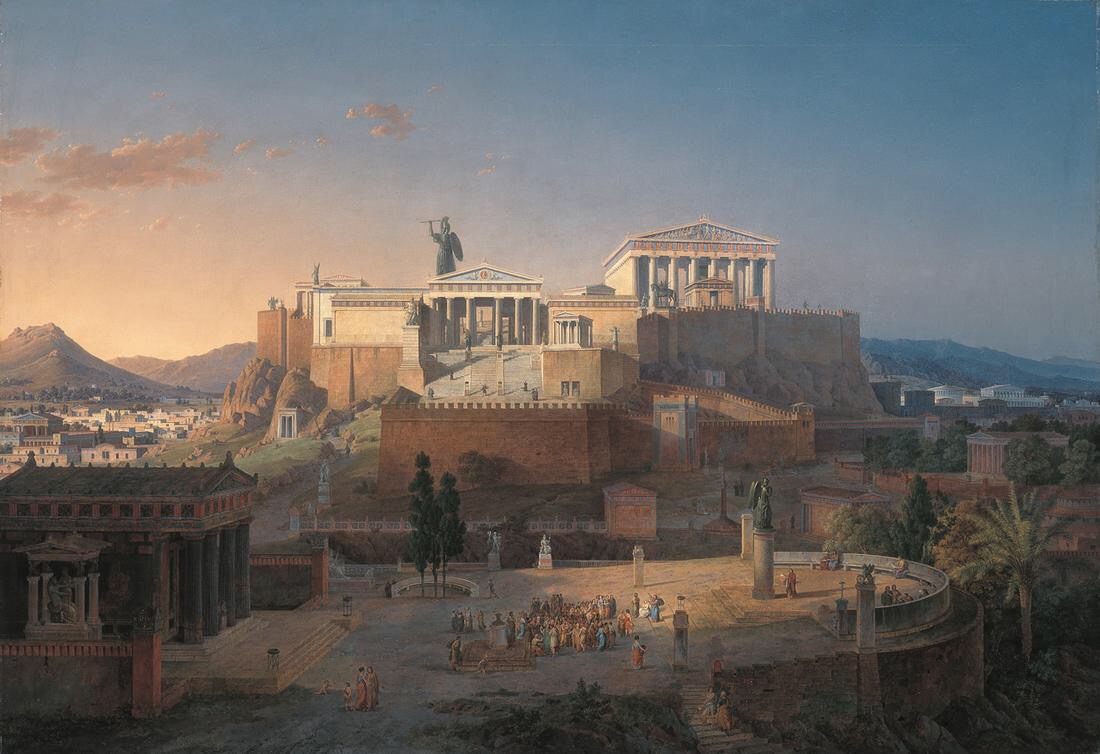
σοφία


As modern Greece struggles with its economic problems, it’s worth remembering: there isn’t a decent concept for living we don’t have the Greeks to thank for.

With help from Wikipedia, try: 

Prohairesis – προαίρεσις

The ‘moral character’ or prohairesis, was brought to the world by Aristotle in the eminently readable Nicomachean Ethics (which first inspired this blog five years ago). Prohairesis is the capacity to reflect, and not be carried away by what our senses serve up.

For the stoic Epictetus, life is all about prohairesis; separating what we experience from how we choose to feel about it:

“Remember that what is insulting is not the person who abuses or hits you, but the judgment that these things are insulting.”

“So when someone irritates you, realise that it is your own opinion that has irritated you. Try, therefore, in the first place, not to be carried away by the impression; for if you once gain time and respite, you will find it easier to control yourself.”

Prosoche – προσοχή

In the Platonic Academy, prosoche referred to the discipline of “attention” – noticing the judgements that we make about ourselves and the world. 

Once observed, the next step is observing whether or not these judgements are in ‘conformity’ with the reality of our situation; and correcting them as needed so as to maintain appropriate behaviour and equilibrium (ataraxia). 

Prosoche is broadly equivalent to the Buddhist disciplines of ‘mindfulness’ as developed through meditation.

A Greek ‘prosoche’ poem sums it up: 

Give me the Serenity to accept
the things I cannot change,
the Courage to change the things I can,
and the Wisdom to know the difference.

Areté – αρετή

For Aristotle, bravery is the first virtue. It came up at work this week. 

It is, quite simply, consciously choosing to walk the difficult tightrope between fear and courage:

“A brave man is one who faces and fears what he should for the right reason, in the right manner and at the right time. A brave man performs his actions for the sake of what is noble. Those who err by excess with regard to this virtue are called rash, but one who is exceedingly fearful is called a coward.”

“Men who show courage because they are optimistic and they think they will win are not brave, because they do not act for the right reasons, and when the situation does not turn out well, they end up being cowards.”

“Men who are ignorant of danger are also not brave, but only appear to be so because they have no knowledge of the danger.”

Prohairesis, Prosoche and Areté: character, consciousness and choice, all come together in sophia σοφία; the title above, and Greek for ‘wisdom’ – the root of philosophy φιλοσοφία philo-sophia.

Whatever the state of their οἰκονομία (economy), Greeks deserve our enduring thanks; for all they invented in the life of the mind.

Stop Hoovering

  
I knew this (or at least I kind of did) but a line in a book has recently kept it on my mind… ‘Mood’ is more a matter of biochemistry than anything else.

In the right mood everything is possible: ingenuity, problem-solving, creativity and joy. In the wrong mood, it’s all too much; all too hard and nothing can be done.

Win the lottery, lose your job, whatever happens most people’s underlying ‘mood’ ticks along remarkably unaffected; so long as you let it. Apparently only bereavement really affects mood for extended periods. It seems we can’t short circuit grief.

So ‘mood’ in fact, is not really about how happy, fulfilled, successful, busy or creative we are. It’s about noradrenaline, serotonin, cortisol and melatonin. These operate in an internal chemistry set, controlled by the limbic system – which is pretty much the same as in a bear, a monkey, a cat or a dog.

The limbic system is very resilient, very effective and very old – crocodiles have one. But it needs looking after. Apparently if you stress it to much, it chemically crashes and puts you into a state of hibernation. Literally. 

My book says the physiological symptoms of stress-related depressive illness are best understood, as exactly what happens in a bear’s body when it prepares for hibernation…
  

Why? Because the limbic system interprets the signals from the environment as too ‘hostile’, and that same old system kicks in: which enables a crocodile to lie dormant in mud for months; or a bear to hole up in a cave. We shut down; to wait for better days.

And here’s where the Hoover comes in. Because if you’re working yourself to the point your limbic system is about to blow a fuse – you have to stop; however exhilarating is the sense of achievement of getting more things done, or however great the pressure to do even more.

The test for hard-working diligent people is this; literally and metaphorically can you sometimes ‘leave the Hoover in the middle of the room’..? That is, can you visibly leave half-finished a task, you and people around you expect you to finish? 

Ouch, guilt and fear of humiliation – that hurts…

Because if you can’t – and you don’t listen to your body and look after your mood, there’s only one place you’ll end up…. shattered, flat and feeling like hibernating. 

This much I have learned in the past few weeks – if you want to avoid becoming a very grizzly bear, sometimes you have to leave the Hoover in the middle of the room.

Black Cat


Apparently human beings are easily fooled by coincidence – we are tuned for life in a Stone Age village, where not that much happened.

The maths of probability are skewed by the everyday experience of everything happening to us. As the precocious footballer Mario Balotelli is wont to say ‘why always me?’

Lady Luck is our constant companion, as we try to fit random events into a sensible narrative of what the blazes is happening to us. Studies suggest the gods (although not God) first sprang from here.

So how much of life is luck, how much is the luck you made – for better and for worse? Who knows. It all seems to makes sense looking back; but at the time…

Was it me, others, chance, caprice – or the hand of gods or God? Whatever and wherever you ascribe the credit or blame, like the handsome black cat who once stalked me for a fortnight, I have landed firmly on all four paws this week. 

Happy days.

Scrim Down


scrim: (noun) pronunciation /skrɪm/ Theatre: a piece of gauze cloth that appears opaque until lit from behind, used as a screen or backcloth: “a plain scrim for backcloth and good lighting are all that are needed.”

We all live in our own personal cinema. Much, if not all the time, the way we experience and interpret the world is based on the familiar script of how we view ourselves; played out against the cast of characters with whom we are surrounded. Sometimes the hero, sometimes a victim; it is often supremely hard to see beyond the daily soap opera which occupies our heads.

The late American psychologist Donald C. Klein has some interesting things to say on this, in his 2004 paper ‘Appreciative Psychology: An Antidote to Humiliation’:

“The scrim is a transparent curtain on which theater people paint scenery. When illuminated by footlights and spotlights from the auditorium to the stage, the scenery appears opaque. 

That scenery and the actors playing their parts on the stage in front of the curtain constitute “reality” for audience members. The curtain no longer is perceived as transparent. 

If, however, the scrim is lit from behind, the scenery fades or even disappears. The curtain now appears transparent and the audience can see through the curtain to a whole new vista of objects and people, that is, a new reality. 

It is as if each of us has a ‘mental scrim’ on which, from earliest childhood, we have been painting the scenery of our lives, literally millions of thoughts about ourselves and the world around us. 

When we are an ordinary state of being, we take these ideas very seriously and treat them as the only reality that is available to us. Under ordinary circumstances, this is the only reality of which we are aware. 

Under special circumstances, however – as, in my case, when I witnessed a beautiful sunset and experienced the awe and wonderment – our mental scrims become transparent. The clutter of thoughts about ourselves and the world fade or even disappear. We see through and beyond our mental scrims.”

It’s a lovely concept. If (to paraphrase Klein) you can regularly get beyond:

  1. how one imagines one appears to other people; 
  2. one’s imagination of other people’s judgment of that appearance; and 
  3. emotional reactions related to one’s sense of self…

…you are metaphorically, and sometimes literally laughing; as I was yesterday with a great friend, as we laughed and laughed at each other’s French phraseology.

If you feel the ‘mental scrim’ of the ‘millions of thoughts about ourselves’ and the soap opera of ‘one’s imagination other people’s judgements’ coming down, all you have to do to escape, is concentrate hard for a moment on looking through it. 

Reality is often full of little-appreciated beauty, joy, happiness and love which is simply masked by the vivid, all-consuming but largely psychological ‘light show’ playing out in nearly all of our heads, nearly all of the time. 

Donald Klein’s ‘mental scrim’ is worth thinking about; and regularly seeing through.

The Lost Jockey

IMG_3184-0.PNG

This week, I have adopted Magritte’s ‘Lost Jockey‘; I found him a home on my iPhone ‘lock’ screen.

Painted in 1948, the ‘Le jockey perdu‘ has lost his racetrack and is charging through an other-wordly sepia forest.

“Racing nowhere fast”, is what the jockey says to me. And that’s why I put him on my home screen. Sometimes I do things faster that than I should. Sometimes I try to do tomorrow’s work today. Sometimes I do good things, but don’t take the moment to enjoy them.

The jockey – whom I have to swipe with my thumb, to open up the brightly lit iPhone world of action, reaction, email, work, stimulation, art, literature, music, aggro and time commitments – has reminded me several times this week not to ‘swipe’ – just do the thing I’m doing; not start something else.

IMG_3177-0.PNG