Bowling along a sunny street today, with the hound and my AirPods in – a couple of ribald thoughts came to mind. I smiled inwardly.
And then what should boom out via iTunes shuffle but Handel’s ‘Hallelujah chorus’…
…And I smiled some more.
And he shall reign forever and ever
King of kings forever and ever
And Lord of lords
hallelujah
hallelujah
And he shall reign forever and ever
Forever and ever and ever and ever
Etc.
Stirring stuff.
And as I sang along in my head, I thought of my poor old ‘inner voice’ who I’ve been giving a hard time of late.
Ignored; in favour of mindfully contemplating my breath and feet and whatnot. Berated; for worrying and dredging up unhappy memories. Muzzled; from saying anything funny, spontaneous or inappropriate. Sidelined; in favour of endlessly listening to others, accepting their points of view (however unreasonable) and looking for common-ground.
My poor old inner voice feels a bit like King George III in the fabulous musical ‘Hamilton’, the under-appreciated autocrat to whom the people of America turn their back.
So, even though my ‘internal King George’ is a right old pain sometimes, I’ve decided to give him a standing ovation today.
Pompous, opinionated, selfish, self-absorbed, self-pitying, sometimes petty and childish and often wrong, my inner voice is thoroughly Hanoverian at times.
And like the Georgian era it can be bawdy and rowdy; but also rational, curious and enlightened.
So here’s to my very own internal King George! A day of appreciation is in order; and an internal reprise of Hallelujah with the obligatory standing ovation to boot.
Hallelujah was written for George II, who set the trend by apparently spontaneously rising to his feet to applaud it on its first performance – although possibly by some accounts more because of pins and needles, gout or the simple desire to stretch his legs.
A bit like the Georgian inner voice – always up to something…
Unlike the gazelle who is straight back to grazing.
I tried it today.
Grumpy, hungry, feeling ‘got at’ and like my morning had been taken away from me, I leashed the dogs and went for a walk. And listening to Mark Williams, I realised all needed to do was stop thinking about it all, and get back to mentally grazing – in my case simply enjoying walking among trees and new growth in the spring sunshine.
Instead of firing red amygdala…
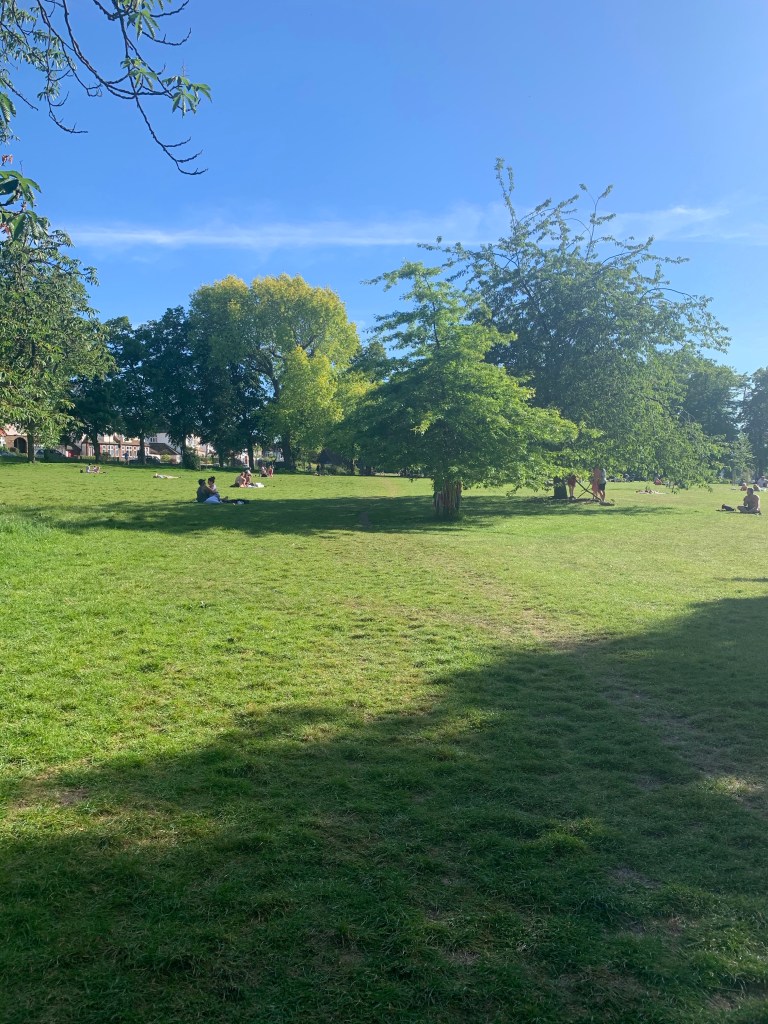
…I found myself enjoying a park walk filled with the colours of spring.
There’s more to life than fight and flight; but you have to stop thinking to find it.
For some time, I’ve noticed that people at the top of them can drive themselves and whole organisations to anxiety, stress and overwork; seeking answers to problems which just may not have one.
In computation there are many ‘undecidable problems’ where any possible computer program may give the wrong answer or would run forever without giving any answer at all. A ‘halting problem’ is one where you’ll never know if the program would end. Some of the questions I get asked at the moment feel like these – decidedly undecidable.
Basically these are problems to which there may well be no simple or knowable answers. Finding the answer could take an eternity (and a mountain of work) or continuing to pursue a better answer misses the moment and makes the situation worse.
Computer science advocates ‘Optimal Stopping’; in essence stopping the analysis early enough to get a resource efficient, computationally efficient, ‘good enough’ answer.
The lack of ‘Optimal Stopping’ in senior folk is bad at the best of times. But with Covid-19 it’s a killer – if you keep chasing and asking more and more questions, you just dive deeper and deeper and deeper into the abyss…
So why do otherwise very intelligent, experienced and senior people do it? Turns out because the very apparatus that made them senior – spotting, sweating and sorting problems – ends up torturing them and others.
They worry and worry and chase and question, and expose bigger and bigger gaps between what is known, what can reasonably be done and the problems we have at hand. They’re trapped in a negatively spiralling perpetual motion machine. Because that’s what the mind is – it has an unlimited capacity to spot problems.
That’s perhaps a bit harsh on the mind though; in fact it’s only doing its job… It’s just trying to help us close the gap between where we are and where we want to get to. And this works beautifully for projects which have a start, middle and an end or which require getting from A to B.
But where the problems start, are when we don’t know where we’re going or how we’re going to get there – or even if we’re on remotely the right road. Especially with the biggest problems of all: how to be happy and live a fulfilling life.
And according to Professor Mark Williams what works for ‘painting by numbers’ problems just makes things worse, when contemplating the complexities of your own self-portrait.
When we find a gap between where we are and where we wanted to be, the ever helpful mind starts trying to close the gap; by asking us questions and spinning at top speed to help us find some answers:
“Why am I sad, why am I failing, why do I feel bad, what can I do about it, how do I fix myself, how do I fix the world”.
It turns out – thanks to that stripy hippocampus – we are easily triggered into repeated patterns of thought by environmental cues. So much of what we think is triggered by our surroundings and situations. If you’ve been in a bad situation before, just being in the same place or context can flip you straight back into the same spin again. Even different types of music can do it – apparently listening to Prokofiev’s Russia under the Mongolian yoke from Alaexander Nevsky at half speed can make you blue in double quick time!
But as well as environmental cues being triggers, so are our own moods. We can trigger ourselves. When we feel sad we can rapidly connect with other sad memories, and bring back negative incidents. As Kate Jeffrey explained, incidents which were stressful are deeply etched and tagged by the hippocampus into our memories.
And this links to the Oxford podcast on treatments, which explains the reasons people who’ve had depressive illness can relapse so readily. It turns out it is less the ‘content’ of the negative thoughts (although these thoughts create the exhaustion which drives the downward cycle) but the combination of contextual and mood-based triggers, which can flip the mind back in time in an instant – and recreate the cycle of past fears and past incidents that mean you’re quickly spinning, spiralling and falling again.
So what to do?
It turns out that the key is to spot the pattern:
The mind finds a ‘gap’ between your actual state and the desired state.
The mind starts searching for answers and starts asking you questions.
You hear the questions as criticisms or further evidence of the gap.
You start to think the gap may be permanent, pervasive and personal – it’s lasting, it’s going to affect everything and it’s your fault.
You step up an energy level, as the mind tries harder to help you close the gap; and repeat; and repeat; and repeat.
Anxiety and low mood kick in; and the cycle deepens.
Given the mind works at the speed of light this can be very fast, very intense and very exhausting. The bodily organ which consumes the most energy is the mind. No wonder people burn out and fall flat on their backs.
William’s treatment – our old friend mindfulness meditation… The only way to stop the cycle is to quickly recognise it, catch it before it spirals and ‘observe’ the thoughts – to avoid getting captured by them. The inner voice is always talking (and in fact always trying to help) but like a critical parent or a demanding boss, it can’t stop itself. You just have to take a breath and let it pass.
That’s why I’m back to mindfulness meditation as of today. I’ve had Williams and Penman’s book Mindfulness for years, and used to listen to the meditations a lot in the early 2010s. But I didn’t know the science then. For anyone with a lively mind it’s the best defence against depression; and we all need a bit of help right now.
I’m looking forward to tucking into their free Coronavirus resources here.
Out walking the dog, what should pop up on my podcast playlist than Keith Frankish on Philosophy Bites explaining why I was lost in thought, while the dog was 100% focused on the walk…
The difference between us is he lives in the immediate, whereas we spend a lot of our time elsewhere.
Why?
Frankish explains:
Consciousness is the distinctive feature of the human mind. Because a conscious thought is a thought about something that isn’t perceptually present. We can react to thoughts about the world detached from immediate perception.
So if we can do it, why can’t animals? Not least given we have ostensibly similar sensory apparatus and not massively dissimilar brains?
The crucial difference is we have language… Frankish’s proposal is that it is the presence of language that enables us to have conscious thought, not just conscious perception.
We don’t just use language for communicating with each other, we use language for communicating with ourselves; for stimulating ourselves in new ways, for representing the world to ourselves, for representing situations that aren’t actually real… situations that ‘might’ happen and this enables us to anticipate, to plan to prepare for eventualities that haven’t yet occurred.
He continues:
This, I think is the function of conscious thought. Conscious thought, I think, is essentially a kind of speaking to ourselves.
And by talking to ourselves we can mentally shift in time and space in ways which my trusty hound probably can’t. He’s a clever little chap – but apart from chasing bunnies and squirrels in his sleep (you can see his legs twitching as he runs them down) he’s a creature of the immediate present.
As Frankish explains:
We might say that one of the main functions of mind generally, in us and other animals, is to lock us onto the world; to make us sensitive to the world around us so we can respond quickly to changes to enable us to negotiate the world in a rapid and flexible way.
But Homo Sapiens has another trick…
The function of the conscious mind, I think is quite different. It’s not to lock us onto the world, it is to unlock us from the world – to enable us to consider alternative worlds, to consider what we would do if things weren’t as we expect them to be, to make plans for how we might change the world.
So this ability to step back from the ‘immediate’ and use language – talking to ourselves – to reflect on what is, has, might or will happen is what our unique combination of language and consciousness give us.
So far so generically interesting. But potentially even more interesting is how I’m going to try and use this insight…
Here are the mental steps:
Most of the bad things that are happening to me in work (and there are plenty) are made worse be me running over them in my mind.
Because I’m quite verbally dexterous I may be guilty of sharpening them in my inner dialogue to the point of exquisite pain.
Treatments may vary but nearly all (bar the most serious) respond to ‘talking therapies’ which aim to change the inner dialogue.
Mindfulness, which helps too, is all about turning off the ‘inner talking’ and returning to the moment – in effect locking back onto the world as a trusty hound would.
Although bad things are happening to me at work (as they are for most people right now) they are still not as bad as the versions in my mind (at least not all of the time) and most of them are anticipated and haven’t actually happened yet.
My inner voice is currently more negative and ruminative than is good for me.
And talking to other people makes it even worse.
So what to do?
Simple – switch language, and here’s why:
People in several different workplaces down the years have commented that I’m very cheerful and animated when I speak French.
I remember that when I used to live in France I couldn’t really do numbers very well in French; it’s like I was saying them in my head but the ‘numbers bit’ of my brain wasn’t properly engaging.
If I’m thinking about something terrible – like getting made redundant or making other people redundant it makes me feel really sad.
If I consciously think about the same thing in French, there is little or no physiological effect… it’s as if the ‘pain connectors’ aren’t there; I think it, but more slowly and not sadly…
Perhaps it’s because I have to work at it. I think more slowly, and my vocabulary is less ‘fine’ in French – but it seems the pain and sadness just isn’t there when I think the same thought in French. In fact it’s not really the same ‘thought’ at all, its more a daisy chain of words which register in the mind but aren’t ‘felt’ in the same way.
So based on Keith Frankish, when bad and sad thoughts crowd in, I clearly need to switch to Frankish – or French as we know it these days. Whenever I start ruminating or feel chest clenching anxieties about work I plan to try thinking about them in French to get them under control.
Let’s see if it works… And if not there’s always Italiano! Vive la France.
There’s a strange paradox about consciousness. On the one hand we tend to believe that it’s a completely private space; so I can never somehow get access to your consciousness and you can never get access to mine. On the other hand it’s the only part of our mental life that we can actually talk to each other about.
So what is it for? We like to think consciousness is in the ‘driving seat’, that we are ‘consciously’ making our decisions and choosing our actions.
But Frith points out that lots of psychology experiments show that consciousness seems to lag behind decisions and actions, rather than the way round we like to believe; which is driving and directing them. It seems a lot of what we what we do is automatic: driven by subliminal processes, autonomous brain processes, reflexes and the subconscious.
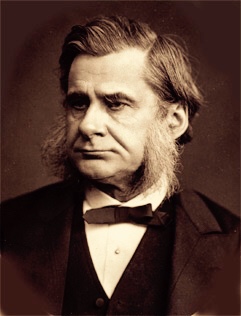
So what’s the point of it? The hard core view, Frith points out, is that consciousness is just an evolutionary by-product and has no actual ‘function’. As Victorian zoologist, biologist and anthropologist Thomas Henry Huxley said:
“Consciousness has as much function on human behaviour as the steam whistle of an engine has on the workings of the engine.”
But the fascinating alternative thesis Frith develops, is that the purpose and evolutionary benefit of consciousness is not to drive but to post hoc rationalise our actions. After all, as Frith says, the whistle might not affect the engine itself – but it certainly draws the attention of others.
And through a series of clever psychology and neuroscience experiments Frith shows that:
People recall things more accurately when they compare notes with others;
We change our subsequent actions based on our conscious (and often inaccurate) retelling to ourselves and others of why we did things.
Frith’s fascinating conclusion is the point of consciousness isn’t real-time decisions; it’s to reflect with others on what we (and they) did, and to learn from it – as highly social beings.
So rather than consciousness being the solitary business of ‘I think therefore I am’, its purpose is to help us reflect and explain – so we can navigate and learn from each other. Consciousness isn’t about being ‘locked in’ on our own – with Descartes’ evil demon – instead it has evolved to help us make our way in our social and sociable human world.
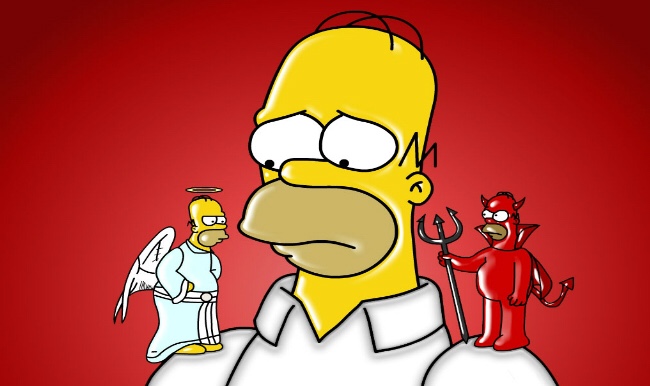
It turns out we seem to actually hover above and slightly behind what we do; rather than right in the thick of it. Perhaps consciousness is indeed the conscience on our shoulder.














 Achilles & Aristotle