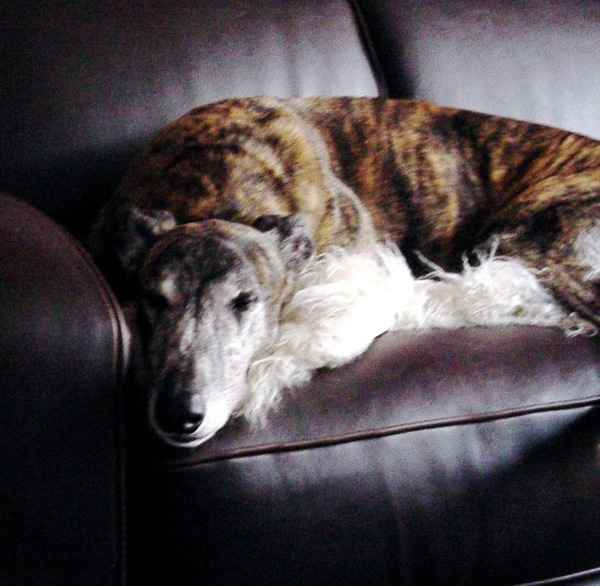
A Dog’s Life

20121014-181909.jpg

I’ve just finished ‘In Defence of Dogs’, a fascinating book on the evolution and psychology of our four-legged friends. Packed with insights, perhaps the most important is: they’re not half as complicated as we think they are.

That’s not to say dogs aren’t smart. But they proceed by ‘associative learning’ – always assume result b) follows directly from cause a) i.e. that which immediately preceded it.

Dogs, it seems, have no real capacity for introspection or to place events in the past – even the comparatively recent past. So shouting at them when they finally come back – or when you come back home and they’ve made a mess – just confuses them.

In the dogs head it’s “Smell x, smell y, hear shout from owner, bark, sniff, run around, bark, wag, return to owner – get shouted at.” The only associative learning possible from this is ‘Sometimes when I return to my owner I get shouted at.’

Dog owners project the full gamut of human emotions onto their dogs – guilt first and foremost. I did, Charles Darwin did, every dog owner does. But in fact there is no evidence dogs can feel guilt or can learn from it.

But they are hugely sensitive to humans and very attuned to us. So they can certainly tell when we’re not happy with them. What they can’t tell is why, unless it’s for the very last thing they did.

The capacity to appear ‘smart ‘ whilst lacking complex cognition is not a bad thing to have in mind for young kids too. We easily assume kids have fully featured introspection, a ‘theory of mind’ and the ability to think ahead. But a focus on the immediate and simple ‘associative learning’ is undoubtedly a big part of how kids are too.

My supersmart 8 year old daughter – on getting out of the bath last week – said: “Daddy, it seems to me that other people aren’t always thinking the same things that I am thinking.” “Indeed.” I said. “So how can I tell what other people are thinking” she asked? “That, my love”, I replied ruefully, “is the entire complexity of human life.”

On one level, it’s a bit sad to learn dogs can’t do complex emotions. It makes them seem a bit simple. But there is overwhelming evidence that dogs can – and do – do ‘happy’, ‘sad’ and most of all ‘love’.

And they reserve their deepest, most unconditional love for us – humans of all shapes and sizes, personalities and temperaments, faults and failings – their owners.

It’s a dogs life being scolded for stuff you can’t remember or understand. But what ‘In Defence of Dogs’ establishes beyond doubt is; we towering two-legged creatures are the centre of their world. We should aim to love them as much as they love us.

Plus ça change

20121006-200928.jpg

An article in the New Scientist suggests that the pace of human innovation may appear rapid for short periods, but over the longer term is generally quite slow. Why? Simple, we keep on forgetting things.

Apparently technological innovations are as prone to extinction as woolly mammoths and sabre-tooth tigers. More innovations and technical advances have been lost than kept through history – forcing the proverbial wheel to be re-invented many times.

Scattered populations, expertise confined to a few and lost records mean great ideas go missing. Indeed science has yet to find a way of ensuring everything we know today isn’t lost, when today’s digital memories and readers become obsolete.

There is evidence though, that the pace of discovery and innovation has indeed increased in recent centuries – due to words, books and libraries. Ideas are saved more easily thanks to greater population density and stronger networks for knowledge transfer – the Internet just being the latest and greatest.

But in recent decades it seems that some forms of innovation might actually be slowing down. How could that be?

One reason is young people have to spend so much time learning what has already been discovered, they have no time to think of anything new. Most schoolchildren will never get beyond 19th century physics and chemistry, as that’s what they’ll be tested on. But maybe a grounding in the ‘Great experiments’ isn’t such a bad idea. It’s certainly fun.

On a strangely reassuring trip down memory lane this morning, we went to look at a school for my son. A charming older boy showed us round a large campus with a nice well used, ‘lived in’ feel.

And memories of my own school days were reignited by the whiff of a Bunsen burner and two boys messing about in goggles with a tripod, gauze and beaker, setting fire to things in the chemistry lab.

Happy days. I remember Russell Cross’s wooden pencil case being surreptitiously filled with sulphuric acid and his pens and pencils dissolving nicely before he and the teacher could save them.

Then the occasion that entire back lab bench managed to change into their P.E. kit and retake their places – apparently attentive for a good five minutes – before being rumbled.

Finally the bungled experiment where nitric acid went in the beaker instead of hydrochloric, generating thick brown vapours and an evacuation – to general delight – as the potion was stuffed in the fume cupboard to boil off poisonously.

Each generation needs its turn at dissecting bull’s eyes, making hair stand on end with the van de Graaf generator and of course setting fire to things with Bunsen burners.

There may not be much scientific innovation but messing about in the lab is an important rite of childhood passage. In this safety conscious age many schools don’t let kids get ‘hands on’ with the old science favourites. I liked today’s school all the more for still letting them.

Chameleon

20120916-190545.jpg

I read this week that science has discovered when a lizard re-grows a tail – having dropped the original to escape a predator – what grows back is not the same. It looks the same. But the new tail has a cartilage tube instead of vertebra and very little sensation except at the tip. A pale imitation.

This reminded me of a conversation with a good friend on Friday – who’s looking very lean. What you expect to see conditions how you view what you are seeing. I saw ‘thin’, thought ‘he’s ill’ and started worrying. But on closer inspection he is actually in tip top shape.

We had our ’25 years on’ University reunion yesterday, along with ’40 years on’, ’50 years on’ and ‘past counting’. My year all looked older. Not a lot older – you’d still recognise us on the fresher’s photo. But inescapably older.

The classes of 1972 and 1962 though were in a different league – much much older. I couldn’t help wondering how we’ll see each other when we are that group. How much will we see each other’s age, how much will we still see the people we were aged 18?

Talking to folk I’ve not seen in years, I was surprised by what they expected from me. Of course everyone remembers you as you were, not as you are. I was famously grumpy, but I’m not now. It’s funny how people couldn’t quite cope with that. They all prefer the cheerier 21st century me, but couldn’t quite believe it.

What we expect to see conditions what we do ‘see’ even when all the evidence is to the contrary. People can look the same and be very different, look different but still be the same. I can still do grumpy, but I’ve found a happy colourful chameleon has more fun than a grumpy one.

Facts and Data

20120621-211207.jpg

Stone me, or rather half a stone me. It transpires that our bathroom scales couldn’t be more wrong. A combination of old age (theirs) and youth – the kids jumping on them – means they turn out to be massively misleading!

Looks like I’ve been convincing myself that my slightly wobbly belly was one step short of emaciation, when the truth is it’s half a stone of unnecessary blubber!

Like ‘faster than light’ neutrinos at the Large Hadron Collider, the measurements were wrong. My theory of thinness has been falsified by new experiments – the missus has bought some shiny new bathroom scales.

I’ve been following my own personal satnav into a bowl of empty calories. It’s amazing how we blindly follow instruments in modern life.

So the hard work of shedding the pounds begins. But like a good scientist, I’m mainly glad to have corrected my error. New data, new knowledge, new understandings. Bang go the ice creams this summer…

Sugar Solution

20120527-081140.jpg

In a workshop this week I learnt a bit of the brain science behind ‘fast thinking’ and how it leads to ‘unconscious bias’. I suspect it’s just a different way of framing what I think of as my ‘Bayesian brain’: rapid-fire probabilistic assessments of people and situations based on a lifetime’s experiences and situations.

We were informed that ‘fast thinking’ leads us very often to bad judgements. ‘Slow thinking’ – when we deliberate – is the alternative. And indeed there are things we can do with slow thinking which we simply can’t with fast – complex arithmetic for example.

But slow thinking also suffers from ‘confirmation bias’ – where we look for evidence to confirm our decision or prejudice and screen out data which doesn’t fit. So ‘slow’ ain’t necessarily so, if it just seeks to confirm ‘fast’.

I think where our trainer went wrong was to leave the impression we should all think harder. I think the answer to unhelpful bias is to stop thinking and absorb more data.

I found myself, at times, in the workshop completely relaxed – open and with a conscious feeling of just soaking up what our trainer was saying; new data and new ways of looking at data.

Where I found myself far less at my best, was when asked to make spot judgements on what it all means and what we should do about it. Or indeed listening to other people disputing or challenging when I’d have rather just listened.

My feeling was, unless you’re a brain scientist or a trained psychologist don’t waste energy or thought arguing or critically appraising stuff you don’t know about. Just soak it up.

As our trainer explained our brain runs on glucose. It’s a big sugar soaked sponge, with its myriad connections made and laid down by filigree fibres powered by sugar solution. A bit like a wet candy floss. But too much thinking and the glucose runs down. And temper and thought deteriorate.

The answer to changing your mind, I reckon, is to soak up more info and leave the soggy sugar to work it out. Thinking hard just makes your glucose run out, your head sore and your mistakes worse. From soaking and sweetness comes good judgement.