I’ve just bought La Rochefoucauld’s ‘Maxims’ on Kindle.
What does Wikipedia have to say about maxims:
A maxim is a ground rule or subjective principle of action; in that sense, a maxim is a thought that can motivate individuals. It is defined by the Oxford Dictionary of Philosophy as:
“Generally any simple and memorable rule or guide for living; for example, ‘neither a borrower nor a lender be’. Tennyson speaks of ‘a little hoard of maxims preaching down a daughter’s heart’ (Locksley Hall), and maxims have generally been associated with a ‘folksy’ or ‘copy-book’ approach to morality.”
Oh dear not so positive… Still the rather wonderful Leonard Tancock begs to differ in the terrific intro to the Penguin Classics Edition.
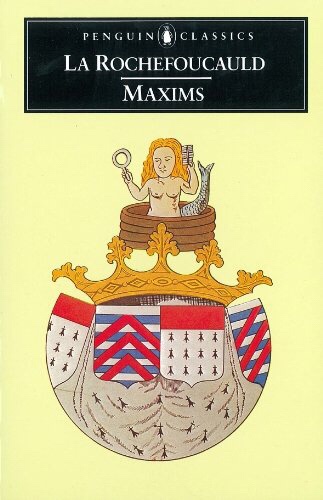
Voltaire describes the Maxims of La Rochefoucauld as one of the works which contributed the most towards forming the taste of the French nation and giving it a feeling for aptness and precision.
This little book of reflections about human nature, perhaps the most penetrating and disconcerting ever written, appeared in its original form, in 1665, in the middle of the wonderful decade which saw the flowering of the genius of Molière, Racine, La Fontaine, Boileau, Bossuet, and a galaxy of masterpieces by artists in other forms, painting, sculpture, architecture; the age that is made alive for us by the incomparable letters of Mme de Sévigné, one of La Rochefoucauld’s closest friends.
Tancock explains the origin of ‘maximes’ as the famous literary salons of the time:
It would be difficult to overestimate the benefits conferred by the salons upon French literature, language, and even thought during the first half of the seventeenth century, whilst some of the greatest writers of the second half had been brought up in them.
In the linguistic field the constant influence of the salons of such ladies as Mme de Rambouillet and Mme de Sablé upon most of the great writers of the day gradually transformed the picturesque and over-rich legacy of the sixteenth century into the clearest and most elegant medium for conveying abstract thought known to the modern world, and in the fields of matter and taste these salons worked a comparable miracle.
They turned the manners and conversation of the barrack-room into discussion of moral, sentimental, psychological problems, observation of human behaviour and speculation upon its motives and aims, overt or hidden.
What did the habitués of the salons talk about?
Apart from the merely social and frivolous side of their activity, their object was to enjoy interesting and elegant conversation.
And Tancock sets out some maxims of his own for the art of conversation:
Now conversation means conversation, and not a series of monologues, nor impassioned argument. Therefore they avoided certain topics and cultivated others.
Two subjects lead sooner or later to hot tempers, shrill monologues, rudeness, boredom, and all kinds of social discomforts: one is religion and the other politics.
Moreover, apart from exhibitions of stupidity, prejudice, and intolerance, religious discussion usually ends in embarrassing personal allusions or indelicate self-revelation.
Politics is not only boring to all but fanatics, but highly dangerous in a society dominated by a tyrant and riddled with spies. In such a society these subjects are best left alone.
Neither does one converse about any specialized subject on which an enthusiastic crank can lecture in technical jargon meaningless to half the company.
And above all one avoids talking about oneself, not merely because social convention discourages the first person singular, but for the much more important reason that each human being is so wrapped up in himself that he cannot abide hearing about the self of any other.
A bore, somebody has said, is a fool who insists on telling you about himself when you want to tell him about yourself.
Maxims enabled elegant conversation without recourse to religion, politics, enthusiastic crankery or bores:
…pithy, proverb-like generalization about human conduct known as the sentence or maxime… the skill consists in expressing some thought about human motives or behaviour in a form combining the maximum of clarity and truth with the minimum of words arranged in the most striking and memorable order.
The concocting of these maxims was therefore a society game, and maxims were the product of communal efforts at pruning and arranging.
But returning to the slightly sour definition from the Oxford Dictionary of Philosophy; Tancock makes the case that maxims added up to more than their parts. Properly assembled they guide the life of the ‘honnête homme’:
Modern English-speaking people, tend to think of the seventeenth-century French as heroic supermen tempered by ‘reason’, ‘will-power’, ‘the middle way’, who lived in an age when all things were straightforward.
But in reality most thinking people at that time, as always, were profoundly disturbed and perplexed by the evils and contradictions, the grandeur and misery of the human condition.
Not only was it evident that men are neither heroes nor reasonable beings, but it was clear, as Descartes had pointed out, that much of man’s so-called moral and psychological nature is simply the product of his physical condition, of his humeurs, and, more humiliating still, that man’s physical condition may depend upon quite fortuitous things, devoid of any apparent sense or plan, such as the piece of grit which, according to Pascal, introduced itself into the ureter of Oliver Cromwell and reversed the trend of English history.
All this is the very opposite of what the text books call the reason and good sense of the classical period, and these misgivings are reflected in the Maxims, which show mankind tossed hither and thither by passions born of a deep-seated self-centredness, by all kinds of physical factors including fluctuating state of health, by sheer chance.
It was precisely because the French towards the middle of the seventeenth century were sickened by the iniquities of public life and frightened by these glimpses into the abyss of man’s private nature that they evolved a modus vivendi, the ideal of the honnête homme.
Since man cannot live unto himself, but must contrive to exist in the company of his fellow creatures, it follows that the ideal type of person is the one who can lead a sociable life with other men of all sorts and conditions, whose character, behaviour, and opinions give the least offence to others.
The seventeenth-century honnête homme is not unlike the gentleman as defined by Cardinal Newman: ‘one who never inflicts pain… his great concern being to make everyone at their ease and at home.’
This kind of natural gentleman never hurts or embarrasses others by asserting himself or deviating too markedly from the accepted norm of decent conduct, whether in the direction of virtue or of vice, for excessive, intransigent virtue can be as painful to others as wickedness, and as upsetting to the equilibrium of society.
The honnête homme is moderate and unobtrusive in all things, doing his exact share in society, nor more nor less. The man who insists on being different or outstanding, above all the man with a mission to ‘improve’ his fellow men, is either a villain or a fool, wicked or laughable.
But we must not conclude from certain remarks of those in Molière’s plays that the honnête homme was a negative creature, a non-committal yes-man intent on mere conformity and etiquette, for officiousness and bowings and scrapings can be a nuisance and an embarrassment, and therefore the very opposite of good manners.
Perfect manners come only from within, from real goodness, kindness, respect, and understanding.
What’s not to like in the honnête homme? I’m all for real goodness, kindness, respect, and understanding. ‘Perfect manners come only from within’ is not a bad maxim itself. One down; only another 600+ maxims to go.

 Achilles & Aristotle