A Taste of Luxury


Four days of luxe in the Balearics leaves me with mixed emotions. It cost a lot. We’ve never done anything this expensive, in the more-than-a-decade since we’ve had kids: it’s their first ever flight on a plane. 

It was absolutely lovely in the main. We didn’t pinch the pennies, and largely had and did what we all wanted. 

We also succeeded with multiple modes of transport: car, bus, plane, hire car, ferry; navigating ‘sin plomb’ with aplomb, in the obligatory last minute hire-car-drop-off-petrol-top-up-panic – arriving with fully 5 minutes to spare.

A breeze through the airport, and as I sit here with bad inflight coffee in hand, it’s all been very good. 

But you couldn’t but notice that the many kind and smiling people who served us on our hols, weren’t anywhere near as flush as we are; and back at home we feel poor enough.

The nice young man, at last night’s eye-wateringly expensive restaurant, has a small son and daughter in Spain. A need for work took him hundreds of miles away from them – to serve us unnecessarily fancy food at our boutique hotel.

On the next-to-last leg we went the wrong way round the Ibiza Port one way system; and drove past a three storey yacht. Complete with polo shirted crew and chi chi cocktail party “How much would one of those cost?” my daughter asked.

Her mother and I had no idea. But one thing is for sure, absent major criminality, venal corruption or sustained workplace psychopathy – and I don’t do those – the massive yacht will likely elude us.

At the airport, the first thing ‘free wifi’ served up, was one of my colleagues tweeting from a refugee camp in Beirut, about the everyday courage of people protecting and promoting their arts and culture in Lebanon. Puts it all in context.

Jeremy Deller’s ‘We sit starving amidst our gold‘ captures the right attitude to that super yacht for me; a giant William Morris, the great Victorian social reformer, lifts and hurls one into the sea.

We had a lovely lovely time. But luxury is expensive, intoxicating and addictive. Like all such delights, it is best tasted sparingly.
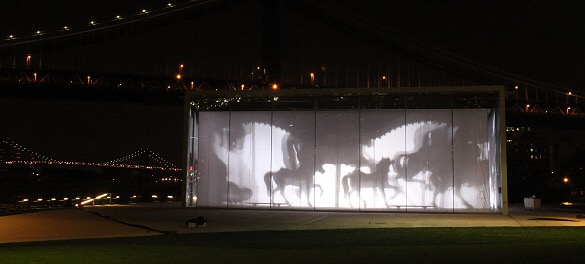

Scrim Down


scrim: (noun) pronunciation /skrɪm/ Theatre: a piece of gauze cloth that appears opaque until lit from behind, used as a screen or backcloth: “a plain scrim for backcloth and good lighting are all that are needed.”

We all live in our own personal cinema. Much, if not all the time, the way we experience and interpret the world is based on the familiar script of how we view ourselves; played out against the cast of characters with whom we are surrounded. Sometimes the hero, sometimes a victim; it is often supremely hard to see beyond the daily soap opera which occupies our heads.

The late American psychologist Donald C. Klein has some interesting things to say on this, in his 2004 paper ‘Appreciative Psychology: An Antidote to Humiliation’:

“The scrim is a transparent curtain on which theater people paint scenery. When illuminated by footlights and spotlights from the auditorium to the stage, the scenery appears opaque. 

That scenery and the actors playing their parts on the stage in front of the curtain constitute “reality” for audience members. The curtain no longer is perceived as transparent. 

If, however, the scrim is lit from behind, the scenery fades or even disappears. The curtain now appears transparent and the audience can see through the curtain to a whole new vista of objects and people, that is, a new reality. 

It is as if each of us has a ‘mental scrim’ on which, from earliest childhood, we have been painting the scenery of our lives, literally millions of thoughts about ourselves and the world around us. 

When we are an ordinary state of being, we take these ideas very seriously and treat them as the only reality that is available to us. Under ordinary circumstances, this is the only reality of which we are aware. 

Under special circumstances, however – as, in my case, when I witnessed a beautiful sunset and experienced the awe and wonderment – our mental scrims become transparent. The clutter of thoughts about ourselves and the world fade or even disappear. We see through and beyond our mental scrims.”

It’s a lovely concept. If (to paraphrase Klein) you can regularly get beyond:

  1. how one imagines one appears to other people; 
  2. one’s imagination of other people’s judgment of that appearance; and 
  3. emotional reactions related to one’s sense of self…

…you are metaphorically, and sometimes literally laughing; as I was yesterday with a great friend, as we laughed and laughed at each other’s French phraseology.

If you feel the ‘mental scrim’ of the ‘millions of thoughts about ourselves’ and the soap opera of ‘one’s imagination other people’s judgements’ coming down, all you have to do to escape, is concentrate hard for a moment on looking through it. 

Reality is often full of little-appreciated beauty, joy, happiness and love which is simply masked by the vivid, all-consuming but largely psychological ‘light show’ playing out in nearly all of our heads, nearly all of the time. 

Donald Klein’s ‘mental scrim’ is worth thinking about; and regularly seeing through.

Enobarbus


I always remember – from my youth – Enobarbus’s immortal line from Antony and Cleopatra…

Age cannot wither her, nor custom stale
Her infinite variety. 

Antony and Cleopatra: Act II Scene II

I was Enobarbus in our classroom rendition of Shakespeare’s classic. And as it was in the play, so it is in life.

‘Infinite variety’ keeps you on your toes. Sometimes frustrating, but perhaps essential in a life partner. 

But as Lepidus says at the start of the scene:

Good Enobarbus, ’tis a worthy deed,
And shall become you well, to entreat your captain
To soft and gentle speech.

‘Infinite variety’ and ‘soft and gentle speech’ aren’t bad ingredients, to keep the most important relationship on the right road.

Hell in a handcart


We were burgled last weekend. Not a massive disaster, but unsettling none the less. 

As I hacked back the plant to reveal an old burglar alarm box, and then drove to the badlands of London to recycle the clippings; I was sent, en route, to buy a replacement Xbox at Argos, in order to cheer up the kids.

It set me thinking. What kind of a society do we live in, when someone is prepared to risk incarceration to nick our old out-of-date Xbox 360? Who is desperate enough to give them a bundle of notes to own it? And why am I here, perpetuating this ‘circle of life’, scrabbling with everyone else for a metal and plastic electronic narcotic, which sends healthy minds to sleep…

Hmmm. 

I’m reading Neil MacGregor’s terrific book Germany: Memories of a Nation – its history seen through the prism of fascinating lives, inventions and objects. It brings together a story of what is ‘Germany’ in images and items, from the Renaissance prints of Durer to the Bauhaus-inspired gates of despair at Buchenwald, here:


Jedem das seine: “to each his due”, as the proverbial and double-edged sign reads. 

At the top is MacGregor’s picture of one of the millions of traditional handcarts, in which even more millions of displaced people carried what little they could; across fought over and destroyed lands. When the world has literally gone to “hell in a handcart” of what value are material wealth and possessions?

MacGregor’s story makes you think about, care about and better understand Germany. It’s also a reminder that acquisitiveness and retribution are the twin roads to perdition. Happiness, for people or countries, is not found in revenge or fighting for more stuff.

Friction


Friction: the force resisting the relative motion of solids, fluids and materials moving against each other.

A week of friction, heat and bother. It’s a mug’s game to try to move things faster than contradictory natures allow – but I fall for it every time…

People, organisations and situations exert a constant pull. So the occasional ‘moonlike’ bound forward is illusory – gravity always pull you back to earth.

Easy to think you’re doing the Lord’s work; trying to fix what needs fixing. But fix things too fast and people complain: “What’s going on, what are you doing, you didn’t tell me, what does it mean for me, why?”

As so often, slowing down a bit is probably the answer. Fix less, explain more. Then who knows? Perhaps less will need fixing. 

At the very least, there’ll be less friction from the atmosphere.