Cheerfulness

20130511-204258.jpg

Hard yards at the moment. Much ado at work and plenty on at home. But the top tip of this week comes from the Royal Navy – cheerfulness counts.

From the Battle of Trafalgar to the present day, Britain’s Royal Navy has run on cheerfulness.

Nobody follows a pessimist. And grumpiness ain’t attractive. However hard, keeping your chin up cheers everyone up.

So despite the temptation not to, I’m keeping smiling. Life’s too short. Cheerfulness counts : )

Irrelevant Complexity 1) – Odd Jobs

20130427-144320.jpg

‘Relevant complexity’ is my theory of everything: satisfaction and joy arise from the pursuit of complex, worthwhile and comparatively challenging pursuits.

Art history, particle physics, the raising of children, the preparation and enjoyment of good food etc etc – all relevantly complex.

You need to learn, improve, occasionally triumph – and sometimes feel you actually know almost nothing – to achieve the satisfaction of mastering relevant complexity with a good degree of skill.

Then there are hobbies. Same effect Csikszentmihalyi’s ‘flow’ – as one become adept or expert but some risks: becoming a bore or solitary obsessive. I have achieved ‘flow’ by hoovering well, even cleaning a fridge. But these are not monuments to my life’s work or relevantly complex pursuits I’d want defining who I am.

What’s in? An eclectic and erratic list: cooking, relevant; gardening, chore. Writing, relevant; drawing embarrassment. Cleaning the fish tank, chore (and only tolerable if I’m left to do it properly) odd jobs, drilling and hanging things source of great irritation and angst. Why?

Because it’s hard to get odd jobs right. Our walls are rubbish, you only ever do a thing once – so you make maximum mistakes, never get the chance to practice what you’ve learned. And the smallest thing can take disproportionate time for a disappointing effect; which then stares down at you in reproach for years. Aaargh. Irrelevant complexity.

My latest botched odd job stares down at me here:

Curtain derailed
DIY failed
Drooping drapes
In awkward shapes
Lots of screws
And hacksaw blades
Variety of fixings
Wobbling and fiddling
Scarcely blocking the sky
Humble pie.

But every cloud has a silver lining. After three separate wasted days on and off up ladders, with hacksaws, at the DIY shop, I definitively gave up in a huff on our lounge curtains.

Then a miracle intervened. My beloved took to the ladders, took up the drill and made it all hang together. Perhaps she found it satisfying enough that she might become Oddjob now… Fingers crossed.

Cogito ergonomics sum

20130420-103805.jpg

I think therefore I am – ‘the cogito’ – is Descartes most famous contribution to philosophy. I might doubt everything else; that I am thinking is a certainty.

But thinking – and doing something about it – requires a comparative absence of distraction and ideally a modicum of comfort. And that’s where design comes in.

One of the reasons I’ve written less in the last few weeks is my new shiny iPhone 5. In many ways a splendid device. But more is sometimes less. And I find I can’t write on it.

It’s too big. I can’t reach the top corner ‘action’ buttons. It feels like it’s constantly going to tip over backwards – and tumble and smash into small, beautifully machined Apple pieces.

So I’m back tapping on the iPhone 4 (which I couldn’t give up despite a generous financial offer from a good friend). Fast, fluid, typing is a doddle again.

Ergonomics matter. Hard to think when you’re uncomfortable, hard to write when your hand hurts.

Technology isn’t always getting better. The iPhone 4 is my perfect writing device. Like Hemingway’s Moleskine or Remington’s typewriter, when it comes to writing iPhone 4 is the classic.

Sunshine

20130414-144459.jpg

After the longest winter I can remember, warmth and sunshine break through the never-ending clouds and cold. What a difference the sunshine makes.

Yesterday, in the driving rain, I debated with my daughter whether this country is just too chilly these days. Her view: “This may be the safest country in the world but it is much to cold and wet – really!”

“Yes” I agreed “but we’d miss the seasons if it were always hot – and we’d be eaten by the bugs and the wildlife.” “Hmmm” she said.

This winter has been hard and has set me thinking about my autumn years. How many more long cold grinding winters like this do I want to endure? And rattling about the house doesn’t help.

Should I quit my job and do something different? Aspects are a ball ache, but a lot of it is perfect. I can’t really imagine a much better job in all honesty. Hmmm.

Should I set about fixing our house. It’s pretty chilly, pretty untidy, most stuff’s not where we want it and there’s a thousand and one things I could mend. Hmmm.

Should I write a book – or wait, it’ll give me something to do in a decade or two. But I might peg it before I’ve even got started. Should I start right away? Hmmm.

Should I, should I… Or should I go and sit in the garden, on a kitchen chair, soak up some sunlight and do nothing at all? Well not much anyway, just tap on an iPhone screen.

That’ll do. Simple is best. Sunshine, it’s a wonderful thing.

Physics

20130317-173727.jpg

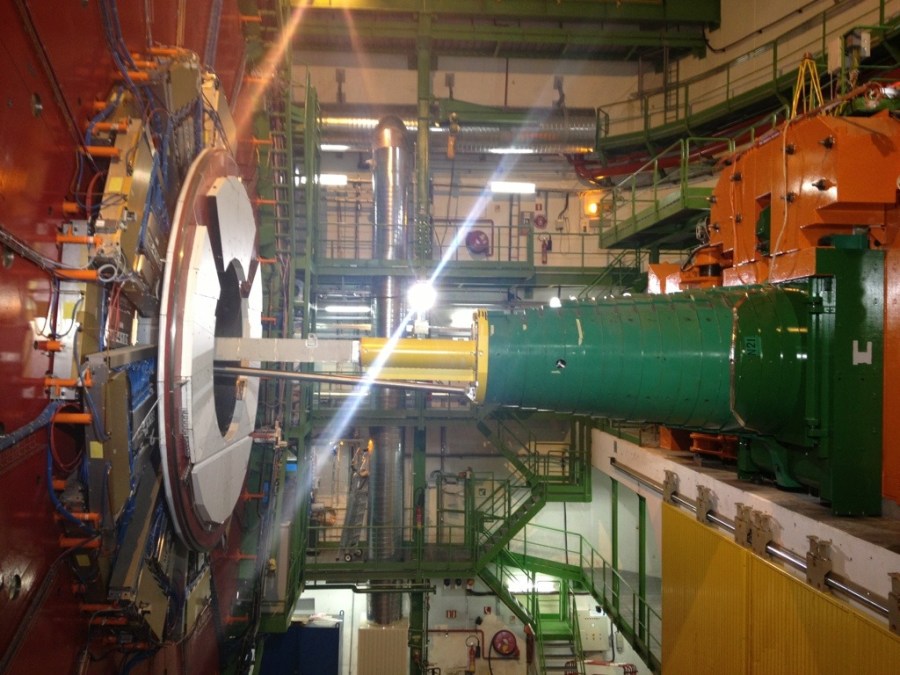
I’ve just spent the weekend at @CERN – home, among other things, to the biggest physics experiment on earth, the Large Hadron Collider (above).

It’s quite a place. Much like a campus university; a jumble of blocks and walkways, carparks, corridors and doors of many ages, styles and states of repair. But the scale and precision of what is done underground is uniformly cutting edge.

Take the equivalent in matter of one hair from your head, accelerate it to the speed of light through four vast machines built over five decades. Then inject it one hundred metres underground into the coldest most magnetic 27km circuit in the known universe.

Then do the same again. Inject it in the opposite direction. Smash the two hairs’ worth together in a beam no wider than those hairs. Catch the debris in two enormous detectors. And there you have the LHC. Simple.

CERN also produces antimatter. But at a rate which would take a billion years or so to produce one gram. And ‘paff’ each batch, painstaking produced, vaporises in an invisible ‘ping’ of energy in less than ten minutes. So no risk of annihilating the planet just yet.

But what was even more impressive than the huge tunnels, control rooms, detecters and machines, is the the people.

They visibly share a common purpose to go beyond what is known. They have nurtured a spirit of endeavour which has constantly to push technology and techniques way what’s currently thought possible. And they manifest an ethos of genuine teamwork and collaboration, uniting staff and researchers from over 100 countries.

All that underpinned by a shared respect for science and the scientific method – and it must be said some very very large public funding.

If you wanted to imagine an idealist’s world where people of all nations come together to advance the sum of human knowledge and achievement; stop imagining and go visit. It exists, on an ‘international’ patch of land between the French Jura and the Swiss Alps.

But what’s also nice is not everyone is a particle physicist – most are engineers. I met a young Danish marine engineer in the control room who explained you have to be able to fix anything on a boat – which is the ideal training for looking after a particle accelerator!

So you don’t have to be Albert Einstein to have a thrilling career in physics. And here’s a nice story I read in the New Scientist on the flight home, from the physicist Leonard Susskind, on his tussle with his father over practicality versus physics:

I did not come from an academic background. My father was a smart man, but he had a 5th-grade education. He and all his friends were plumbers. They were all born around 1905, in great poverty in New York City, and had to go to work when they were 12 or 13 years old. But sitting around the kitchen in our house, they had all sorts of interesting conversations. There was a funny intellectuality to them.

I went to college because my father thought that I should learn engineering, because he wanted to go into the heating business with me. There I realised I wanted to be a physicist. I had to tell him, which was a somewhat traumatic experience.

For months I had been trying to figure out how to tell him. One day I drove over to his house. This is emblazoned in my memory: it was a terrible, terrible feeling.

He had a plumbing shop in the basement, and was there cutting pipe for the next day’s job. I went down and said, “I’m not going to be an engineer.” He got upset. Though he almost never used bad language, he said, “What the fuck are you going to be? A ballet dancer?”

I said, “No, I want to be a physicist.” He said, “No, you ain’t gonna work in no drugstore.” I said, “No, no, a physicist, not a pharmacist.” And then I can’t remember the exact conversation, but I do remember the magic word was “Einstein”. I said I wanted to do what Einstein did. That just shocked him.

Something snapped, and he decided right then and there that that is what I had to do. That was the end of it. From then on, my father tried very hard to learn a little about physics.

Dads and their lads eh. But what a great story of a father’s love for his son conquering all. Physics, it’s a beautiful thing.