Montaigne on Virtue

20120410-112035.jpgThree hundred and one dailylit.com episodes of Essays in and Michel de Montaigne serves up another view I 100% agree with, five centuries on. When it comes to ethics the the answer is staring you in the face – in the bathroom mirror.

To ground the recompense of virtuous actions upon the approbation of others is too uncertain and unsafe a foundation, especially in so corrupt and ignorant an age as this.

“What before had been vices are now manners.” – Seneca

You yourself only know if you are cowardly and cruel, loyal and devout: others see you not, and only guess at you by uncertain conjectures, and do not so much see your nature as your art; rely not therefore upon their opinions, but stick to your own:

“Thou must employ thy own judgment upon thyself; great is the weight of thy own conscience in the discovery of virtues and vices: which taken away, all things are lost.” – Cicero

Or as my son’s preferred sage Master Yoda might say: the keeper of your own conscience are you.
To Do List

20120406-163502.jpg

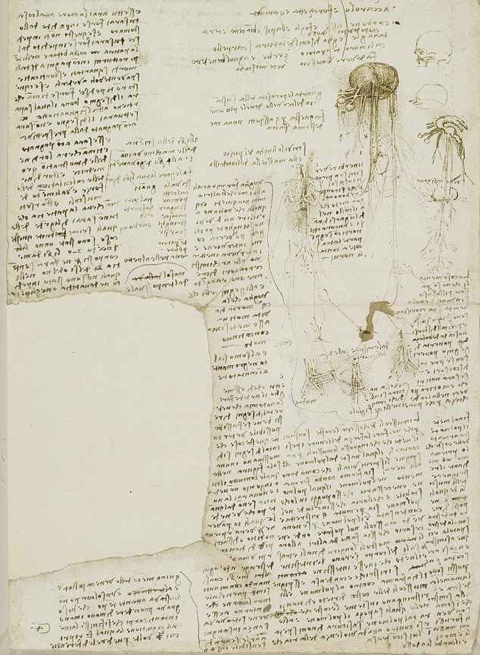
In the last couple of years I’ve become a big advocate of hobbies. Hobbies maketh the man. I like a good to do list too. Hats off then to Leonardo da Vinci – ultimate Renaissance man and top polymath – for his splendid to do list of 1510:

1) Obtain skull
2) Get books on anatomy bound
3) Observe holes in the substance of the brain
4) Describe jaw of a crocodile

Sadly there was no ‘App for that’ in 1510 – the parchment (above) being the iPhone ‘Notes’ of his day. Leonardo sets the bar high for a Bank Holiday weekend. Certainly beats cleaning the fish-tank.

Postscript: turns out on Leonardo’s own holiday list were: chalk, wrapping paper, a pane of glass, nutmeg and describing the tongue of a woodpecker. Perhaps he did his fish-tank the week before.

Competitive Dad

20120331-085837.jpg

Competitive Dad
Get your fleece off honey!
Competitive Dad
Get your hands in the air!
Competitive Mum
Get in tighter!
Competitive Mum
Get your hands in there!
Bemused Daughter
Alright, alright!
Bemused Daughter
Would you both stand over there.

Our standard position is “We’re not really competitive people in our house”. But the missus and my behaviour yesterday put a dent in that theory. I found myself the only adult shouting at my daughter’s end of term school netball completion, except for… my other half.

It’s the first time in my life I’ve attended a competitive team sporting fixture in which my daughter was playing. And what an extraordinary experience that is. I was rooting for her, so much I couldn’t stand still and certainly couldn’t help trying to catch her eye and shouting advice at her.

I need to learn from my own Dad: arrive without fanfare, be present, then quietly disappear.

Amor Fati

20120324-205709.jpg

This week, my mind was briefly boggled by this most detailed ever picture from a space telescope. It purports to show 200,000 galaxies.

Our nearest star – on the most optimistic estimates – would take some 10,000 years to visit. And that’s one star, in the billion, in one galaxy, of the 200,000, you can see in this picture. Make you feel just a little insignificant.

On the same day into my inbox dropped a relevant entry, in the self-styled ‘Intellectual Devotional’ I get by email from dailylit.com. Duff title but there is the odd cracker in there.

‘Transcendent Significance’ is a good one. We all like to think our lives have a transcendent significance. Hence narcissism, religion, artistry, poetry, politics… and Nietzsche.

Why Nietzsche? Because one answer to transcendent significance according to the Intellectual Devotional is:

The doctrine of “eternal recurrence”, which posits that the universe has been recurring, and will continue to recur ad infinitum, in a self-similar form. Rooted in Indian and Egyptian philosophy, and taken up by the Pythagoreans and Stoics, with the fall of antiquity and the spread of Christianity, the concept of was gradually lost.

Enter Nietzsche who gave “eternal recurrence” a second chance, as a reason to affirm life in the face of a world without God:

“My formula for human greatness is amor fati: that one wants to have nothing different, not forward, not backward, not in all eternity. Not merely to bear the necessary, still less to conceal it… but to love it.”

I’m not sure I can go the whole hog on Nietzsche – and want nothing different in all eternity. But I can have a decent crack at wanting nothing different in the here and now.

Is there a better place in those 200,000 galaxies? Maybe, but probably not. Has there been a better time to live in human history? Almost certainly not. Healthy happy middle age on planet earth in the 21st century has its compensations. Amor fati – what’s not to like?

Lost in Translation

20120318-114727.jpg

20120318-114753.jpg

As I read and write more, I come to enjoy the turns of phrase of past times. I’m not arguing for Chaucer in the original – life’s too short. But the thundering prose of the King James Bible or a decent translation of Aristotle, for example.

Having learnt that ‘plot’ is everything in poetry, I largely fell for Aristotle’s Poetics based on one line:

The getting-up of the spectacle is more a matter for the costumier than the poet.

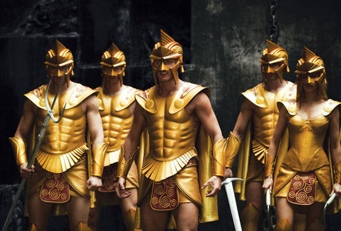
I’ve quoted this at work a few times to point out the job at hand – substance not spin. And I found myself quoting it to the missus last night having watched ‘The Immortals’, which I found a big disappointment.

I do enjoy a good ‘sword and sandals’ epic, and I really wanted to like it. But ‘The Immortals’ managed to make very little of the ‘plot’ of Theseus, whilst expending far too much effort on the costumes and CGI. They even ripped off Maximus’s helmet from ‘Gladiator’ for an all too boyish Zeus (see above).

Ridley Scott knows, as Aristotle said, that: the first essential – the life and soul of Tragedy – is the Plot. I fear the Director of last night’s disappointing fayre, was reading the more leaden modern translation of my favourite ‘Poetics’ quote, from the duff version I bought on my Kindle:

The production of spectacular effects depends more on the art of the stage machinist than on that of the poet.*

Too much stage-machinist and not enough poet in ‘The Immortals’ for me. Had Aristotle seen it, he’d be gently shaking his head – more in sadness than in anger. Theseus, the founding myth of Ancient Greece, was very much lost in translation.

*So if you’re buying Aristotle’s Poetics, I’d buy Ingram Bywater’s 1920 OUP translation, which you can get for free on dailylit.com.