Character Forming

I read an interesting article in my old favourite the New Scientist this week. I’ve been ploughing through some accumulated backnumbers, the magazine having recently been forcibly rehabilitated as a format, after the missus trod on my Kindle and bust it.

What goes around comes around, as the rustling of magazine pages and the need for more light to read newsprint disturbs her slumber at lights out. I feel a shade guilty and remember that part of the reason I bought a Kindle was to be a more considerate bedfellow – and to save my dwindling night reading vision. More carrots and a new Kindle are in order.

Back to the point. The article’s writer Samuel Barondes says ‘personality’ is best understood as a composite of: dispositional traits, troublesome patterns, character strengths and sense of identity.

I like this idea. But a trying to remember it, sat on the Tube today, mutation and evolution intervened and I came up with a subtly different variant:

1) Innate preferences
2) Experiences
3) Bad traits
4) Our internal narrative.

Similar, but not quite the same. I’ve subconsciously pulled out experiences – and therefore, implicitly, the environment. Perhaps that’s because I increasingly believe much of what we are is shaped by chance and circumstances.

But ‘bad patterns’ or traits, as a significant part of who we all are, is a discovery. When you think about it we all have them. And when it comes to bringing them to life, Theophrastus, whom the article signposts, takes some beating. Theophrastus was a pupil of Aristotle and wrote extensively on flora. He also wrote a field guide to that most variegated of fauna – the human being.

The Characters of Theophrastus – a bit like Aristotle’s ‘On Physiognomy’ – tend towards the negative in people. Perhaps both disliked extremes and preferred the ‘golden mean’ as their prescription for the ‘good’ character. For his part Barondes says every culture values self-control, kindness and a sense of one’s place in the universe.

I read Theophrastus’s thirty ‘characters’, and to my growing embarrassment recognised myself strongly in two, and a little in another one. The good news, at least based on my list, is I can forgive myself a bit.

Some of my bad patterns are innate, some the fault of my environment. But my best defence against my ‘bad traits’ is an increasingly clear narrative if who I am and what I am for. Half-way through my life, I reckon the last element of ‘character’ is the one I can do most about.

We are all basically a self-edited ‘story’ looking backwards. And, following Aristotle, we are all the sum of our actions going forward. So I conclude it’s well worth continuing to pay proper attention to both. Theophrastus is a warning to those who don’t.

The Eaves

Cycling to work every day I get a regular soaking. Decent waterproofs help. But there are days, when looking out of the kitchen window, I don’t fancy it much. A number of years ago in the book ‘Angry White Pyjamas’ I read a quote from the Hagakure – the Japanese Book of the Samurai. It advised stepping out from the eaves:

There is something to be learned from a rainstorm. When meeting with a sudden shower, you try not to get wet and run quickly along the road. But doing such things as passing under the eaves of houses, you still get wet. When you are resolved from the beginning, you will not be perplexed, though you still get the same soaking. This understanding extends to everything.

I was reminded of this, in the week, by Montaigne’s similar write-up on the Roman Legions:

Their military discipline was much ruder than ours, and accordingly produced much greater effects. The jeer that was given a Lacedaemonian soldier is marvellously pat to this purpose, who, in an expedition of war, was reproached for having been seen under the roof of a house: they were so inured to hardship that, let the weather be what it would, it was a shame to be seen under any other cover than the roof of heaven. We should not march our people very far at that rate.

I don’t mind being rained on, but I’ve often thought I’d last about five minutes on a proper Roman or Medieval battlefield. Some glum milling about before, and then probably a spirited moment of excessive unavoidable bravery early doors followed by a sharp death. That sounds about my fate. I can only assume my forebears were quick to procreate, as I don’t reckon we’d have lasted long.

But my other pet theory is we were scouts and messengers. Sharp eyed endurance runners with a precise tongue. Who knows. The Hagakure is admirably clear on the matter: ‘Bravery and cowardice are not things which can be conjectured in times of peace. They are in different categories.’

Some Hagakure quotes are positively Aristotelian, take:

‘Intelligence is nothing more than discussing things with others. Limitless wisdom comes of this.’

But like Aristotle, with his theories on biles and humours – and posture, character and beards – not everything in the Hagakure is to modern tastes. As ‘Angry White Pyjamas’ also highlighted:

When one departs for the front, he should carry rice in a bag. His underwear should be made from the skin of a badger. This way he will not have lice. In a long campaign, lice are troublesome.

I’ll step out from the eaves in GoreTex and Lycra, but I draw the line at the skin of a badger.

Sock Drawer

In a brief moment of peace this morning – as newly shod children ran from the house with their mother – I wedged in a bit of Aristotle. Via dailylit.com, I opened a couple of chapters of ‘On Poetics’, including the famous line: ‘Poetry is finer than history, as it describes the universal, while history describes only the particular.’

Aristotle is fascinating on ‘plot’, beginnings and endings and the ideal length. Most of all though his point is that plot makes poetry – not verse or the central character. The poet’s prime job is to say something transcendent and universal about the human condition, in a length which contains no more and no less than is needed.

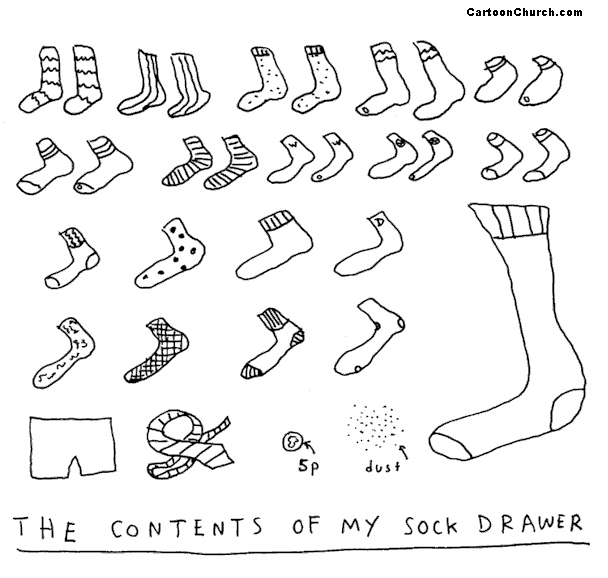
Reading Aristotle is like having your intellectual sock drawer sorted for you. Concepts ordered, ideas reconnected. Then everything neatly paired and placed just so. Not showy nor rhetorical, bombastic nor florid. No more and no less than is needed. And, without fuss, a tidy drawer of knowledge and ideas added to your head. Marvellous.

Bayesian Ethics

As I’ve written before, one of my past wrestles is with Utilitarianism: that the moral act is the one with the best consequences regardless of what rules it breaks. I’m now firmly Aristotelian – aka a ‘virtue ethicist’ – we are what we repeatedly do.

But Anthony Appiah the Princeton Philosopher has some challenging things to say about virtue ethics in a Philosophy Bites podcast – including some experiments. And I’m inclined to listen. I like a bit of scientific method.

I like Appiah’s ‘Cosmopolitanism’ too which has helped me articulate my ‘live and let live’ theory of internationalism at work. Humans value culture. Different cultures value different things. And Cosmopolitanism says, short of harm, we should let them. Which I think is about right.

Appiah challenges virtue with ‘experimental ethics’ – seeing what people actually do, rather than what we theorise, and looking inside people’s heads in brain scanners. He finds, for example, nearly everyone gets more generous to strangers if they find a suitably planted $10 note on the floor.

His conclusion is that the idea of a ‘moral’ person in the Aristotelian sense is not borne out by the experimental reality. For him, we make moral choices based on context, stimulus and ‘in the moment’ not based on ‘character’. I don’t entirely agree, but it’s interesting stuff.

Learning to use the head to override the instinctive ‘yuk’ response or being over-influenced by the situation is one of the things he advocates. But only sparingly. Here’s where rules, norms and culture – plus a moral education – might help. But he’s not for becoming too calculating.

He disagrees with Utilitarianism for example. First, because it doesn’t capture the experimental reality of how we respond to moral situations. Second, because were to implement calculating ‘consequentialism’ wide-scale it would dramatically impoverish human existence. Largely because promoting purely rational calculation would tend to demote difference and different views.

Cultural Cosmopolitanism makes life interesting and liveable. And if you’re going to accept difference in culture you have to accept it in worldview and ethics too. That people care about different things is what makes people interesting – and maddening.

I personally think virtue and ‘outlying’ single instances of behaviour are not incompatible. I don’t doubt that you can get very good and very bad moral choices and behaviours out of me if you significantly change my conditions and stimuli.

I also think that the prospects of me making better or worse choices are determined, yes, by the context and circumstances – but crucially, combined with who I am. And who I am is the product of a life lived, previous choices made, data, concepts and theories within and Bayesian probability mashing all that together in a nano-second every time I act.

I think there is ‘virtue’ and I have a ‘character’. It’s just that the complexity of the probabilistic calculations – all done subconsciously by that marvel of existence, a human brain – mean Utilitarianism is too crude and individual ethical experiments are too simple to anything like capture them. I return to my own dictum – if the human brain were simple enough to understand, we’d be too simple to understand it.

So I like Appiah’s ethical experiments – they deserve a well signposted place in my Bayesian brain’s data set – and I’ve shared then with others too to influence them. But virtue, character and Aristotle’s ‘I am what I repeatedly do’ still work best for me. Thanks to Appiah though, I’m also a Cosmopolitan. So I’m delighted to weigh a well-wrought difference of opinion in the Bayesian ethical balance. It all goes in the mix.

Change the Record

At lunch with a good friend today, we got talking about people and politics. We both admitted to getting cross, as we get older, at having to spend time with people whose views never change and who keep chewing the same cud. We concluded that people – even friends – who repetitively complain about things, moan about politics and never do anything about anything, are to be frequented with caution.

Later, I found myself writing a speech about society and citizenship for work. Where else to turn than Aristotle and Aquinas. Looking for inspiration, I stumbled across the reason my friend and I had been so grumpy about the monotonous tunes of stuck records. They are missing the point. Here (shortened) is what the Internet Encyclopaedia of Philosophy has to say on politics and society:

Following Aristotle, Aquinas believes that political society (civitas) emerges from the needs and aspirations of human nature itself. Thus understood, it is not an invention of human ingenuity nor an artificial construction designed to make up for human nature’s shortcomings. It is, rather, a prompting of nature itself that sets humans apart from all other natural creatures.

To be sure, political society is not simply given by nature. It is rather something to which human beings naturally aspire and which is necessary for the full perfection of their existence. The capacity for political society is not natural to man, therefore, in the same way as the five senses are natural.

The naturalness of politics is more appropriately compared to the naturalness of moral virtue. Even though human beings are inclined to moral virtue, acquiring the virtues nonetheless requires both education and habituation. In the same way, even though human beings are inclined to live in political societies, such societies must still be established, built, and maintained by human industry.

Both Aquinas and Aristotle write about how, and why, families, the household, villages and clusters of villages come together – basic biological needs and division of labour. But ‘society’ only emerges beyond a certain threshold. And why? Because:

In addition to yielding greater protection and economic benefits, it also enhances the moral and intellectual lives of human beings. By identifying with a political community, human beings begin to see the world in broader terms than the mere satisfaction of their bodily desires and physical needs. Whereas the residents of the village better serve their individual interests, the goal of the political community becomes the good of the whole, or the common good

The political community is thus understood as the first community (larger than the family) for which the individual makes great sacrifices, since it is not merely a larger cooperative venture for mutual economic benefit. It is, rather, the social setting in which man truly finds his highest natural fulfillment. It is in this context that Aquinas argues (again following Aristotle) that although political society originally comes into being for the sake of living, it exists for the sake of “living well.”

And this is what we were scratching at today. Friendship, communities, politics and society all require some form of constructive engagement, contribution and participation to reap the rewards of an ‘enhanced moral and intellectual life’ and “living well”. So we voted with Franklin D. Roosevelt, don’t waste time our time blaming the system, other people or society. As Roosevelt famously said ‘Do what you can, with what you have, where you are.’ Or change the record.