The fear of fear itself

From multiple sources and stimuli this week, a penny has dropped… as Franklin D. Roosevelt famously said one of the biggest things we fear is fear itself;

There’s a name and a proper medical definition for it: phobophobia. But there’s also a bit of chicken and egg about all this: which comes first – the feeling or the thought?

As a person who spends a lot of time in my own head, I’d concluded it was often the ‘thought’ that comes first. I’d assumed for a lot of things it’s thoughts which gets the fear cycle going; thinking of something going wrong or that could be painful, embarrassing, poverty-inducing or lethal for example. But now I’m not so sure…

A combo of a bit of mindfulness, and some very helpful prompting from someone posing the question – “Where do thoughts come from?” has had me pondering.

On one level it seems easy; thanks to our old friend Descartes. With ‘I think therefore I am’, Descartes has firmly planted in our minds that it’s the thinking that defines us; so it’s easy to assume it’s the thinking that comes first. But is it?

Lots of great thinkers suggest otherwise. Aristotle and Aquinas had us down as composites of flesh and blood and mind – and far closer to animals than pure ‘spirit’.

Mineral, Vegetable, Animal, Human, and Divine

So back to the question I’ve been asked: “Where are the thoughts coming from?”

The short answer is I’m not entirely sure; but what is increasingly clear is they are not all coming from my Cartesian ‘conscious’ mind. Lots of them come unbidden. They ‘well up’ from the subconscious. And today I caught one ‘popping up’ from a place of pure feelings…

You have to be soooo fast to catch the mind. It’s like running a precision scientific experiment, it’s all in the milliseconds… But, while cheffing up a beetroot curry this lunchtime – from nowhere I had a vague generalised sense of anxiety – and a millisecond later a thought popped up to help me explain it. And immediately the two become one and the thought becomes the ‘source’ of the anxiety.

But it wasn’t. I simply concentrated on the feeling – and both went away. There is no reason to believe the specific ‘thought’ I had was anything to do with the general feeling of anxiety. I was ‘feeling’ anxious that my precious Sunday was half over – but the ‘thought’ was about a specific work-related problem I’ll be back to facing on Monday. Related but independent. Correlated but not causally connected…

What if the arrow of causation is the other way around… what if most or all of my thoughts are triggered by feelings… two books I’m reading suggest there’s something in this.

The first, ‘Why Buddhism is true’ by Robert Wright, points out that our emotions and perceptions were shaped by natural selection – not to be accurate, but to spread our genes.

All emotions and feelings, Wright points out, basically come from the same thing an amoeba has – a primordial urge to ‘approach’ or ‘avoid’. Our fancy mental apparatus can post-hoc rationalise it all, and give them more subtle and sophisticated names; but they are just differently packaged composites of approach/avoid.

The second ingredient comes from The Power of Negative Emotion by Robert Biswas-Diener and Todd Kashdan.

Their argument is we need negative emotions not least to spur us into action.

Richard Wright’s point is that natural selection deliberately keeps us anxious; Biswas-Diener and Kashdan advise us to embrace and use that.

So today I slightly changed a mantra I have in one of my many lists of ‘things to remember’. It was:

Avoid fear as a motivator

And now I’ve changed it to:

Accept fear is a motivator

And why? Simply because it is; fear is a motivator, and avoiding it means avoiding pretty much everything.

The limbic system is way more powerful than conscious thought as a motivator – it has been keeping ‘all creatures great and small’ safe for hundreds of millions of years.

There’s no point trying to avoid fear, you just have to feel it; and then do something about it.

Goals + Agency + Pathways = Hope

A timely blog from the always readable Eric Barker brings us the science of hope.

Before his passing, Charles Snyder was a professor at the University of Kansas and editor of the Journal of Social and Clinical Psychology. His books are Handbook of Hope: Theory, Measures, and Applications and Psychology of Hope.

Barker tells us that Snyder defined the route to hope thus:

Hope is the sum of perceived capabilities to produce routes to desired goals, along with the perceived motivation to use those routes… According to the theory, people who are hopeful believe they are good at generating goal thoughts, creating effective pathways leading to goal attainment, maintaining agency thoughts to provide enough motivation for the goal pursuit, and handling barriers that arise.

After all, as Barker reminds us, right now:

You’re dealing with life and death, financial concerns, issues of justice, and the safety and sanity of those you love. We have to get all that back on track in a world where clear answers are less than forthcoming. Human nature is on our side but we have plenty of work to do. Planet ain’t gonna fix itself; grab a shovel.

And so:

We don’t need wishes. We need active hope. The kind of hope that comes from a good plan, one that you are confident you can execute.

But in the endless weekly grind of ‘lockdown’ and Covid anxieties, it’s hard to come up with a plan that feels up to task. It’s all either too wishful or too timid. So what to do?

It starts with the goals:

Goals + Agency + Pathways = Hope

When you have goals (knowing what you want) and agency (the drive to get what you want) and pathways (the ability to generate methods to achieve what you want), you get hope.

With this type of hope, you don’t wish things will work out; you know deep down in your bones they will. You never doubt it.

I’ve always rather hated setting goals… what if I fail, is this the right thing to be shooting for, will it be worth it?

After all as Barker says:

Asking yourself “What are my goals?” is an excellent way to make your mind go blank.

He advises getting specific:

List out the major areas of your life (“career”, “family”, etc.) and beside each one simply write “I want…” Then finish the sentence. Be specific…

No, even more specific…

Sorry, still not specific enough…

Don’t say, “I need to find a new job,” say “I’m going to spend one hour every morning job-hunting on LinkedIn and reaching out to contacts.”

Snyder says you want “Specific, growth-seeking, performance-based, moderately-difficult goals.”

We’ve covered the ‘specific’ part. What’s a “growth-seeking” goal?

The right goals for ‘right now’ forget hope for the applause of others, and focus on personal growth.

Snyder’s research shows:

There is evidence that people who set validation-seeking goals are more prone to depressive episodes and self-esteem loss than those who set growth-seeking goals (Dykman, 1998). Validation-seeking goals are strivings to prove one’s self-worth, competence, and likeability through attainment of a goal. In contrast, growth-seeking goals are strivings to learn, grow, and improve.

I’m pretty good at action (agency) and finding routes forward (pathways) but Barker helped me realise I could do with a clearer more positive goal right now. Not least given my first thought was the one Barker advised against – get a new job!

So instead I’ve worked on some ‘growth’ goals:

  • Practice forgiving myself and others for what’s happening at work,
  • Be curious; practice and learn new psychological techniques through conflict at work,
  • Take breaks several times a day to breathe, reset and be ‘mindful’,
  • Keep learning Italian and French, and
  • Keep learning more about psychology and neuroscience.

I still think I should get a new job though!

However, as chance would have it an email from Chris Croft dropped into my inbox today; reminding me to find some things to enjoy at work too… So I’ll be looking for laughter where I can find it, and for the opportunity to write and create at work this week, among all the other difficult things.

Both Barker and Chris Croft reckon you can’t be happy or hopeful without some written goals. I’ve concluded, especially when everything is going wrong, they’re probably right.

Hallelujah!

Bowling along a sunny street today, with the hound and my AirPods in – a couple of ribald thoughts came to mind. I smiled inwardly.

And then what should boom out via iTunes shuffle but Handel’s ‘Hallelujah chorus’

…And I smiled some more.

And he shall reign forever and ever

King of kings forever and ever

And Lord of lords

hallelujah

hallelujah

And he shall reign forever and ever

Forever and ever and ever and ever

Etc.

Stirring stuff.

And as I sang along in my head, I thought of my poor old ‘inner voice’ who I’ve been giving a hard time of late.

Ignored; in favour of mindfully contemplating my breath and feet and whatnot. Berated; for worrying and dredging up unhappy memories. Muzzled; from saying anything funny, spontaneous or inappropriate. Sidelined; in favour of endlessly listening to others, accepting their points of view (however unreasonable) and looking for common-ground.

My poor old inner voice feels a bit like King George III in the fabulous musical ‘Hamilton’, the under-appreciated autocrat to whom the people of America turn their back.

So, even though my ‘internal King George’ is a right old pain sometimes, I’ve decided to give him a standing ovation today.

Pompous, opinionated, selfish, self-absorbed, self-pitying, sometimes petty and childish and often wrong, my inner voice is thoroughly Hanoverian at times.

And like the Georgian era it can be bawdy and rowdy; but also rational, curious and enlightened.

So here’s to my very own internal King George! A day of appreciation is in order; and an internal reprise of Hallelujah with the obligatory standing ovation to boot.

Hallelujah was written for George II, who set the trend by apparently spontaneously rising to his feet to applaud it on its first performance – although possibly by some accounts more because of pins and needles, gout or the simple desire to stretch his legs.

A bit like the Georgian inner voice – always up to something…

Gazelle like?

A nice idea from Prof Mark Williams in the final podcast in the excellent ‘New Psychology of Depression’ series – think like a Gazelle…

Not because they are fast and agile…

Nor because they can evade danger…

Because sometimes they can’t…

But because of what happens after they’ve been chased…

They just get straight back to grazing.

The point here, is that a Gazelle’s amygdala fires ‘flight and fight’ just like ours…

But the difference is, once they’ve done fighting or flighting, guess what…

Straight back to grazing.

And this is the big idea. Because we have fancy things like a prefrontal cortex, language and the endless voice of conscious thought in our heads, when our amygdala fires we’re off to the mental races. The metaphorical cheetah has gone but we’re worrying about what it means for our future, worrying when it might happen again, remembering how terrifying it all was, and busy hatching a plan for how we avoid cheetahs for ever more.

Unlike the gazelle who is straight back to grazing.

I tried it today.

Grumpy, hungry, feeling ‘got at’ and like my morning had been taken away from me, I leashed the dogs and went for a walk. And listening to Mark Williams, I realised all needed to do was stop thinking about it all, and get back to mentally grazing – in my case simply enjoying walking among trees and new growth in the spring sunshine.

Instead of firing red amygdala…

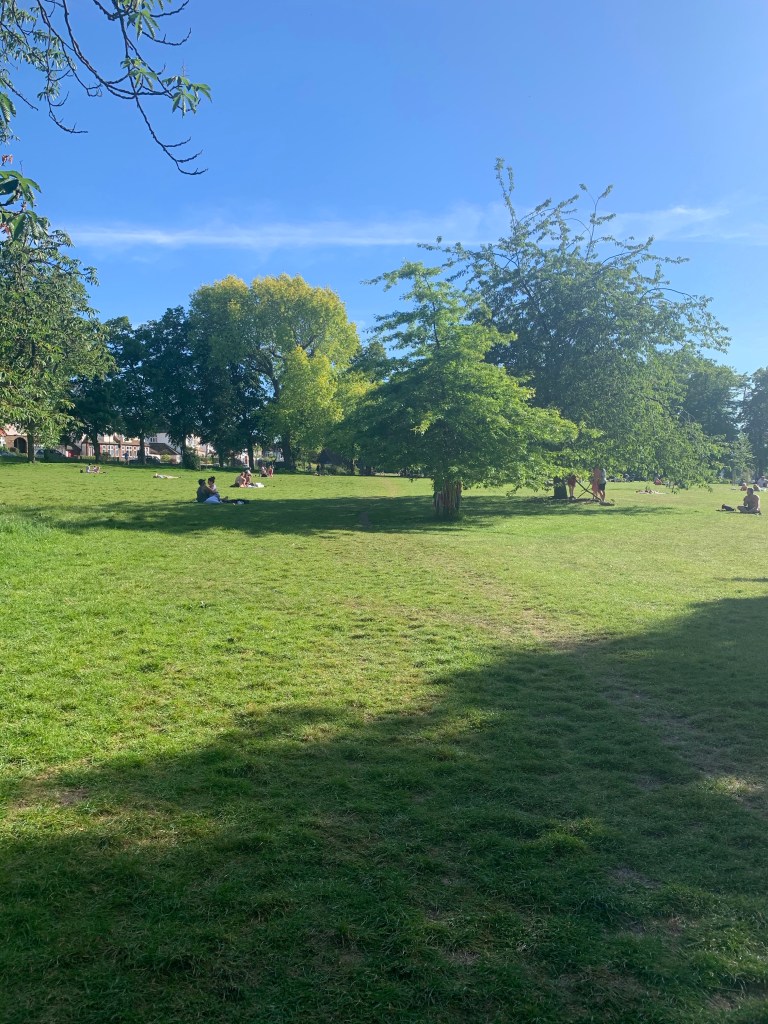
…I found myself enjoying a park walk filled with the colours of spring.

There’s more to life than fight and flight; but you have to stop thinking to find it.

Mind the Gap

For some time, I’ve noticed that people at the top of them can drive themselves and whole organisations to anxiety, stress and overwork; seeking answers to problems which just may not have one.

In computation there are many ‘undecidable problems’ where any possible computer program may give the wrong answer or would run forever without giving any answer at all. A ‘halting problem’ is one where you’ll never know if the program would end. Some of the questions I get asked at the moment feel like these – decidedly undecidable.

Basically these are problems to which there may well be no simple or knowable answers. Finding the answer could take an eternity (and a mountain of work) or continuing to pursue a better answer misses the moment and makes the situation worse.

Computer science advocates ‘Optimal Stopping’; in essence stopping the analysis early enough to get a resource efficient, computationally efficient, ‘good enough’ answer.

The lack of ‘Optimal Stopping’ in senior folk is bad at the best of times. But with Covid-19 it’s a killer – if you keep chasing and asking more and more questions, you just dive deeper and deeper and deeper into the abyss…

So why do otherwise very intelligent, experienced and senior people do it? Turns out because the very apparatus that made them senior – spotting, sweating and sorting problems – ends up torturing them and others.

They worry and worry and chase and question, and expose bigger and bigger gaps between what is known, what can reasonably be done and the problems we have at hand. They’re trapped in a negatively spiralling perpetual motion machine. Because that’s what the mind is – it has an unlimited capacity to spot problems.

That’s perhaps a bit harsh on the mind though; in fact it’s only doing its job… It’s just trying to help us close the gap between where we are and where we want to get to. And this works beautifully for projects which have a start, middle and an end or which require getting from A to B.

I heard Kate Jeffrey explain in a super ‘Mind Bites’ podcast today how our beautifully striped hippocampus constantly encodes the environment, to help us learn, remember and get about effortlessly.

But where the problems start, are when we don’t know where we’re going or how we’re going to get there – or even if we’re on remotely the right road. Especially with the biggest problems of all: how to be happy and live a fulfilling life.

And according to Professor Mark Williams what works for ‘painting by numbers’ problems just makes things worse, when contemplating the complexities of your own self-portrait.

When we find a gap between where we are and where we wanted to be, the ever helpful mind starts trying to close the gap; by asking us questions and spinning at top speed to help us find some answers:

“Why am I sad, why am I failing, why do I feel bad, what can I do about it, how do I fix myself, how do I fix the world”.

Once the spinning starts it’s endless and exhausting. And it’s a major driver of clinical depression, the incidence of which has rocketed in the last 50 years, now commonly starting as early as 13 years of age. All of this and more I learnt in a remarkable series of podcasts from Oxford University on depression by Mark Williams and Dr Danny Penman.

It turns out – thanks to that stripy hippocampus – we are easily triggered into repeated patterns of thought by environmental cues. So much of what we think is triggered by our surroundings and situations. If you’ve been in a bad situation before, just being in the same place or context can flip you straight back into the same spin again. Even different types of music can do it – apparently listening to Prokofiev’s Russia under the Mongolian yoke from Alaexander Nevsky at half speed can make you blue in double quick time!

But as well as environmental cues being triggers, so are our own moods. We can trigger ourselves. When we feel sad we can rapidly connect with other sad memories, and bring back negative incidents. As Kate Jeffrey explained, incidents which were stressful are deeply etched and tagged by the hippocampus into our memories.

And this links to the Oxford podcast on treatments, which explains the reasons people who’ve had depressive illness can relapse so readily. It turns out it is less the ‘content’ of the negative thoughts (although these thoughts create the exhaustion which drives the downward cycle) but the combination of contextual and mood-based triggers, which can flip the mind back in time in an instant – and recreate the cycle of past fears and past incidents that mean you’re quickly spinning, spiralling and falling again.

So what to do?

It turns out that the key is to spot the pattern:

  • The mind finds a ‘gap’ between your actual state and the desired state.
  • The mind starts searching for answers and starts asking you questions.
  • You hear the questions as criticisms or further evidence of the gap.
  • You start to think the gap may be permanent, pervasive and personal – it’s lasting, it’s going to affect everything and it’s your fault.
  • You step up an energy level, as the mind tries harder to help you close the gap; and repeat; and repeat; and repeat.
  • Anxiety and low mood kick in; and the cycle deepens.

Given the mind works at the speed of light this can be very fast, very intense and very exhausting. The bodily organ which consumes the most energy is the mind. No wonder people burn out and fall flat on their backs.

William’s treatment – our old friend mindfulness meditation… The only way to stop the cycle is to quickly recognise it, catch it before it spirals and ‘observe’ the thoughts – to avoid getting captured by them. The inner voice is always talking (and in fact always trying to help) but like a critical parent or a demanding boss, it can’t stop itself. You just have to take a breath and let it pass.

That’s why I’m back to mindfulness meditation as of today. I’ve had Williams and Penman’s book Mindfulness for years, and used to listen to the meditations a lot in the early 2010s. But I didn’t know the science then. For anyone with a lively mind it’s the best defence against depression; and we all need a bit of help right now.

I’m looking forward to tucking into their free Coronavirus resources here.