Complex Pleasures

20130120-164003.jpg

Talking last night with friends about ‘pleasure’, we recognised it’s a complex beast. One of our party admitted she was happy with her life but generally not happy as she lived it. How could this be?

I listened again to Thomas Hurka on Philosophy Bites today to remind me. Hurka identifies four types of pleasure in two categories: ‘felt’ and ‘thought’.

The two ‘felt’ pleasures are: first, ‘simple pleasures’ i.e. specific immediate sensations: “mmm tasty” or “ahh comfortable.” And second, moods – which are a general and last for a duration.

The two ‘thought’ pleasures are specific: “I’m happy that… my daughter is in the school play” or “my football team won” and general: “overall I’m happy with how my life is going”, aka Aristotle’s flourishing.

Of course they are all intertwined. A life of physical pleasures – pure hedonism – might come up short on achievement. Or get cut short by a heart attack. But a life of too much ‘thought’ might lack passions and pleasures and the achievements of love and family.

Apparently, most parents say that the thing which has given them most pleasure in their lives has been the raising of children.

But also, apparently, if you give parents of young children an electronic ‘clicker’ to register every time they feel a sensation of pleasure during their day, they register fewest clicks of personal pleasure when they are actually with their kids. Probably haven’t got time to click…

So Hurka’s four pleasures explain how our friend can think “I am happy with how my life is going” whilst feeling in a permanent bad mood – they have three kids who run them ragged. Doesn’t sound great. But she’s happy, at least on one level.

Sleep’s the big one for me. Now I’m getting my sleep and enjoying my work – as well as enjoying time with my kids – I’m in a pretty permanent good mood. Feeling good is a great addition to my life. Simple to feel, complex to achieve.

Relevant Complexity 5) Age

20120707-124703.jpg

Talking to someone at work, she said she’d been surprised that a very experienced chap in his late 50s had come on a training course.

We concluded that age shouldn’t matter in deciding who gets training. I know plenty of pig-headed twenty and thirtysomethings who’d have got less and will give less as a result of that training course – it’s openness to new ideas that matters.

It dawned on me that nearly all the people I most enjoy conversation and contemplation with, are at least ten years older than me. And many much older. When it comes to thinking about things, you can’t beat the right sort of older person.

Contemporary society glorifies youth. But younger people haven’t always got much to say. Of course there’s freshness and simplicity but relevant complexity in people takes time to grow.

Openness, curiosity and the experience of age are key attributes of the Aristotelian ‘friend in contemplation’. Aquinas’s ‘prudentia’ – practical wisdom – is not innate, it is learned. Wisdom takes time. Forget youth, when comes to interesting people – the oldies are the goodies.

Flights of Fancy

20120519-121313.jpg

I found myself in a back room at the British Museum this week, looking at pen and ink drawings. I took a couple of photos of simple but stunning sketches by Picasso and Rembrandt.

20120519-123215.jpgAs a child, I remember being taken to see Michelangelo’s cartoons and being mightily disappointed they weren’t a patch on Hanna-Barbera. They were instead faded brown pastels. How times change.

Why the reappraisal – I’m much taken by Ernst Gombrich’s narrative that art of the Dark Ages was flat and naive because it was telling you something. The idea wasn’t to lose yourself in clouds, folds of garments or acres of flesh – but to ‘read’ a very simple and profound message. Almost always an illustration of virtue, sin or gospel truth, simplicity and directness were the point.

This takes me back to Aristotle’s Poetics – plot trumps spectacle and no more or less than is needed. Were I to embark on a painting I’d feel constrained to ‘represent’, to paint ‘well’ and show some technique.

Perhaps that’s not the point, the starting point for the artist is: ‘what am I wanting to say or explore?’ As with poetry, seen this way we are not ‘trapped’ by the fact that everything has been painted more beautifully by Titian, or precisely by the Dutch masters or bleakly by Caspar David Friedrich or vibrantly by Van Gogh.

20120519-090306.jpgThe job of the artist is simply to convey what they want to say or explore. Technique and materials come second. No need therefore to hack off our beautiful – or rudimentary – artistic wings. We can all have a go.

Art and Artists

20120411-223341.jpg

I’ve started E.H. Gombrich’s ‘The Story of Art’ which was recommended by one friend and came up in conversation with another today. Gombrich says there is really no ‘Art’, only artists and what they create.

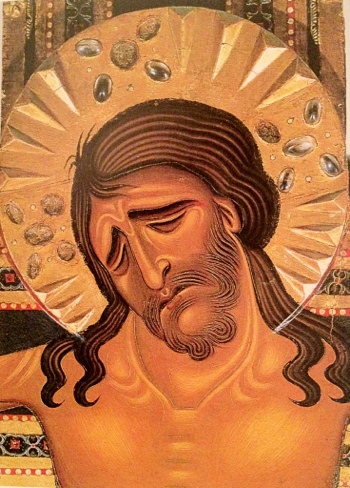
A lot of what what ‘Art’ is actually about, is nothing to do with experts, critics, audiences or patrons – it’s about the artist and their personal effort to produce something of intrinsic value. The painting above from ‘The Story of Art’ simply and powerfully captures not only the passion of Christ, but also the passion of the unknown 12th Century artist.

I pointed out today that this connects with one of my dictums for social media – if you like what you’ve done that’s good enough, don’t worry about anyone else. I think social media is largely about forgetting the ‘audience’ and simply writing or posting something you personally care about, are interested in or want to say. It then finds an audience through chance and serendipity.

At this point in our conversation today I was forced to bring in Aristotle – and we had a laugh about it. Aristotle is knockout reference once you buy into him. There’s often nothing more to say once you’ve heard what Aristotle said on a subject.

So, drawing on Aristotle’s ‘Poetics’, my definition of the job of the artist – and bloggers too, I reckon – is to forget about ‘Art’ or ‘audience’ and simply:

Say, write, paint or sculpt something transcendent and universal about the human condition in no more and no less words, notes, chisel blows or brush-strokes than are needed.

If it’s good it will find appreciation – if only from the person who matters most, the artist.

Lost in Translation

20120318-114727.jpg

20120318-114753.jpg

As I read and write more, I come to enjoy the turns of phrase of past times. I’m not arguing for Chaucer in the original – life’s too short. But the thundering prose of the King James Bible or a decent translation of Aristotle, for example.

Having learnt that ‘plot’ is everything in poetry, I largely fell for Aristotle’s Poetics based on one line:

The getting-up of the spectacle is more a matter for the costumier than the poet.

I’ve quoted this at work a few times to point out the job at hand – substance not spin. And I found myself quoting it to the missus last night having watched ‘The Immortals’, which I found a big disappointment.

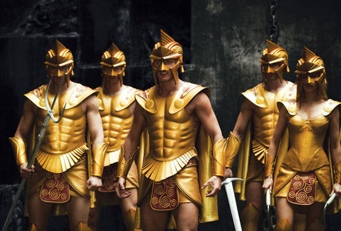
I do enjoy a good ‘sword and sandals’ epic, and I really wanted to like it. But ‘The Immortals’ managed to make very little of the ‘plot’ of Theseus, whilst expending far too much effort on the costumes and CGI. They even ripped off Maximus’s helmet from ‘Gladiator’ for an all too boyish Zeus (see above).

Ridley Scott knows, as Aristotle said, that: the first essential – the life and soul of Tragedy – is the Plot. I fear the Director of last night’s disappointing fayre, was reading the more leaden modern translation of my favourite ‘Poetics’ quote, from the duff version I bought on my Kindle:

The production of spectacular effects depends more on the art of the stage machinist than on that of the poet.*

Too much stage-machinist and not enough poet in ‘The Immortals’ for me. Had Aristotle seen it, he’d be gently shaking his head – more in sadness than in anger. Theseus, the founding myth of Ancient Greece, was very much lost in translation.

*So if you’re buying Aristotle’s Poetics, I’d buy Ingram Bywater’s 1920 OUP translation, which you can get for free on dailylit.com.