Deep Time


Reading Neil MacGregor’s A History of the World in 100 objects, on chapter 91 I came across the concept of ‘deep time’. And deeply troubling it must have been in the 1800s; as people began to come to terms with it.

‘Deep time’, I discover, was the dawning recognition that the world was much much older than people had thought – and far less constant. Prior to ‘deep time’ the world was assumed to be capricious (hence gods) but unchanging (hence the need to pacify them).

The geneticist Steve Jones (who I’ve been fortunate to spend some time with) is quoted thus: 

The biggest transformation since the Enlightenment has been a shift in our attitude to time, the feeling time is effectively infinite, both the time that’s gone and the time that’s to come. It’s worth remembering that the summit of Everest, not long ago in the context of deep time, was at the bottom of the ocean; and some of the best fossils of whales are actually found high in the Himalayas. 

Deep time threw everything up in the air – origins, purpose and our place not just in the world; but in those unfathomably vast aeons of time and the unimaginably vast expanse of the universe. We went from the centre of everything to tiny, transient and trivial.

Faced with this reality I’ve often cheered myself up with the thought that bits of me were formed in stars. And I read somewhere once, we all have some molecules in us which were once in Julius Caesar and Napoleon. 

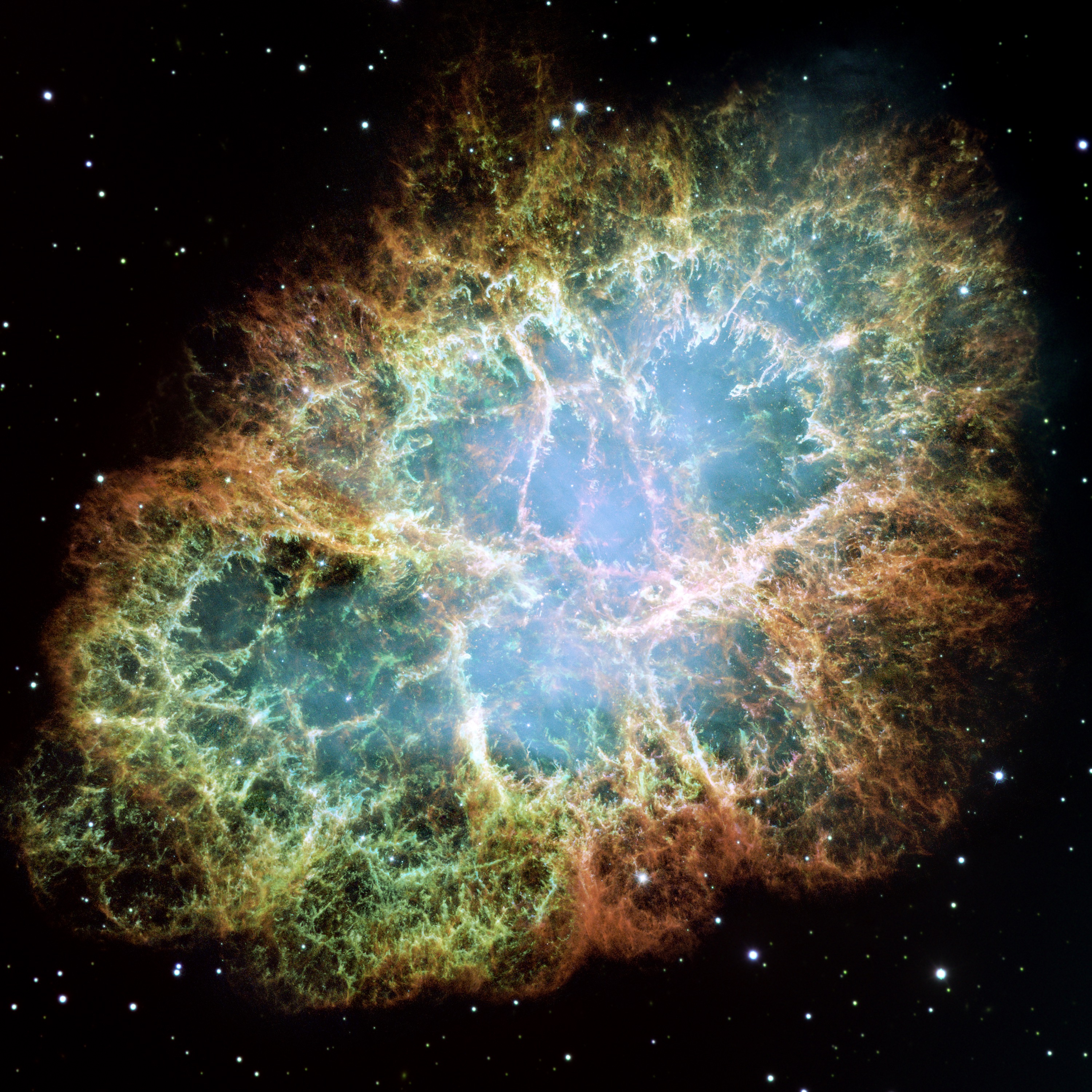
Nice therefore to read an entire feature in the New Scientist today, predicated on exactly this; the calcium atom formed in a star which is now in our bodies, the water in our blood which was once in a dinosaur etc. But the one which sparked my imagination was Stephen Battersby’s story of the iron ion formed in a supernova. 

I pick up the iron nucleus’s journey here, as it is spat out from the periphery of a large black hole: 

By the time our iron nucleus leaves this maelstrom, it has an energy of about 8 joules, millions of times greater than anything Earth’s Large Hadron Collider can provide. Now at about 99.9999999999999999 per cent of the speed of light. It is flung out of its native galaxy into the emptiness of intergalactic space.

As the iron nucleus wanders between galaxies, pulled this way and that by magnetic fields, its view of the universe is a strange one. At this ludicrous speed, the effects of relativity compress faint starlight from all directions into a single point dead ahead. Relativity also does strange things to time. While the nucleus is travelling, the universe around it ages by 200 million years. In another distant galaxy, Earth’s sun completes one lazy orbit of the Milky Way, dinosaurs proliferate, continents split and rejoin. But to the speeding nucleus, the whole trip takes about 10 weeks.

On the last day of its intergalactic holiday, our traveller finally approaches the Milky Way’s messy spiral. It heads towards a type G2 dwarf star, and a planet where the dinosaurs are now long dead. According to onboard time, the iron nucleus passes Pluto just 16 microseconds before it reaches Earth. When it arrives here we call it an ultra-high-energy cosmic ray.

The wispy gases of our upper atmosphere present a barrier far more challenging than anything it has encountered so far. The iron nucleus hits a nucleus of nitrogen, and the extreme energy of the collision not only obliterates both, but creates a blast of pions and muons and other subatomic particles, each with enough energy to do the same again to another nucleus, generating a shower of ionising radiation that cascades down through the atmosphere. 

Some of these particle will hit an airliner, slightly increasing the radiation dose of passengers and crew. Some may help trigger the formation of water droplets in a cloud – perhaps even help spark a lightning bolt. Some will find their way into living cells, and one will tweak an animal’s genes, spurring on the slow march of evolution. But it is very likely that nobody will even notice as the atmosphere scatters the ashes of an exceptional traveller that once flirted with a black hole in the faraway Virgo Cluster.

Remarkable. When I had the chance in 2011 to spend a couple of hours with Sergei Krikalev (at that time the cosmonaut who had spent the most time in space) he told me you typically see eight to ten scintillations in your eyes every minute in orbit – little flashes in your vision – which are the cosmic rays punching through your eyeballs.

But this story of an iron nucleus would surely seem as far fetched to a person in 1815, as the things they believed then may sound to us now. A reminder that deep time for us, is only 200 years old – just a blink (or twinkle) of the eye for a cosmic ray.

Looping

  
I’ve been repeatedly turning over a few tricky challenges in my head. Talking helps, but I realised this week the answer is to stop talking and get biking…

Since I started my new job I’ve been cycling much less. Complex logistics, earlier starts, different buildings, unpredictable start and end points. It all adds up to getting the bus. But that needs to change.

I realised this week that one of the things I’m missing the most, is the answers to difficult situations floating into my head 20 mins into cycling into work…


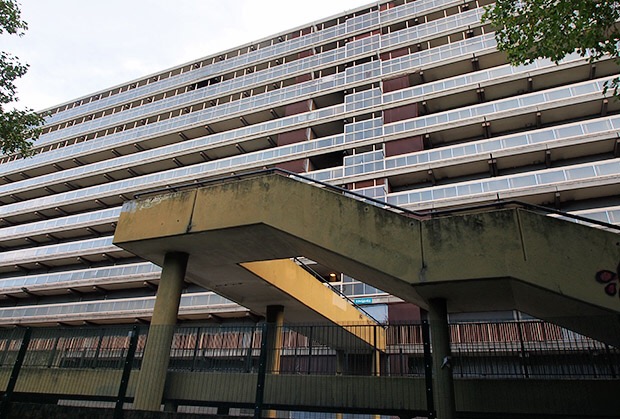
It always happens on this same corner too – which used to be an awful high rise (as above) then derelict and is now a huge building site. 

Hardly inspiring. But whatever the state of that corner it’s always the place inspiration comes. 

It’s clearly a freewheeling thing. Because it’s a certain time into biking a very familiar route my mind obviously goes into neutral – and goes neural. I can’t count the number of good ideas I’ve had on that corner. 

So if I want to stop looping on the same complex problem, the answer is – get on my bike. I’ll be doing so from Monday. 

A problem shared


Lots to learn and lots to figure out in my new job – I’m dreaming complex organisational structures most nights; and in truth, I’d rather not be. But the most important lesson of all is… even if not halved; a problem shared is a problem better understood.

Three people greatly helped me with my problems this week. Not by changing anything about the real world situation; but by taking time, listening, showing concern and helping me to describe what is happening. 

It’s a rare person indeed who is prepared to properly care; so I’m very lucky indeed to have access to a handful of exceptional people with great life experience and insight who really do. 

None of these people are ‘friends’ in the classic modern description: they’re not people I’ve known since schooldays, inflict my family on or go on holidays with. They’re all people I’ve met in a variety of work situations. 

None of them know each other – I don’t even know if they’d get on. But my life is enriched and any problems I have (and there are usually one or two) are reduced by talking to any one of them.

Someone I also saw this week – whose professional life went badly wrong once – asked me if I had anyone to talk to about where I’m at; any kind of support network? 

I smiled inwardly at that. The answer is an unequivocal yes. I have some very special people, who will always listen and help me to a better place.

A problem shared with these remarkable friends, really is a problem halved.

Peace in our time

After some months of high emotion, major change, turbulence and anxiety; this morning I woke up knackered – but at peace.

My other half greeted me, observing I looked like ‘death warmed up’; sleepy, unshaven and generally out of it as I staggered into kitchen. True, but that wasn’t the point….

Some minutes later: accompanied by a nice piece of classical music, porridge on the boil; duck ramen, a bunch of flowers and a trip to Sainsburys in my plans – normal service has resumed.

Not that ‘change’ is done. More that it’s here to stay and be lived with. There’s a stack on at work, the kids are growing faster than feels comfortable, and we’re none of us getting any younger…

But yesterday for half term, my smart cookie of a daughter and I toured the architectural wonders of my new workplace, two museums, Chinatown, saw Giacometti sculptures, bought books and ate Japanese.

Perhaps that’s what’s fixed me. I don’t feel rattled, restless or anxious – for the first time in weeks. I just am. And she’s nearly finished munching a ham and cheese croissant in front of me now, so back to it.

Perspectives


The thought that ‘people’ are just a manifestation of different causes, drivers and phenomena is an interesting one. 

We all have a strong sense of ‘self’. And an equally strong sense of other ‘selves’ too – not least when those other selves jostle, oppress and thwart us.

So the Buddhist doctrines of ’emptiness’ and that we have no ‘inherent existence’ challenge the common sense experience of selves, ourselves and selfishness.

Somewhat tired, somewhat hot; and somewhere between bored and irritated – I had a moment of enlightenment reflecting on this, at a work event this week.

This speaker who is mildly irritating me, on many levels simply does not exist at all…

If I looked at them at the molecular level, they’d just be a greyish fuzz of particles – in fact when you think about it, at the molecular level it probably makes no real sense to think in colours or shapes at all, it’s all a probabilistic blur.

At a bacterial level, that person was a teeming mass of microbes; which largely outnumber ‘their’ own cells. And many of those were probably running faster, because of the heat of the room and the anxiety of speaking.

As they were speaking, the speaker was constantly having holes punched through them by cosmic rays – some generating cellular malfunctions and mutations which the person’s immune system was hopefully mopping up.

At a planetary level, the roomful of people I was sat amongst would be about as visible and significant as a handful of microbes on a Petri dish is to the human eye.

And at a room level, lots of mounds, fungi and little creatures were probably gently coming to life thanks to the light, heat, food and prey that sixty odd people were all exhaling, expelling, shedding and radiating. 

And that’s before we get onto scales of time – how does an hour of speeches look on the timeline of a mayfly, an oak tree or a solar system?

With all those things going on, it’s hard to stick with the idea that the only thing happening in that room, was a person with an ego imposing their ego on my ego.

Letting go of the ‘person’ and seeing the myriad causes, effects, scales and timescales in which you could see them, helped me escape irritation; and embrace a sense of wonder. 

Different perspectives helped me get a different perspective.