
A Much Loved Friend

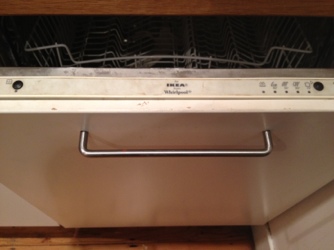
20120128-191348.jpg

A much loved friend
Has come to the end
The dishwasher, tired
Has finally expired
I’m left bereft
And swabbing mop handed
The hours I’ve spent
Hunched and bent
Playing messy chess
With cups, plates and dishes
But now it stands idly
Lights out and silent
It shared my pain
But could no longer drain
A decade of suds
Cut off at the mains.

We take for granted labour-saving devices. But you sure notice them when they’re not there. It has only been bust for a day, but the dishwasher is sorely missed. According to a book the missus is reading, it takes less than a second today to earn an hour’s worth of artificial light. In the 1950s it took three seconds. In 2000 BC it took 9 months – the only oil was olive.

Our modern lives are remarkably free of fetching, carrying, scrubbing and cleaning – which has come to pass in less than a lifetime. As I don rubber gloves and squirt washing up liquid, I am briefly (I hope) reacquainted with the drudgery of pot washing.

I will miss my reliable old friend and the three dimensional chess which was packing a family’s pots, pans and dishes into its slightly too small space. A flashy new one should arrive in a week – fingers crossed – but this one has earned its place in white goods heaven.

Relevant Complexity 2) Hobbies

20120129-213404.jpg

Until last year I absolutely didn’t get ‘hobbies’. Now I am persuaded hobbies maketh the man. The big mistake in life, I reckon – observing overwork, depression and recession hitting even the most high powered of my friends – is to have your work completely define who you are.

As Aristotle said: All paid jobs absorb and degrade the mind.

Sure we all have to earn a living. And if a trick of fate and a twist of ability take us to major responsibility, so be it. But a wider reading of Aristotle suggests no man can be ‘excellent’ who only works; much less ‘happy’.

Who we really are is often better indicated by what we do for leisure and pleasure. Of course being a ‘wage slave’ doesn’t always leave much space or time – and in antiquity, for most, there’d have been no time for leisure or pleasure at all.

But what we ‘freely’ do is a window to a person’s soul. Or perhaps better – as a typing mistake just suggested – a window to a persons ‘souk’: the bazaar of stuff we do and like.

A lot of hobbies are conventional: sports, music, walking, reading and none-the-worse for that. Some are apparently bonkers. I know a man who has laboriously constructed a scale railway in his back garden which his own daughter is forbidden to touch.

Some hobbies are sociable – choirs, ensembles, ramblers. Some are quite solitary – stamps and the myriad forms of collecting. Some border on sociopathic – travelling football fans notably. But what they all have in common is they endlessly fascinate the aficionado and generally bemuse the disinterested onlooker.

Of course once you spot it, the driver is ‘complexity’. Hobbies enable us to collect deep knowledge, unique complex skills and relevant (at least to obsessive) complexity. Hobbies are Csikszentmihalyi’s ‘flow’ par excellence – high challenge met with high skill.

“Who scored the winner against Scunthorpe in 1974?”, “What was the printing error in the 4d Commonwealth Games commemorative stamp?”, “What’s the winter plumage of that bird?”, “Can you play Schubert?”, “Is that a class 47 locomotive?”, “Is that a Bordeaux or a Burgundy?”

All of of these bring ‘flow’ to the expert. They are validated, either, by one’s personal appreciation of oneself or the appreciation of the ‘community’ of expert practitioners, fruitcakes and obsessives who share our particular interest.

But the art of life – and hobbies – I think is to weave together our passions with the other things we care about: family, friends, communities. There is joy to be had in literally any hobby – with practice we progress and develop mastery of its complexity.

As Aristotle said: ‘Excellence is an art won by training and habituation. Excellence, then, is not an act but a habit. [Or maybe a hobby?].

But there is also a trap – eccentricity and sheer oddness. The trick is in making at least some of our hobbies cohere into ‘relevant complexity’ so they define and develop us as much as our work does.

A friend described how he and his teenage son seek the ultimate ‘fried breakfast butty’ every Saturday. It’s about the only thing which always brings them together; relevant complexity. Building a garden railway, for me at least; irrelevant complexity. Writing for pleasure, relevant; long stints staring at the telly, irrelevant.

Albeit, as Aristotle said: different men seek after happiness in different ways, I think sewing (or knitting for my other half) ‘relevantly complex’ hobbies into the fabric of our lives is essential to properly embroidering life’s rich tapestry.

As Aristotle said of education, but might have said of hobbies if he’d read Csikszentmihalyi:

Education is [Hobbies are?] an ornament in prosperity and a refuge in adversity.

And

Education is [Hobbies are?] the best provision for old age.

But, of course, who am I to say. As the great Greek also points out:

Happiness depends upon ourselves.

And the fact I am secretly proud that I know what a Class 47 locomotive is, shows the perils and pleasures of hobbies. Keep it relevant.
Surprise!

20120116-214314.jpg

Guilty dad
Feeling bad
Leaving son
To party ‘fun’
Two hours later
The flushed victor
Allays my cares
He’s only the winner of musical chairs.

Kids eh. There’s always more to them than meets the eye. Much like particle physics, if you’re there to observe them you become quantum entangled and affect what they do. Left to his own devices in a roomful of strangers, the boy done just fine.

Buddhify

20120114-181217.jpgI’ve been up for a bit of meditation for a while. But I didn’t fancy too much mumbo jumbo so I’ve dithered. I mentioned it to someone who’s origins are in the East and he smiled sagely and commended it. “Everyone should learn to control their mind.” he said. I said I’d try it when I have time. He smiled knowingly and offered “make the time”.

A friend put me onto ‘mindfulness’ before Christmas and suggested a CD. But that left me thinking where can I play a CD in peace in our house? Pondering this – as so often in modern life – I found a solution waiting for me in the Apple App Store: Buddhify.

Buddhify is a nicely designed no-nonsense ‘snack-sized’ introduction to ‘urban meditation’ which certainly works for me. On a train, yesterday, I did a short module designed for travel on ‘clarity’.

The idea, gently and melodiously articulated, was to step back from noises and lights and people and rattles and clunks and view them as a mental ‘firework display’. And one, which with training, you can observe with a certain amount of abstraction.

As the voice-over says, it’s interesting how our consciousness is ‘tugged’ from one thing to another: staccato sunlight shining low through trees, the heater blasting out under my feet, an itch behind my knee, my breathing, a person tapping on a table, the clatter of wheels on rails.

There are lot of mental fireworks going off all the time when you stop to’observe’ them – even when you’re not consciously thinking or doing anything. Little wonder it’s sometimes hard to relax.

But, in a matter of minutes, whether by breathing, watching the fireworks or noting that I live in a body, and noticing which bits of me are tense and which relaxed (I noticed bizarrely that my front teeth were my most relaxed bit once) these little Buddhify routines clear the head and calm the body and mind.

The tricky bit is finding a place and a time where it’s ok to close my eyes! Announcing you’re ‘off to meditate’ sounds a bit yogic. But slipping some iPhone earphones in is neutral enough. Well done Buddhify – a miniature, minor, modern marvel built on centuries old wisdom. Well worth a mindful if you have a smartphone.

Relevant Complexity 1) The Spice of Life

20120108-152605.jpgMy new theory of everything: all purpose and enjoyment in life is found in ‘relevant complexity’.

I came to the idea via the Hungarian American psychologist Mihili Csikszentmihalyi’s theory of ‘flow’: that we achieve optimum experience when we meet considerable challenge with considerable skill. Or put another way – when we master complexity.

I propose, that, the value of doing something and the intrinsic enjoyment in doing it, lies in it having and creating further ‘relevant complexity’. Let’s prove the pudding with food.

Does relevant complexity describe our relationship with food? Yes, I think it does. I’ve started doing lots of cooking lately – not least Indian. I seem to really enjoy it. Why? It needs doing. I get a break from the kids. When I get it right I get positive feedback from the missus. And, I mostly quite enjoy eating what I cook.

Notwithstanding there are some great dishes which are very simple, most of what’s considered ‘tasty’ in the world’s cuisines involves blending different ingredients, tastes and textures in relevant complexity.

To many, too much of one, one that’s out of place or the wrong blend of ingredients creates irrelevant complexity – often simply nasty. In fact I’d argue that even the simplest ‘great’ foods rely on great ingredients – which are often very complicated to grow, make or rear, requiring optimum care and conditions.

As the scientific chef Heston Blumenthal points out, cooking is applied chemistry. The complexity comes in applying it to that most unpredictable of non-linear systems – human taste.

And tastes develop and mature with experience. Taste doesn’t stand still, it is cultivated and grows. Blame ‘flow’, if the challenge doesn’t move on we become bored.

So, I conclude the joy in making and eating food lies in creating, enjoying and cultivating a taste for ‘relevant complexity’. It’s the spice of food life. Mmmm.