Language

Re-reading a chapter of Herbert McCabe’s ‘On Aquinas’ last night, the outline of a new understanding emerged from the complex conceptual haze of the ‘philosophy of language’.

Language is the means through which we transcend individual experience and share our lives, ideas and culture with others. So far so obvious – Stephen Hawking’s is a brilliant mind but without a twitch sensor and a computer voice he’d be lost to us, alone trapped in his own head.

McCabe, following Aquinas and Wittgenstein considers language as exclusively ‘public’. It exists outside and apart from the sense perceptions of people – it has to otherwise it would not work as a means of sharing understanding.

So while my ‘red’ might look and feel different to yours (although probably not that much) as soon as we name it, it ceases to be my ‘property’ and becomes a shared one. As McCabe points out, my sense perceptions are my own, but my words ‘belong’ to the English language and are public, shared and ‘intersubjective’ – i.e. most people would agree on what they mean, otherwise they wouldn’t work.

Why is this so important? Well as Aristotle said: ‘It us the mark of an educated mind to be able to entertain a thought without accepting it’.

Similarly it is the mark of an animal with language to be able to describe, contemplate and imagine actions, not simply to feel, jump and act. Without language there is no reflection, just action and reaction.

For Aristotle, Aquinas, Wittgenstein and McCabe, language is not just a fancy tail feather or ornament on human intellect – it is human intellect. Language is the difference between pure instinct and intelligence, communication and culture.

The penny has dropped for me – something I didn’t ‘get’ when I did philosophy at University. David Hume and others persuaded me that sensations come first and language just describes them. But I now reckon it’s the other way around – language marks off and frames sensations so we can contemplate them. Language is not just communicating, it’s everything.

Language also connects us across boundaries of space and time. Herbert McCabe lives on through his limpid, lively philosophical prose. Like Montaigne, you feel you know the man when you read what McCabe has written. Shrewd, perhaps a little stubborn, quick-witted, sharp – and for a monk, disarmingly worldly and funny.

As Aristotle said, we are we repeatedly do. Perhaps, also, we are what we repeatedly write – poetry, prose or philosophy.

Veni, Vidi, Amici

As I get on in life, I get to spend time with some interesting, clever people. But they can come with sizeable egos. And that can translate into ‘High Status Behaviours’.

That’s not necessarily a problem. ‘Happy High Status’ is feeling good enough about yourself that you can feel relaxed and good about the success and contribution of others. But not everyone manages to keep the ‘Happy’ in High Status.

The alternative is less attractive – being so concerned with your own status that you need everyone else to recognise it. Or worse, to knock down others to assert it. I wonder if there’s a Greek term for that? Narcissism is one.

But whatever you call it, loneliness seems to me to be an inevitable by-product. I think dominant High Status behaviours are completely missing the point of life.

For Aristotle, that central point is to attract and nurture better friends. Friends care for our virtue and excellence, as we care for theirs. The best of friends are the means and end of it all.

But, as Aristotle said:

No one loves the man whom he fears.

He who hath many friends hath none.

No one would choose a friendless existence on condition of having all the other things in the world.

So why do smart, successful, powerful people sometimes behave in ways that seem to get in the way of true friendship?

Seeking power, wealth and acolytes has always been a primal driver. And on the face of it, it helps not to be too sentimental. But an instrumental view of others – that they are means to your end, hammers useful only as long as there is a nail – is missing the point I feel. As Aristotle also said:

My best friend is the man who in wishing me well wishes it for my sake.

Friendship of this type is earned, nurtured and freely given, not bought, demanded or taken. About the best thing in life, I reckon, is true Aristotelian friendship.

A contented ego is a prerequisite, but a conceited, instrumental or selfish one just gets in the way. Friendship, not conquest, is the purpose of the good life.

Five Minutes

What is time? Judging by my day today, five minutes is the difference between happy and sad, frustration, tears, pressure in the chest cavity and making it just in time – or just too late.

As Kierkegaard said, the demands of the ‘ethical phase’ of life are unlimited. And they lead ultimately to failure and despair. 

But perhaps not. Five minutes is also long enough to clear your thoughts, take a breath and change the internal weather. A smile, a shrug, a stoical thought and a moment’s reflection before marching on. 

It all gets done, and if the demands are unlimited, the rewards are too – a big hug from a small child, a smile of thanks from a good person you’ve helped and the sense of being appreciated, needed and loved.

As the philosopher king and Roman Emperor Marcus Aurelius wrote in his Meditations:

The only rewards of our existence here are an unstained character and unselfish acts.

It’s not all bad meeting the insatiable needs of others, so long as you save the odd five minutes for yourself.

Sacre Bleu

A splendid weekend en famille à Paris was marred only by two extraordinarily slooowly served meals. I’d write Zzzzz. But with four children, from 4 to 8 years old, over an hour of waiting – each time – for any food was more @!&£.

I was less bothered than the people I was with. Perhaps because having lived in Paris, I find surly service strangely reassuring. As a Parisien taxi driver told me on my last visit:

God, he is deciding to make a very beautiful country. He is making it very big and putting beautiful countryside and animals in it. He is giving it very good food and very good drink. But then he is realising every-body will want to live here. Merde. So he has an ideé! He puts French people there, so nobody else will want to stay!

In fact once you get the hang of French ‘pipple’ they are quite straightforward. First contact is often brusque – borderline rude – to a British taste (or Australian since we were with Aussies). But give as good as you get and add a bit of humour and you’re ‘best mates’ in no time. It’s as if there’s a threshold of rudeness, which you have to meet, to join ‘Le club français’. Too polite and you’re not worth the bother.

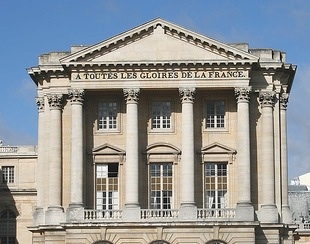
An inscription on the pillared back of Versailles shouts out in capital letters ‘To all the glories of France’. You can’t beat Paris: the Tour Eiffel, the Champs Élysées, crazy driving, le hot dog, le steak frites et le petit café to finish.

Add to that the people. Splendidly rude. But often warm, once the ‘first joust’ is done. It wouldn’t be la belle France without them.

Character Forming

I read an interesting article in my old favourite the New Scientist this week. I’ve been ploughing through some accumulated backnumbers, the magazine having recently been forcibly rehabilitated as a format, after the missus trod on my Kindle and bust it.

What goes around comes around, as the rustling of magazine pages and the need for more light to read newsprint disturbs her slumber at lights out. I feel a shade guilty and remember that part of the reason I bought a Kindle was to be a more considerate bedfellow – and to save my dwindling night reading vision. More carrots and a new Kindle are in order.

Back to the point. The article’s writer Samuel Barondes says ‘personality’ is best understood as a composite of: dispositional traits, troublesome patterns, character strengths and sense of identity.

I like this idea. But a trying to remember it, sat on the Tube today, mutation and evolution intervened and I came up with a subtly different variant:

1) Innate preferences
2) Experiences
3) Bad traits
4) Our internal narrative.

Similar, but not quite the same. I’ve subconsciously pulled out experiences – and therefore, implicitly, the environment. Perhaps that’s because I increasingly believe much of what we are is shaped by chance and circumstances.

But ‘bad patterns’ or traits, as a significant part of who we all are, is a discovery. When you think about it we all have them. And when it comes to bringing them to life, Theophrastus, whom the article signposts, takes some beating. Theophrastus was a pupil of Aristotle and wrote extensively on flora. He also wrote a field guide to that most variegated of fauna – the human being.

The Characters of Theophrastus – a bit like Aristotle’s ‘On Physiognomy’ – tend towards the negative in people. Perhaps both disliked extremes and preferred the ‘golden mean’ as their prescription for the ‘good’ character. For his part Barondes says every culture values self-control, kindness and a sense of one’s place in the universe.

I read Theophrastus’s thirty ‘characters’, and to my growing embarrassment recognised myself strongly in two, and a little in another one. The good news, at least based on my list, is I can forgive myself a bit.

Some of my bad patterns are innate, some the fault of my environment. But my best defence against my ‘bad traits’ is an increasingly clear narrative if who I am and what I am for. Half-way through my life, I reckon the last element of ‘character’ is the one I can do most about.

We are all basically a self-edited ‘story’ looking backwards. And, following Aristotle, we are all the sum of our actions going forward. So I conclude it’s well worth continuing to pay proper attention to both. Theophrastus is a warning to those who don’t.