The Eaves

Cycling to work every day I get a regular soaking. Decent waterproofs help. But there are days, when looking out of the kitchen window, I don’t fancy it much. A number of years ago in the book ‘Angry White Pyjamas’ I read a quote from the Hagakure – the Japanese Book of the Samurai. It advised stepping out from the eaves:

There is something to be learned from a rainstorm. When meeting with a sudden shower, you try not to get wet and run quickly along the road. But doing such things as passing under the eaves of houses, you still get wet. When you are resolved from the beginning, you will not be perplexed, though you still get the same soaking. This understanding extends to everything.

I was reminded of this, in the week, by Montaigne’s similar write-up on the Roman Legions:

Their military discipline was much ruder than ours, and accordingly produced much greater effects. The jeer that was given a Lacedaemonian soldier is marvellously pat to this purpose, who, in an expedition of war, was reproached for having been seen under the roof of a house: they were so inured to hardship that, let the weather be what it would, it was a shame to be seen under any other cover than the roof of heaven. We should not march our people very far at that rate.

I don’t mind being rained on, but I’ve often thought I’d last about five minutes on a proper Roman or Medieval battlefield. Some glum milling about before, and then probably a spirited moment of excessive unavoidable bravery early doors followed by a sharp death. That sounds about my fate. I can only assume my forebears were quick to procreate, as I don’t reckon we’d have lasted long.

But my other pet theory is we were scouts and messengers. Sharp eyed endurance runners with a precise tongue. Who knows. The Hagakure is admirably clear on the matter: ‘Bravery and cowardice are not things which can be conjectured in times of peace. They are in different categories.’

Some Hagakure quotes are positively Aristotelian, take:

‘Intelligence is nothing more than discussing things with others. Limitless wisdom comes of this.’

But like Aristotle, with his theories on biles and humours – and posture, character and beards – not everything in the Hagakure is to modern tastes. As ‘Angry White Pyjamas’ also highlighted:

When one departs for the front, he should carry rice in a bag. His underwear should be made from the skin of a badger. This way he will not have lice. In a long campaign, lice are troublesome.

I’ll step out from the eaves in GoreTex and Lycra, but I draw the line at the skin of a badger.

Sock Drawer

In a brief moment of peace this morning – as newly shod children ran from the house with their mother – I wedged in a bit of Aristotle. Via dailylit.com, I opened a couple of chapters of ‘On Poetics’, including the famous line: ‘Poetry is finer than history, as it describes the universal, while history describes only the particular.’

Aristotle is fascinating on ‘plot’, beginnings and endings and the ideal length. Most of all though his point is that plot makes poetry – not verse or the central character. The poet’s prime job is to say something transcendent and universal about the human condition, in a length which contains no more and no less than is needed.

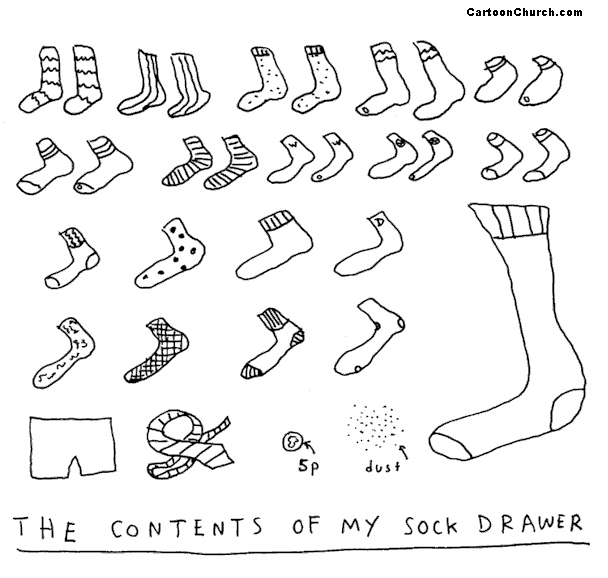
Reading Aristotle is like having your intellectual sock drawer sorted for you. Concepts ordered, ideas reconnected. Then everything neatly paired and placed just so. Not showy nor rhetorical, bombastic nor florid. No more and no less than is needed. And, without fuss, a tidy drawer of knowledge and ideas added to your head. Marvellous.

Luke Skywalker

I read a survey in the week which said 70% of grandparents think their children are too soft in disciplining their kids. I spoke to a grandmother at work about it and she laughed but agreed. She said her grandson behaves (marginally) better with her, but is a real tearaway with his parents.

Too much choice and negotiation these days we agreed. But she coughed one clue to her tricks of the trade: ‘It’s a grandparent’s right to treat their grandkids”… Hmmm where have I heard that before?

The ‘force’ is strong with my son at the moment. Smiling and ignoring instructions has given way to running off laughing and disagreeing with everything. Cheeky monkey.

In the literature this looks like early onset ‘oppositional behaviour’. For which, the prescription is unconditional love and non-negotiable boundaries enforced reasonably – not cajoled with treats. No problem with the unconditional love, but treats have become a bad habit through these long summer holidays. Still he’s starting school next week. That’ll knock him into shape.

All the attention this week has been on his sister starting her new school. That has been an aggravator. Picking her up, with him, he decided to act up. First, running in circles round the climbing frame evading me. Then running around his sister’s rather stern new headmistress. All this, needless to say, against my very explicit instructions.

Back in the car, with controlled fury, I found myself quoting the daddy of daddies – Darth Vader. I gave him a right old talking to. In response to his red-faced “I’m not your friend anymore”, I boomed “I am your father.” Reminding him my job is to set the rules and bring him up properly, I closed with every parent’s classic “You don’t know it now, but one day you’ll thank me for this.”

With both my kids at around this age, I’ve been reminded of the scene in the first Star Wars trilogy when Luke attempts to lift an X-wing fighter from a swamp using only the power of the force. His tutor Yoda looks on quietly amazed.

So it is with pre-school children in my experience. They are intrigued by clumsily smacking large slabs of behaviour into their parents – just to see what happens. Like Luke with the X-wing they dimly understand how, but they move their parents about and get a reaction.

As my mum, and his grandmother, said to me once “Our job is not to be your friend, it’s to be your parents”. Wise words. My son is bright as a button, but he is not a Jedi yet. ‘Teach him I will’ as Yoda would say.

Font of Knowledge

I owe Steve Jobs a good deal. From early dial-up internet on my original Aqua iBook to blogging with an iPhone and iPad. Despite liberating £1000s from my wallet over the years, I am eternally grateful to him. He has opened up a world of new possibilities, knowledge and ideas to me and many millions more.

Poor guy looks like he’s on his last legs though. Emaciated and gaunt, bowing to the inevitable he stood down as Apple CEO the other day. If I were a betting man I’d reckon cancer will have him within 6 months.

A famously hot tempered perfectionist, I wonder how much cancer has changed him. Diagnosed some 6-7 years ago, reading his 2005 Stanford Commencement address – made to a hall of eager freshmen – he had a pretty ‘nailed on’ philosophy well before the ‘Big C’ properly got hold of him. Like David Servan-Schreiber, cancer will extinguish him but it didn’t beat him.

He calls life’s rich pattern ‘connecting the dots’. I think of it as a ‘Nile delta’ of possibilities. Either way, it’s a fact that life often makes sense looking backwards. But the tributaries down which we flow through life are serendipitous, random and unfathomable. Once you’ve noticed your route though, it all looks pre-ordained.

I quoted Jobs’ example of calligraphy (below) the other day. He created, from random events, the font-rich world we take for granted on every electronic device. Imagine if he’d taken technical drawing instead. It could all have been very different.

The moral I draw? Don’t waste time trying to plan life, live it. Think more about today than next year. Don’t sweat the small stuff. And finally, even the big things in life generally happen by accident, it’s how you respond and what you do next that matters.

Here’s a piece of his Stanford address:

I dropped out of Reed College after the first 6 months, but then stayed around as a drop-in for another 18 months or so before I really quit. So why did I drop out?

It started before I was born. My biological mother was a young, unwed college graduate student, and she decided to put me up for adoption. She felt very strongly that I should be adopted by college graduates, so everything was all set for me to be adopted at birth by a lawyer and his wife. Except that when I popped out they decided at the last minute that they really wanted a girl. So my parents, who were on a waiting list, got a call in the middle of the night asking: “We have an unexpected baby boy; do you want him?” They said: “Of course.” My biological mother later found out that my mother had never graduated from college and that my father had never graduated from high school. She refused to sign the final adoption papers. She only relented a few months later when my parents promised that I would someday go to college.

And 17 years later I did go to college. But I naively chose a college that was almost as expensive as Stanford, and all of my working-class parents’ savings were being spent on my college tuition. After six months, I couldn’t see the value in it. I had no idea what I wanted to do with my life and no idea how college was going to help me figure it out. And here I was spending all of the money my parents had saved their entire life. So I decided to drop out and trust that it would all work out OK. It was pretty scary at the time, but looking back it was one of the best decisions I ever made. The minute I dropped out I could stop taking the required classes that didn’t interest me, and begin dropping in on the ones that looked interesting.

It wasn’t all romantic. I didn’t have a dorm room, so I slept on the floor in friends’ rooms, I returned coke bottles for the 5¢ deposits to buy food with, and I would walk the 7 miles across town every Sunday night to get one good meal a week at the Hare Krishna temple. I loved it. And much of what I stumbled into by following my curiosity and intuition turned out to be priceless later on. Let me give you one example:

Reed College at that time offered perhaps the best calligraphy instruction in the country. Throughout the campus every poster, every label on every drawer, was beautifully hand calligraphed. Because I had dropped out and didn’t have to take the normal classes, I decided to take a calligraphy class to learn how to do this. I learned about serif and san serif typefaces, about varying the amount of space between different letter combinations, about what makes great typography great. It was beautiful, historical, artistically subtle in a way that science can’t capture, and I found it fascinating.

None of this had even a hope of any practical application in my life. But ten years later, when we were designing the first Macintosh computer, it all came back to me. And we designed it all into the Mac. It was the first computer with beautiful typography. If I had never dropped in on that single course in college, the Mac would have never had multiple typefaces or proportionally spaced fonts. And since Windows just copied the Mac, it’s likely that no personal computer would have them. If I had never dropped out, I would have never dropped in on this calligraphy class, and personal computers might not have the wonderful typography that they do. Of course it was impossible to connect the dots looking forward when I was in college. But it was very, very clear looking backwards ten years later.

Again, you can’t connect the dots looking forward; you can only connect them looking backwards. So you have to trust that the dots will somehow connect in your future. You have to trust in something — your gut, destiny, life, karma, whatever. This approach has never let me down, and it has made all the difference in my life.

Bayesian Ethics

As I’ve written before, one of my past wrestles is with Utilitarianism: that the moral act is the one with the best consequences regardless of what rules it breaks. I’m now firmly Aristotelian – aka a ‘virtue ethicist’ – we are what we repeatedly do.

But Anthony Appiah the Princeton Philosopher has some challenging things to say about virtue ethics in a Philosophy Bites podcast – including some experiments. And I’m inclined to listen. I like a bit of scientific method.

I like Appiah’s ‘Cosmopolitanism’ too which has helped me articulate my ‘live and let live’ theory of internationalism at work. Humans value culture. Different cultures value different things. And Cosmopolitanism says, short of harm, we should let them. Which I think is about right.

Appiah challenges virtue with ‘experimental ethics’ – seeing what people actually do, rather than what we theorise, and looking inside people’s heads in brain scanners. He finds, for example, nearly everyone gets more generous to strangers if they find a suitably planted $10 note on the floor.

His conclusion is that the idea of a ‘moral’ person in the Aristotelian sense is not borne out by the experimental reality. For him, we make moral choices based on context, stimulus and ‘in the moment’ not based on ‘character’. I don’t entirely agree, but it’s interesting stuff.

Learning to use the head to override the instinctive ‘yuk’ response or being over-influenced by the situation is one of the things he advocates. But only sparingly. Here’s where rules, norms and culture – plus a moral education – might help. But he’s not for becoming too calculating.

He disagrees with Utilitarianism for example. First, because it doesn’t capture the experimental reality of how we respond to moral situations. Second, because were to implement calculating ‘consequentialism’ wide-scale it would dramatically impoverish human existence. Largely because promoting purely rational calculation would tend to demote difference and different views.

Cultural Cosmopolitanism makes life interesting and liveable. And if you’re going to accept difference in culture you have to accept it in worldview and ethics too. That people care about different things is what makes people interesting – and maddening.

I personally think virtue and ‘outlying’ single instances of behaviour are not incompatible. I don’t doubt that you can get very good and very bad moral choices and behaviours out of me if you significantly change my conditions and stimuli.

I also think that the prospects of me making better or worse choices are determined, yes, by the context and circumstances – but crucially, combined with who I am. And who I am is the product of a life lived, previous choices made, data, concepts and theories within and Bayesian probability mashing all that together in a nano-second every time I act.

I think there is ‘virtue’ and I have a ‘character’. It’s just that the complexity of the probabilistic calculations – all done subconsciously by that marvel of existence, a human brain – mean Utilitarianism is too crude and individual ethical experiments are too simple to anything like capture them. I return to my own dictum – if the human brain were simple enough to understand, we’d be too simple to understand it.

So I like Appiah’s ethical experiments – they deserve a well signposted place in my Bayesian brain’s data set – and I’ve shared then with others too to influence them. But virtue, character and Aristotle’s ‘I am what I repeatedly do’ still work best for me. Thanks to Appiah though, I’m also a Cosmopolitan. So I’m delighted to weigh a well-wrought difference of opinion in the Bayesian ethical balance. It all goes in the mix.