Adults and Children

All adults are big kids sometimes, but often the wrong kind. We keep the petty, squabbling, thin-skinnedness of children but often lose the curiosity, spontaneity and sense of fun.

It’s a bit hackneyed but I still have a lot of time for Transactional Analysis. The simple insight that a lot of our interactions are marred by deliberately or carelessly behaving like a domineering ‘parent’, lecturing or judging an errant ‘child’, describes a lot of what happens at work.

I was congratulated this week for doing an hour-long ‘all staff’ talk without once descending into parent-child. Apparently I was ‘adult to adult’ throughout. But the funny thing is, I wasn’t conscious of it. It was simply a case of being open, honest, respectful and genuinely answering the questions people asked. I used to be quick, slick and evasive. Now I’m slower and straighter – a good thing I think.

But I’ve also learnt that there’s still a space for the ‘free child’ at work. That’s when someone comes over all reproving or domineering and you prick their ‘parental bubble’ with a nifty joke at their expense. It’s risky, but done right it doesn’t half work. A bit of ‘free child’ brings some fun too, some laughter, a feeling things are ok and makes for a happier day. As Aristotle would advise it’s all about finding the golden mean between ‘boor’ and ‘buffoon’. He generally gets these things about right.

To finish, a happy chapter on our local community. I write on return from a public meeting, where we overcame some spirited and sustained resistance to more play equipment, in our once bleak – but now thriving – community park. People overlooking feared noise and teenagers and graffiti. Not unreasonable, but there’s a wider community to serve.

I said a few words in favour, but the Chair – a volunteer of course as all the best people are – managed the meeting with great dignity and some skill. I wrote to him just now to say:

You managed that really really well. Inviting everyone to speak – individually – but not allowing ding dongs was the genius of your chairmanship. It kept it civil, kept us from polarising and allowed people to be heard without hijacking. In the end defeat was calm and dignified not angry and litigious.

His skill was helping us to stay adult, as we discussed children. Being the best of both is what I’m working on.

Servan-Schreiber

I was sad to read today that David Servan-Schrieber lost his battle against cancer the other day. But although he lost the battle, I think he won the war. He lived nearly twenty full and vivid years post diagnosis of a brain tumour. His cancer spurred him to develop as a human being and to write. Reading his books and fearing the big ‘C’ did the same for me.

His writing combined a rock solid scientific foundation with an interest in the whole person. As someone wrote in an obituary, he was tete, coeur et corps – head, heart and body. All I have to say is read his books: ‘Healing without Freud or Prozac’ for the head and the heart and ‘Anticancer’ for the body.

A good man, who it is tempting to say died too young. But reading about his full medical, research, writing, speaking, travelling and sporting life, perhaps at 50 he managed as Aristotle recommends: ‘to rise from life as from a banquet, neither thirsty nor drunken.’ I hope so.

Bonhoeffer

I quoted Dietrich Bonhoeffer to a friend the other day. Bonhoeffer stood up to the Nazis and perished for it in a concentration camp. He is celebrated (pictured on the right) as a 20th Century martyr in Westmister Abbey.

A Christian theologian and a man of obvious moral courage, Bonhoeffer argued – like Kierkegaard before him – for a more direct spiritual connection with God. One mediated by fewer trappings of religion.

He believed we have a deep moral sense, beyond the reach of rational thought which is both our guide and goad. He said our conscience comes from a “depth which lies beyond a man’s own will and his own reason and it makes itself heard as the call of human existence to unity with itself.”

For Bonhoeffer, guilt is a warning about our ‘doings’ conflicting with our ‘being’. A guilty conscience arises when we lose the unity – what some people call ‘congruence’. Our conscience is, thus, like an alarm bell, warning us of the risk of damage to ourselves.

I’m not sure I agree with Bonhoeffer that conscience lies beyond the ‘event horizon’ of thought and will. I’m more with Aristotle that we simply ‘are what we repeatedly do’. For me, reason, will, our actions and character all come together in an intertwined person. But the Bonhoeffer quote I read out today is still a powerful one:

The man with a conscience fights a lonely battle against the overwhelming forces of inescapable situations which demand moral decisions despite the likelihood of adverse consequences.

Bonhoeffer found himself up against truly overwhelming forces and a tragically inescapable situation – it cost him his life. He took moral decisions despite the likelihood, entirely realised, of very adverse consequences. Whether he found it in faith or forged it through reason, that is moral courage.

For Aristotle, courage is the ‘mean’ between confidence and fear. To respond to ‘overwhelming forces of inescapable situations’ with the courage of Bonhoeffer requires a strength built within – the confidence in the importance of ‘unity with oneself’ overcoming the fear of ‘adverse consequences’ and considering them a price worth paying.

But what’s the practical day to day application here? Like the other 20th century martyrs in Westminster Abbey, Bonhoeffer faced extraordinary challenges. History has judged him simply and kindly. Most of us live with less extreme, more attritional moral challenges and choices – do I say something or keep quiet, do I stand up for something or let it go, do I join in talking someone down or keep my mouth shut. And implicit in Bonhoeffer’s words are the fact that others won’t always understand and won’t always judge you kindly.

The thought that conscience is a warning that expedient ‘doings’ might undermine my ‘being’ is a valuable one. It’s less about carrying guilt and more about making choices. It achieves some of what Bonhoeffer would no doubt have wished for us; a simple internaliseable test of our actions.

For me, I think it may be this simple: if I can look others in the eye and myself in the mirror – even amidst the adverse consequences of inescapable situations – I know my ‘self’ is in ok shape. If not my ‘doings’ are damaging my ‘being’.

The Forth Bridge

Twice in the last two weeks I’ve cited the Forth Rail Bridge to describe what I increasingly recognise as a not uncommon challenge – being called upon, like Sisyphus, to do the same thing again and again.

Famously, but perhaps apocryphally, the Forth Bridge offered a couple of hardy Scots lifelong employment in the rain, wind and sleet of the Firth of Forth painting and repainting it. A masterpiece of cantilevered Victorian design, it needs constant painting to keep it from corroding. I remember being told as a child that it took the two men five years to do from end to end. Then they had a day off. Then they started again.

At times organisational life is not unlike painting the Forth Bridge. Any organisation worth its salt divides opinion. Putting your best foot forward, making the case and explaining the strategy to the world, outside and in, is a Sisyphean task of care and maintenance.

I’ve started thinking about work as a bit like our busy family home. Something always needs fixing. It can be a bit untidy. There are shelves to put up and occasionally walls to knock down. Just when you have it looking ship-shape the shower leaks or a roof tile falls off. And then there’s that plan for the loft conversion or a new fridge. You live with – not just in – a house. And so it is at work.

I found myself getting frustrated about a misfiring corporate function the other day. But then I thought it’s a bit like an old chest freezer – burns a lot of electricity, some frozen leftovers in the bottom, but still doing a job. Sure a swanky new one would be nice, but there are other things which need fixing, upgrading, repainting first.

The best you can do with a family home is live well in it, keep it structurally sound and leave it in better shape than you found it. I think that’s a lot of what leading an organisation is about too. As Aristotle might say, the job of the bridge painter is to paint bridges, and of the good bridge painter to paint bridges well. There is satisfaction to be found in painting my Forth Bridge well.

Shower

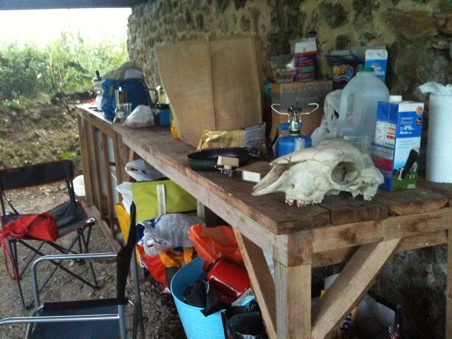
20110718-105113.jpgMan – and woman – in the state of nature is not a pretty sight. Obsessed with feeding and drinking, scavenging for firewood, alternately soaked then sweating. Feral children career about, bumping and thumping each other. Sleep snatched fitfully as the elements do their worst. Not much contemplation here.

What, I ask myself, is the purpose of camping? I may never know. Csikszentmihalyi might posit a ‘rude’ form of ‘flow’. But I’m pretty sure Aristotle wouldn’t have rated it. Certainly not in England’s all too green, and, for much of this weekend, not very pleasant lands. Apparently there was a moment where the entire land surface of Great Britain was simultaneously being rained on. Certainly we were.

I found myself short of temper and shorter of humour. Only Dionysius with his warming grapes and a crackling campfire lifted my spirits. An extra thick sleeping bag and two angelic faces snoring next to me helped too. The family unit held together.

The high point was packing the tent. Both for the manly ‘flow’ I achieved as I dismantled, folded and rolled it and the several nods of recognition for getting it into its bag in one go. More though for what it signified – going home to civilisation.