Mining

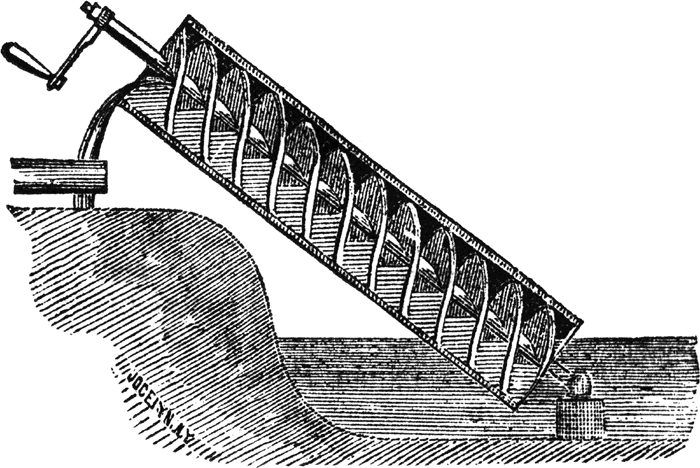
Some time ago the thought came to me that knowledge is an industrial business these days. In Aristotle’s era knowledge was lying around like coals on the fabled Newcastle beach. That’s not to say that Aristotle’s ceaseless collecting and inquiring and ordering where not great feats – and indeed arguably the invention of the scientific method. But there was plenty to go at and lots to be discovered. I consider this the era of beach coal.

Pace the Victorians and the great scientific amateurs. Named for the Latin ‘to love’, they pursued knowledge with independent means, chipping ‘curiosities’ out of geological strata, condensing chemical elements and taking care to ensure god was suitably credited in the processes they discovered. This was the age of independent mining – small entrepreneurs digging deeper and descending into specificity.

Then we enter the industrial era of knowledge. Universities, labs, great machines, competition between countries and ideologies, chemical warfare, Los Alamos, the military industrial complex, the 5 year plan, the ‘white heat’ of progress, the space race and the mindblowingly massive Large Hadron Collider. Science now sinks deep deep shafts and scours entire landscapes in the industrial pursuit of small incremental additions to the sum of what we know.

One of the downsides of this is the great discoverers of our time can generally only tell us a lot about very little. They are so deep down their shaft of knowledge – illuminated only a few feet ahead by their hi-tech miners lamps – that they sometimes struggle to interest the common man. They are also a fractious bunch. As the philosopher of science Thomas Kuhn persuaded me 20 years ago, science is a competitive business. Flying elbows, trashing of reputations, the race to publish first and good old fashioned bickering are all a commonplace. Throw in powerful lobbies and money and the truth easily disappears back down the mineshaft.

Some are frustrated by this and believe public policy makers should rise above the melee and submit to the randomised double-blind trial. Others argue that more research and evidence will lead the human race to peace, prosperity and happiness. A few capture the popular imagination: Dawkins, Hawking for example. A very few (E.O. Wilson the socio-biologist is the only one I can immediately think of) manage to retain an Aristotelian ‘holism’ in their work and advance the big picture as well as the small detail.

So where does that leave the thoughtful polymath of today? Amateurs, in the Victorian sense or ‘lovers’ of knowledge, can feel intimidated without citations, a tenure, papers, experiments, machines and a peleton of research assistants. What chance of any useful discovery? Worse any statement, or thesis advanced might easily be disproved, infirmed or dismissed by competitive, individualistic and fractious experts.

I think the answer is to give up on the search for brand new knowledge. Leave that to the deep shaft miners. And as for ideas, like in the movies all the best plots have been written, all the best ideas have been had. New syntheses are what the complexity, chaos and the pace of change in modern life demand – new takes, approaches, ways of looking at ourselves. 

There are few new discoveries which are accessible to the amateur thinker, but we all have the Bayesian brains to form a new powerful, personal synthesis which helps us and others. 

I think ecology and epidemiology – seeing the interrelations and underlying patterns – not seeking the Eureka moment is where most of us will find our intellectual fulfilment.

Cosmopolitanism

last week, in the middle of an all-day management board full of metrics, deficits, claw backs and targets I popped out to talk to 59 fiercely bright teenagers from 59 different countries on a Global Citizenship programme.

As the bright faces from many places surged into the room, I was coming to terms with the fact that the projector was bust and my well crafted presentation on geopolitics and culture was in tatters. Ho hum. So I went for Plan B which was speak from the heart. I opened with the founding articles of UNESCO’s constitution from 1945:

“Since wars begin in the minds of men it is in the minds of men that the defences of peace must be constructed. Ignorance of each others ways and lives has been a common cause throughout the history of mankind of suspicion and mistrust [which] have all to often broken into war… And that the wide diffusion of culture and the education of humanity… are indispensable to the dignity of man and constitute a sacred duty which all nations must fulfil in a spirit of mutual assistance and concern.”

As said to them, I am a firm believer in ‘founding moments’. It takes great people, but also special circumstances to commit to a different and better way.

I fielded questions about my organisation’s work in education and culture in India, Burma, Aghanistan, Kyrgistan, China and Iran. I talked about what other countries want from the UK and are prepared to work with us on, which varies widely according to the regime, religious beliefs and customs of different countries.

The last question though was a tricky one. “What values do you espouse when you work in other countries and how do you guard against cultural imperialism?” A year ago I’d have struggled with that.

I used to be torn between recognising that if you carry too much ideological baggage or confront cultural differences you get ignored or thrown out, but by the same token you have to stand for something otherwise you feel compromised and weak. I felt that Human Rights were probably where you draw the line, but beyond that I wasn’t sure.

Then I heard Antony Appiah on a Philosophy Bites podcast talking about Cosmopolitanism and it gave me the missing piece in my jigsaw. To paraphrase Wikipedia:

Appiah says Cosmopolitanism is “universality plus difference”, accepting that all of us are fundamentally the same, but we are also all different. He says universality takes precedence over difference and therefore that different cultures are respected “not because cultures matter in themselves, but because people matter, and culture matters to people.” Therefore cultural differences are to be respected in so far as they are not harmful to people and do not conflict with our universal concern for every human’s life and well-being.

When I heard that podcast, some key things slotted into place for me.

So as I said to the 59 young future Global Citizens, I now believe our people should travel light when it comes to values and be interested and curious about difference – even difference we don’t find attractive or acceptable. The Universal Declaration of Human Rights should be stitched into the lining of our jackets, not printed on our tee shirts.

If one of our people finds themselves in a situation where they feel their human rights, or those of another, are being compromised they should feel able to leave. They should be confident the organisation would support them in that. But we are here to engage with difference not shy away from it, we should feel able to say what we each believe and how things are where we come from, but we are not there to singlehandedly confront and change the beliefs of others to be more like ours.

My daughter and I regularly read “We are all born free”, Amnesty International’s super children’s version of the Universal Declaration of Human Rights. She chooses it these days not me.

The 30 Articles, simply put, unarguable, complete and evocatively illustrated. A six year old can largely understand them. And a 42 year old can feel pride in humanity’s occasional capacity to transcend its divisions and write and commit itself to something of lasting value.

I think Cosmopolitanism, with the protection of Human Rights as a floor, is the right answer to a world of cultural difference.

The Fridge Door

I read a top neuroscientist’s suggestion last night that our capacity to understand how the human brain works may ultimately be limited by the capacity of our nervous system. This reminds me of a thought I had when studying philosophy of mind at Oxford: if our brain was simple enough to understand we’d probably be too simple to understand it.

One thing I do believe is that the brain is probabilistic and Bayesian. So I was interested to read what Dorothy Rowe, an Australian psychologist had to say about it in a recent article in the New Scientist:

Over the last 20 years or so, neuroscientists have shown that our brain functions in such a way that we cannot see “reality” directly. All we can ever know are the guesses or interpretations our mind creates about what is going on. To create these guesses, we can only draw on basic human neuroanatomy and on our past experience. Since no two people ever have exactly the same neuroanatomy or experience, no two people ever interpret anything in exactly the same way.

I’m increasingly sure this is right and is part of our everyday experience. But as the world becomes more cosmopolitan, we are more and more likely to encounter people with very similar neuroanatomy, but incredibly different experiences. I’ve read before that humans are very poor judges both of probability and coincidence. When we bump into someone we work with on holiday or a friend we’ve not seen in years in an airport we assume fate, a guiding hand or incredible coincidence.

On holidays this year I bumped into a person from work at a village festival in France, the former Chairman of my organisation on a cliff in Devon and crossed within 6 feet of UK’s Prime Minister, David Cameron, each of us barefoot in shorts on a beach in Cornwall. Incredible. But in fact not. Our brains are tuned for the humdrum of a hamlet, village, smallholding or savanna plain not the incredibly interconnected world of 21st century media, Facebook friends, social networks and ubiquitous travel.

Even if we are from the same physical place, we live on tremendously varied diets of interests, TV and work. The massing moments of the 19th and 20th century: factory gates, church, football, movies and network TV, which gave many people common experiences and outlooks, are no more. What chance then you’ll spontaneously see things the same way as the next man or women at work – almost none.

As Dorothy Rowe writes: This is frightening. It means that each of us lives alone, in our own world of meaning. Moreover, if everything we know is a guess, an approximation, events can, and often will, invalidate our ideas.

I have seen a number of very experienced senior people apply for fewer jobs than there are of them this week. I have spoken at length to several of them. Although trying to hide it, each was frightened, alone and in their own world of meaning. They knew to some degree that future events can and probably will invalidate their ideas of themselves, but each of them was to some extent caught in a solipsistic, self-referencing nightmare of wanting to be in control of their destiny and feeling utterly powerless in the face of their perceptions of the views others held of them – the deciders, their peers, their loved ones, the court of organisational opinion.

As new age writer Don Miguel Ruiz writes: “All the sadness and drama you have lived in your life was rooted in making assumptions and taking things personally. The whole world of control between humans is based on that”. Or as the Greek Stoic philosopher Epictetus said “it is not things in themselves that trouble us, but our opinions of things”.

So: we cannot see reality directly, we are poor judges of probability and coincidence and we are always guessing at what is happening based on snatched perceptions and an experience set which is always different – and sometimes very different – from those we find ourselves working with. As a result we are perpetually making self-limiting assumptions and taking things personally. Thus we are often alone, fearful and perturbed.

Stoicism is one answer. Endure, expect little and shrug off life’s indignities. Being a hermit is another. But if I seek the fulfilment of a public life of Aristotelian virtue – lit by bright flashes of ‘doing the right thing’ with the courage of Achilles – neither of those is enough.

Given the wrapper of how people ‘interpret’ things is all important, this week I’ve tried several times to remember the advice of a friend I spoke to a couple of weeks ago. He has an autistic, teenage stepson. Tricky. He sometimes tries to correct his behaviour and gets a lively reaction. His wife though has a way which works. Instead of saying “you left the fridge door open” she simply says “the fridge door is open”. Nine times out of ten it gets closed without any drama.

Simply saying how things are or how I see them has worked better for me in a very emotionally charged week than assuming, cajoling, second-guessing or taking things too personally.

Simply saying “the fridge door is open” gets it closed more often than not.

The Harp Player

In pursuit of the good life, Aristotle has sent me in a couple of very important directions recently. First the harp. He says that the work of the harp player is to play the harp, and of the good harp player to play the harp well. That way fulfilment lies.

He suggests we all have different ‘virtues’ or capacities which it is our life’s work to bring to excellence. Doing what we are good at ‘excellently’ gives us pleasure in the moment and fulfilment over time. An Aristotelian life is a balanced life though. There are eleven different virtues to cultivate not to mention the welfare and good of the many, politics, as he defines it. It’s a lot to fit in and doesn’t leave much time for pleasure. Or does it?

As Aristotle says: To each is pleasant of which he is said to be fond: a horse, for instance, to him who is fond of horses, and a sight to him who is fond of sights: and so in like manner just acts to him who is fond of justice. So then their life has no need of pleasure as a kind of additional appendage, but involves pleasure in itself. 

In fact Aristotle considers the highest human achievement and pleasure lies in contemplation. I now realise that there are many harps I play well enough to give me eudaimonia. I’m good at work, a decent leader and manager. I’m a good father, I love my kids and love being with them. But, above all, I am a good thinker. A life of thought is a pleasant life for me.

This leads me to the second idea, friendship. Aristotle spends a full fifth of his entire work on ethics in defining and describing the nature, types and specificities of friendship. There are transactional friendships and friendships for fun and frivolity. But the highest form of friends are friends for contemplation. These are friends whose excellence of thought, virtue in action and sheer interestingness in what they have to say draw us to them. And the same draws them to us.

Seeing these two things together is a revelation. We all care about our friends, but Aristotle reveals that our highest order friendships define us, enrich us and enable us to engage in the very highest of human achievements and pleasures – contemplation. As a friend of mine said recently ‘friends are a rich indicator’. They are indeed.

This week I told two of my ‘friends in contemplation’ at work how much I now understand they mean to me. I will seek and tell others in other parts of my life. As one of them told me in return, the great American Thomas Jefferson would always ensure he had his truest friends no more than an hour’s ride away. I now understand why. 

The intellectual harp is a wonderful instrument. But it takes a lifetime of practice to master and the company of fellow harp players to play it well.

Hospital

I went to hospital on Monday to see a consultant to check up on the moles I’ve been worrying about. Here’s what I tapped out on my iPhone as I sat waiting to go in:

Hospital

It scares the living sh1t out of me. Just walking here brings deep anxiety to the surface. My heart rate is up, I’m conscious of my chest.

We don’t see illness and death unless we go looking for it these days, but here it all is. Everyone you look at you don’t know if they’re losing their life or here to save them. Especially the older people.

The NHS is fantastic, but support staff sometimes look right through you. Two members of staff are currently hailing each other down the length of a corridor in front of me, while I sit here with several others wondering whether fate has something lethal, painful or banal in store.

I will likely end my life in one of these places. And in this very hospital we witnessed the start of life too – my son was born here. But this hospital despite its cleanliness and modernity reeks more of entropy, human decline and infirmity than life.

It brings back my melanoma which is why I am here. I don’t want to die here, but maybe I will.

It turned out to be banal. That’s the weird thing about health. Like life, you take it for granted for much of your life, although you know you shouldn’t. But also, like life, you have to take it for granted – to some extent – otherwise you don’t make the best of it.

In the space of five minutes lethal turns to banal and in the space of five days fear to insouciance. I’m glad it’s this way round. But the useful goad to action, which having melanoma on my mind has been, is something I now need to find from a happier more positive place.

Reading my old friend Aristotle again sat on a tube ride yesterday – and talking to half a dozen different really thought-provoking people this week – I have some emerging ideas…