σοφία


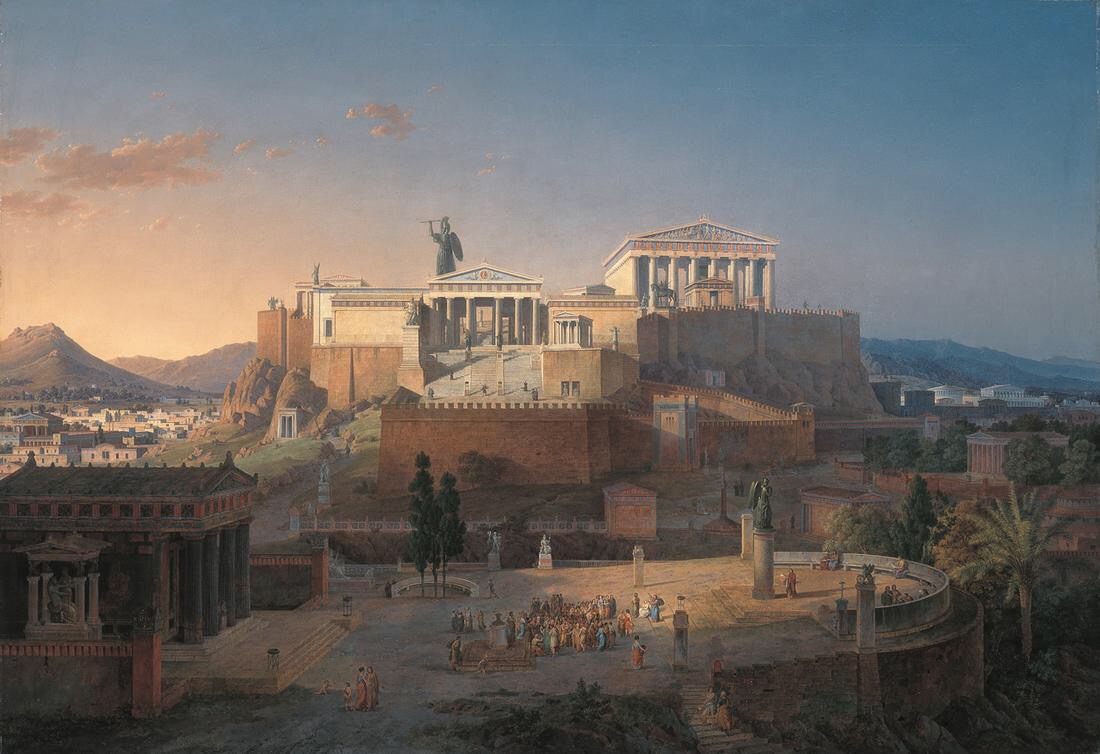
As modern Greece struggles with its economic problems, it’s worth remembering: there isn’t a decent concept for living we don’t have the Greeks to thank for.

With help from Wikipedia, try: 

Prohairesis – προαίρεσις

The ‘moral character’ or prohairesis, was brought to the world by Aristotle in the eminently readable Nicomachean Ethics (which first inspired this blog five years ago). Prohairesis is the capacity to reflect, and not be carried away by what our senses serve up.

For the stoic Epictetus, life is all about prohairesis; separating what we experience from how we choose to feel about it:

“Remember that what is insulting is not the person who abuses or hits you, but the judgment that these things are insulting.”

“So when someone irritates you, realise that it is your own opinion that has irritated you. Try, therefore, in the first place, not to be carried away by the impression; for if you once gain time and respite, you will find it easier to control yourself.”

Prosoche – προσοχή

In the Platonic Academy, prosoche referred to the discipline of “attention” – noticing the judgements that we make about ourselves and the world. 

Once observed, the next step is observing whether or not these judgements are in ‘conformity’ with the reality of our situation; and correcting them as needed so as to maintain appropriate behaviour and equilibrium (ataraxia). 

Prosoche is broadly equivalent to the Buddhist disciplines of ‘mindfulness’ as developed through meditation.

A Greek ‘prosoche’ poem sums it up: 

Give me the Serenity to accept
the things I cannot change,
the Courage to change the things I can,
and the Wisdom to know the difference.

Areté – αρετή

For Aristotle, bravery is the first virtue. It came up at work this week. 

It is, quite simply, consciously choosing to walk the difficult tightrope between fear and courage:

“A brave man is one who faces and fears what he should for the right reason, in the right manner and at the right time. A brave man performs his actions for the sake of what is noble. Those who err by excess with regard to this virtue are called rash, but one who is exceedingly fearful is called a coward.”

“Men who show courage because they are optimistic and they think they will win are not brave, because they do not act for the right reasons, and when the situation does not turn out well, they end up being cowards.”

“Men who are ignorant of danger are also not brave, but only appear to be so because they have no knowledge of the danger.”

Prohairesis, Prosoche and Areté: character, consciousness and choice, all come together in sophia σοφία; the title above, and Greek for ‘wisdom’ – the root of philosophy φιλοσοφία philo-sophia.

Whatever the state of their οἰκονομία (economy), Greeks deserve our enduring thanks; for all they invented in the life of the mind.

Relevant Complexity

Relevant Complexity Link

Here’s to a brand new year.

And to celebrate I’ve bashed out a new blog, based on what I’ve learned about life, the world and everything since I started Achilles and Aristotle in 2010.

Time flies – or rather it doesn’t; a lot of water has passed under the bridge since then. But ‘Relevant Complexity’ was a fairly early discovery, I first wrote about it in January 2012 here.

Like all good things in the writing life, the more you write about it, the more you think about it, the more it changes you and what you do – Aristotle said as much.

I’ll plan to keep both blogs going: this one as a reminder of what I was up to in years to come; the new one to remind me to live for the day and enjoy a life full of ‘Relevant Complexity’.

Roman Walls

20140906-170723.jpg

Stop growing and you’re already shrinking. Resolve to hang on to what you’ve got and you’ll probably lose it. Stick to what you’ve always known and you are getting stuck. The best bet in life is to give up self-defence – and march ever onwards.

This came to me, when I was talking to a nice person at work, about her natural desire to protect what she has. When we feel vulnerable or change is in the air, we all get defensive. I admitted I had felt very much the same, until quite recently. Then something I read about the Romans came to my assistance.

Historians sometimes mark the height of the Roman Empire as Marcus Aurelius’ defeat of the Germanians. But you can trace the start of its decline two emperors earlier, to Hadrian’s decision to stop advancing and instead build walls. The construction of walls marked the edge of civilisation and was designed to keep out barbarians. For which, Hadrian famously put one up across the North of Britain.

But in that moment the Romans subtly and implicitly signalled their limits – and invited attack, decline and fall. No longer advancing, assimilating and civilising; they’d said: “That’s it, we’re digging in, hanging on and giving up.”

My conversation partner and I reflected on the fact that perhaps life, and indeed working life, are much the same. Keep moving forward, keep an open mind, keep learning and doing new things; and momentum, new challenges and opportunities come along.

Hunker down, dig in and hang on – even behind the most impressive fortifications, and you’re already sinking into decline and fall. And this couldn’t have been more amply demonstrated, than in a valedictory interview I watched, between two ageing newsmen a few day later: one, retiring, cynical, dogmatic and closed minded; the other delightfully open, interested and enthusiastic about life, other people and the world.

There are always more intellectual aqueducts to construct, chasms of ignorance to span with new bridges and viaducts, roads to pave to fresh knowledge and ideas. Whatever the temptation to stop, rest or settle, the best answer is always to keep moving on, growing and learning.

Dasein

20140523-191853-69533252.jpg
Heidegger is a notoriously heavy read – and a controversial one, given he lived in Germany through two world wars and after. His concept of Dasein – the world as perceived and lived in by humans has made me think though.

It’s easy to imagine there’s a world without us. Of course there is. Surely? A world of maths, logic, science and mindless physical processes. Not to mention a less thought-filled living world of birds and beasts – nature red in tooth and claw.

So what’s so special about humans that Heidegger says we define our very own universe? I think I get his point. Everything we see, refer to, understand and know is in fact self-referring – it is based on human experiences, human timescales, human sensory apparatus and the human scale.

We can’t truly understand or describe the world from the point of view of an ant, let alone from the perspective of a celestial body. But a celestial body is dead, so it has no perspective surely? If I read Heidegger right – I think it does.

Knowledge, wisdom, trial and error, mindless and mindful – the course of the universe is to record more and more information in itself including embodied intelligence – information stored in physical forms.

In the same way as an ant contains within it information about carbon-based life, geological time and the process of evolution; even the most basic planet contains information about the elements, supernovae and stellar aeons which led to it.

From the blinding simplicity of the Big Bang to the unimaginably vast store of data which is a galaxy – let alone a universe of them – the course of ‘life’ has been captured, recorded, embodied and stored in both vast and minuscule stores of accumulated ‘relevant complexity’ – in effect: information.

As Heidegger suggests, our mentally comprehensible portion of this recorded information is determined by our embodied human faculties and timescales. But for the ant or the celestial body the ‘recording’ is at vastly different scales. Dasein or the ‘human universe’ is but a tiny portion of this. And what each of us sees and understands of it, is but the portion lit by our own tiny flickering candle.

That we see and understand even that much, is an accident of stellar and evolutionary history – our tiny illuminated moment in space and time. But for each of us it is a very fortunate and beautiful one. And Heidegger invites us to live it to the full.

Balance

20140517-104703.jpg

A few weeks back, a very wise friend I bumped into serendipitously mentioned this:

In the end, only three things matter:

1) How much you loved,

2) how gently you lived, and

3) how gracefully you let go of things not meant for you.

Whose words of wisdom are they? Transpires it was the Buddha.

Numbers 1) and 2) aren’t that earth shattering. And ‘living gently’ is maybe not that exciting.

I get the point; let go of hatred and anger. But like with Roman Stoicism, I’m a bit watchful that Buddhist ‘patience’ and ‘tolerance’ – good though they are – don’t turn into accepting stuff which is unacceptable or giving up on things which are important.

But number 3) is a gem. This week I ‘let go gracefully’ of something that ‘wasn’t meant for me’ and feel infinitely better for it.

Power, money and status are inviting and intoxicating, but there are are phases to life and choices to make. So this week I put my family ahead of my career and let go of seeking advancement. Not forever, but not for now.

The Buddha is bang on – by letting go of what was ‘not meant for me’, and doing it ‘gracefully’ on my own terms I have protected what matters, lost nothing and gained a great deal: a self-imposed burden removed, a lightness of spirit returned and a much readier smile on my face. Balance restored.