Someone once rather unkindly described one of my past jobs as ‘janitorial services’… i.e. cleaning up the messes made by other people.
If you ever take a moment to talk to anyone who genuinely does do ‘janitorial services’, you soon learn it is hard work, low status and low paid. We should all be a little more respectful and grateful to those who do.
But stimulated by the book Atomic Habits by James Clear, I’m making small incremental improvements (and not sweeping goals) the priority.
Tidying up around the house has been this weekend’s zeitgeist – and in the process I realised, why not tidy up Achilles & Aristotle too… If I haven’t got the muse or anything new to say, then why not do a better job of what I’ve already said!
There’s no piece of writing that can’t be a little better, so punctuation and small edits are my target. And in the process I get a free trip down memory lane – starting back in 2010, as I did this morning.
Much as I found in my ‘janitorial services’ job, cleaning up can be just as fulfilling as ‘creating’ if you change your mindset.
A friend sent me this yesterday, on the topic of hope:
Ah, hope! You probably know the old story. A farmer throws his old, decrepit mule down a well. And starts shovelling earth onto it to bury it.
The mule gets a shovelful of earth in its hair and at first is resigned to be buried alive. Then it notices that if it shakes its head, the earth falls to its side, and that it can step up onto the new soil.
And that’s how it lives (and eventually gets out of the well) – shake it off, and step up. Shake it off, and step up!
And as I replied just now:
A great deal to like here. And the mule is excellent – very much what I think mindfulness is; shaking off the earth one shovelful at a time!
It’s quite a nice way to think about it really. Especially as we continue to be showered by debris from despots, demagogues – and own goals from our own democratically elected leaders!
The path to enlightenment is no doubt winding; but letting go of a strong sense of ‘self’ is one of the core ingredients.
I’m enjoying Waking Up (as above) with Sam Harris, and in particular the ‘Path of Insight’ offered by the exceptionally wise Joseph Goldstein.
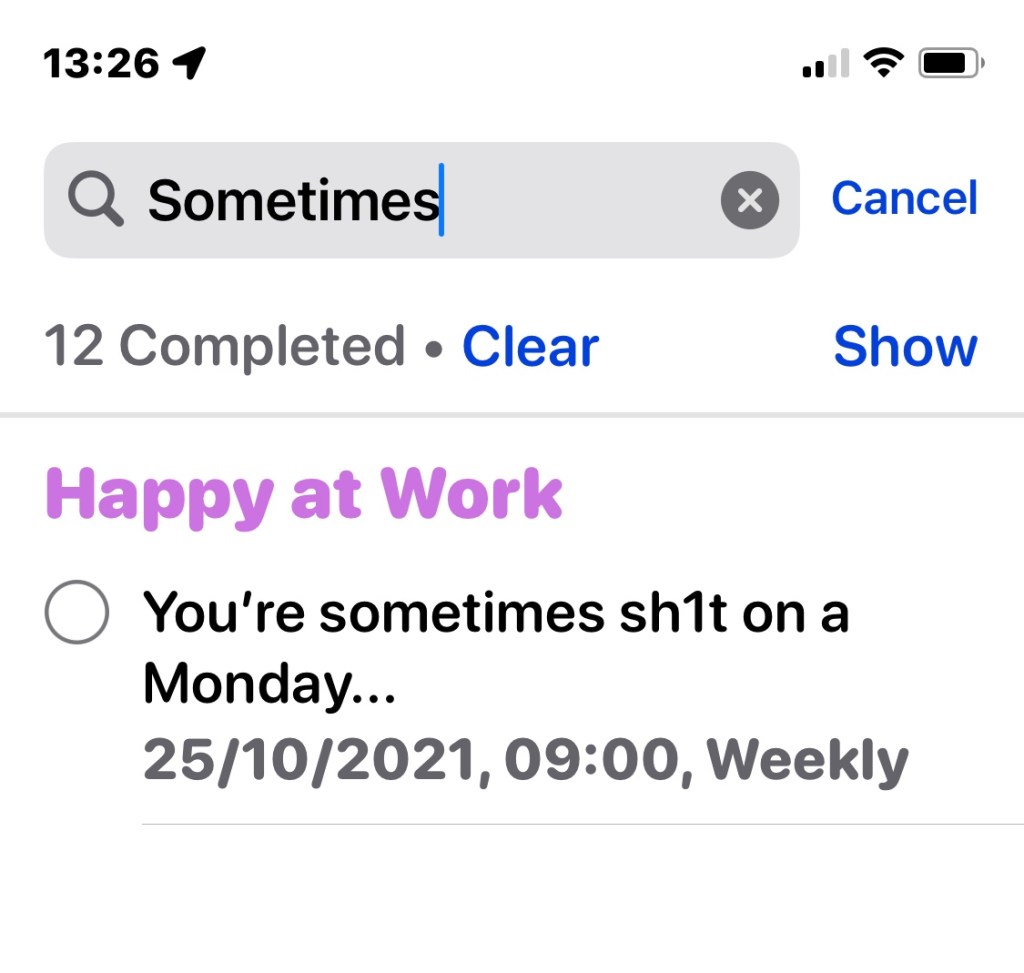
Yesterday was a pretty ordinary day at the (virtual) office. Plenty of small impediments and human scale frustrations. But I’m well prepared for this, thanks to my longstanding Monday reminder:
But remembering the ‘learned optimism’ of Martin Seligman (explained here) I changed this reminder recently… now it’s:
But on a much sunnier (in every sense) Tuesday, I’ve realised that Joseph Goldstein would likely nudge me to an even better place… namely:
Job done. No need for ‘self’ talk; just remembering to spot the universe up to its usual Monday tricks. Another step on the path to enlightenment.
Up before 7am – a cup of tea made, the bed stripped and sheets in the washer before 9am. Out to the shops before several of them were open, and it’s a Saturday!
What’s going on?
18 months without drinking is what’s going on… Who’d have thought it? Not me that’s for sure. Least of all when I wrote this blog on New Year’s Day 2020.
Still (as subsequent reading has helped me realise) the signs and signals were there some while before. Five years ago in fact:
And then more recently:
So how did we get here? Two books, some Lego, a flower and a podcast…
Book one, by Simon Chapple, spoke to my cultural background as a middle aged British bloke; and dealt with my conscious mind:
Reading this led me to book two, by Annie Grace, which gave me stories, science and neuroscience; this dealt with my subconscious mind:
To get through the first days in early Jan 2020 (and it sustained me through the onset of the pandemic and more) I bought myself a Lego ‘clock’ which I converted into a day counter:
Coming up to three months…At the turn of the year I gave up counting.
The flower is the carnivorous pitcher plant. It lures unsuspecting insects in search of a pool of delicious sweet nectar. Some varieties have a gentle slope which invites you in. Indiscernibly the insects passes a point of no-return. And then ‘plop’, into the drink and a sticky end.
The argument is we’re all inexorably wandering down the enticing slope of the pitcher plant with alcohol. It’s just a question of whether we’re meandering, or marching purposefully.
Finally, regular reinforcement as been helped by a podcast series, which is so culturally different for me (largely American, deeply personal life stories, mainly from women) that I find it incredibly powerful. It gets through my residual subconscious resistance to the reality of alcohol:
In sum, it’s a bit like when I quit smoking; thoroughly disgusted with myself after smoking three packs (and drinking a skinful) at a wedding in 2001. I’ve not had a cigarette since. I think I’d just had enough – and reminding myself of quitting smoking certainly helped on the odd day I’ve fancied a drink since 2019.
I can’t see myself going back though; and this week has given me a couple of reminders why.
Heading indoors to a pub (for the first time since lockdown) on Monday to celebrate a friend’s birthday, I arrived to find tequila shots already on the table. I smiled and said:
“Sorry chaps, I’m still not drinking.”
A few disappointed and incredulous looks, but people are getting used to it now. I ordered a low alcohol Erdinger and settled in for the evening.
Two and a half hours later it was getting on for time to leave. A half-hearted shout went up for “One more beer?” Everyone was tired, we’d had a good laugh and it was a ‘school night’ so there were mumbles of “Not for me”, “I’m good” etc. But then the inevitable happened in the ‘world of men’… someone pressed the group into “one more”. Another shot of tequila. I smiled and said I’m off.
As any heavyweight boxer will tell you (if they still can) it’s the late-career, late round punches that do all the damage. Into our fifties at past 11pm on a Monday night, we have no business doing shots. That’s a younger man’s game. I’m glad to be out of it.
And so to this morning. Bright, alert, healthy, happy, well-rested and ready for my day. And the only explanation (and it takes a year for the brain to rewire, the chemicals to rebalance and the urge to hit the alcohol ‘kill switch’ and turn your mind off to pass) is the absence of alcohol from my life.
The great Dutch philosopher Spinoza has always appealed to me; but all the more so now I’ve studied more psychology.
Baruch Spinoza 1632 – 1677
Spinoza’s ethics are ‘naturalistic’ and spring from simple real-world causes. There is no divine origin or human uniqueness. Everything stems from the simple proposition (as Michael LeBuffe explains in The Stanford Encyclopedia of Philosophy) that:
Human beings desire whatever will bring joy and are averse to whatever will lead to sadness.
This fits beautifully with modern psychological theories that, along with animals, we have one of two basic reactions to everything: approach or avoid. And it all stems from a simple, unquenchable, animalistic drive which Spinoza describes thus:
Both insofar as the mind has clear and distinct ideas, and insofar as it has confused ideas, it strives, for an indefinite duration, to persevere in its being and it is conscious of this striving it has.
Spinoza’s ‘passions’ are the manifestations of this striving, as LeBuffe describes them:
Human passions are for Spinoza changes, that is, increases or decreases, in the power with which we, or parts of us, strive.
And again, as modern psychology suggests, Spinoza suggests a lot of what drives us is subliminal and below the level of consciousness:
Between appetite and desire there is no difference, except that desire is generally related to men insofar as they are conscious of the appetite. So desire can be defined as appetite together with consciousness of the appetite.
And the mind is constantly on the lookout for ‘perfection’ via more ‘joy’ and less ‘sadness’.
By Joy, therefore, I shall understand in what follows that passion by which the mind passes to a greater perfection. And by Sadness, that passion by which it passes to a lesser perfection.
All of which drives our actions or ‘striving’ accordingly:
We strive to promote the occurrence of whatever we imagine will lead to joy, and to avert or destroy what we imagine is contrary to it, or will lead to sadness.
And virtue for Spinoza is simply ‘correctly’ striving:
Consciously trying to preserve oneself is right and neglecting to preserve oneself is wrong.
The more each one strives, and is able, to seek his own advantage, i.e., to preserve his being, the more he is endowed with virtue; conversely, insofar as each one neglects his own advantage, i.e., neglects to preserve his own being, he lacks power.
All very simple – but we’re pretty complex in our motivations aren’t we? All that complexity comes from our reaction to other people and things; or as Spinoza has them ‘objects’.
There are as many species of Joy, Sadness and Desire, and consequently of each affect composed of these (like vacillation of mind) or derived from them (like love, hate, hope, fear, etc.), as there are objects (i.e. things) by which we are affected.
And a key part of achieving virtue, and correctly developing and using our ‘power’ of right action, is developing ‘clear and distinct ideas’ on things. As LeBuffe explains:
When I do something that fails to help me to persevere, it’s because the ideas on which I based my action were confused; that is, I thought I knew what would help me to persevere, but I was wrong.
When I do something that does help me to persevere, though (unless I have simply been lucky in acting from an inadequate idea), it is because I acted on clear and distinct ideas or, in other words, genuine knowledge about what would help me to persevere.
And this of course is a life’s work; coming to know ourselves, understand others and appreciate how the world works.
But does this mean there is no objective good and bad? Looks like it… For Spinoza:
As far as good and evil are concerned, they also indicate nothing positive in things, considered in themselves, nor are they anything other than modes of thinking, or notions we form because we compare things to one another. For one and the same thing can be good, and [evil], and also indifferent. For example, Music is good for one who is melancholy, [evil to] one who is mourning, and neither good nor [evil] to one who is deaf.
Truth is, as Spinoza sees it, they are the other way around:
It is clear that we neither strive for, nor will, neither want, nor desire anything because we judge it to be good; on the contrary, we judge something to be good because we strive for it, will it, want it, and desire it.
LeBuffe concludes we need to stop kidding ourselves:
The ideal we set before ourselves will be a person who possesses the greatest possible power of action. This would be, in effect, to correlate our systematically distorted ways of perceiving ourselves—as free agents pursuing as an end a model of human nature—with the causes that really determine our actions.
So does this mean anything goes?
No, because we live in community, society and constant connection with myriad others, each with their own delusions, desires, passions and ideas of what’s good and bad; and that 100% creates our context.
And so as Susan Jones explained in Philosophy Bites in December 2007, Spinoza’s sage advice is to find a ‘community’ whose values you share – as he himself did. Because given how small our ‘power’ to influence events, people, ourselves and human nature truly is, you won’t make much headway in changing one you don’t.
And this piece of Spinoza’s advice – from across time and place – is part of why I’m changing jobs next month.





 Achilles & Aristotle