Font of Knowledge

I owe Steve Jobs a good deal. From early dial-up internet on my original Aqua iBook to blogging with an iPhone and iPad. Despite liberating £1000s from my wallet over the years, I am eternally grateful to him. He has opened up a world of new possibilities, knowledge and ideas to me and many millions more.

Poor guy looks like he’s on his last legs though. Emaciated and gaunt, bowing to the inevitable he stood down as Apple CEO the other day. If I were a betting man I’d reckon cancer will have him within 6 months.

A famously hot tempered perfectionist, I wonder how much cancer has changed him. Diagnosed some 6-7 years ago, reading his 2005 Stanford Commencement address – made to a hall of eager freshmen – he had a pretty ‘nailed on’ philosophy well before the ‘Big C’ properly got hold of him. Like David Servan-Schreiber, cancer will extinguish him but it didn’t beat him.

He calls life’s rich pattern ‘connecting the dots’. I think of it as a ‘Nile delta’ of possibilities. Either way, it’s a fact that life often makes sense looking backwards. But the tributaries down which we flow through life are serendipitous, random and unfathomable. Once you’ve noticed your route though, it all looks pre-ordained.

I quoted Jobs’ example of calligraphy (below) the other day. He created, from random events, the font-rich world we take for granted on every electronic device. Imagine if he’d taken technical drawing instead. It could all have been very different.

The moral I draw? Don’t waste time trying to plan life, live it. Think more about today than next year. Don’t sweat the small stuff. And finally, even the big things in life generally happen by accident, it’s how you respond and what you do next that matters.

Here’s a piece of his Stanford address:

I dropped out of Reed College after the first 6 months, but then stayed around as a drop-in for another 18 months or so before I really quit. So why did I drop out?

It started before I was born. My biological mother was a young, unwed college graduate student, and she decided to put me up for adoption. She felt very strongly that I should be adopted by college graduates, so everything was all set for me to be adopted at birth by a lawyer and his wife. Except that when I popped out they decided at the last minute that they really wanted a girl. So my parents, who were on a waiting list, got a call in the middle of the night asking: “We have an unexpected baby boy; do you want him?” They said: “Of course.” My biological mother later found out that my mother had never graduated from college and that my father had never graduated from high school. She refused to sign the final adoption papers. She only relented a few months later when my parents promised that I would someday go to college.

And 17 years later I did go to college. But I naively chose a college that was almost as expensive as Stanford, and all of my working-class parents’ savings were being spent on my college tuition. After six months, I couldn’t see the value in it. I had no idea what I wanted to do with my life and no idea how college was going to help me figure it out. And here I was spending all of the money my parents had saved their entire life. So I decided to drop out and trust that it would all work out OK. It was pretty scary at the time, but looking back it was one of the best decisions I ever made. The minute I dropped out I could stop taking the required classes that didn’t interest me, and begin dropping in on the ones that looked interesting.

It wasn’t all romantic. I didn’t have a dorm room, so I slept on the floor in friends’ rooms, I returned coke bottles for the 5¢ deposits to buy food with, and I would walk the 7 miles across town every Sunday night to get one good meal a week at the Hare Krishna temple. I loved it. And much of what I stumbled into by following my curiosity and intuition turned out to be priceless later on. Let me give you one example:

Reed College at that time offered perhaps the best calligraphy instruction in the country. Throughout the campus every poster, every label on every drawer, was beautifully hand calligraphed. Because I had dropped out and didn’t have to take the normal classes, I decided to take a calligraphy class to learn how to do this. I learned about serif and san serif typefaces, about varying the amount of space between different letter combinations, about what makes great typography great. It was beautiful, historical, artistically subtle in a way that science can’t capture, and I found it fascinating.

None of this had even a hope of any practical application in my life. But ten years later, when we were designing the first Macintosh computer, it all came back to me. And we designed it all into the Mac. It was the first computer with beautiful typography. If I had never dropped in on that single course in college, the Mac would have never had multiple typefaces or proportionally spaced fonts. And since Windows just copied the Mac, it’s likely that no personal computer would have them. If I had never dropped out, I would have never dropped in on this calligraphy class, and personal computers might not have the wonderful typography that they do. Of course it was impossible to connect the dots looking forward when I was in college. But it was very, very clear looking backwards ten years later.

Again, you can’t connect the dots looking forward; you can only connect them looking backwards. So you have to trust that the dots will somehow connect in your future. You have to trust in something — your gut, destiny, life, karma, whatever. This approach has never let me down, and it has made all the difference in my life.
Rhetoric

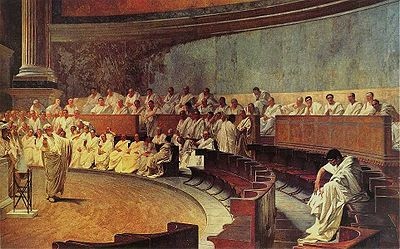
I’ve been doing a lot of presentations on strategy in the last few weeks. The good news is people say it’s all very clear. They like it. “A lot better than it was too” some say. I acknowledge, slightly wistfully, that our old strategy was bigger on soaring rhetoric – and I miss that a bit. But not much. Clear and credible is better.

Reading Montaigne and Aristotle on Rhetoric I can see why. Montaigne first:

Eloquence most flourished at Rome when the public affairs were in the worst condition and most disquieted with intestine commotions; as a free and untilled soil bears the worst weeds.

Oh dear – suggests I may have been part of indigestion in our organisational intestines. Our rich intellectual soil allowed many rhetorical flowers to bloom. Perhaps some tilling was called for.

Aristotle for his part, in his encyclopaedic and comprehensive way, offers three volumes on Rhetoric covering it’s function, forms and stylistic niceties.

A dense but magisterial account on the Stanford Encyclopaedia of Philosophy runs through Aristotle’s work. In essence the purpose of rhetoric is to persuade. It is neutral and can be used well or badly and for good or for ill. The Rhetorician, like the physician should be judged, not, on whether he or she saves every patient or wins every argument, but on his or her use of the relevant tools, interventions and skills.

The Stanford encyclopaedia offers that persuasion itself depends on (a) the character of the speaker (b) the emotional state of the hearer (c) in the argument (logos) itself. The speaker can employ his or her skills as a stimulus for the sought emotion (pathos) from an audience. However, along with pathos, the speaker must also exhibit ethos, which for Aristotle encompasses wisdom (phronesis), virtue (arete), and good will (eunoia).

Persuasion is accomplished whenever the speech is recieved in such a way as to render the speaker worthy of credence. If the speaker appears to be credible, the audience will form the second-order judgment that propositions put forward by the credible speaker are true or acceptable. The catch is for it to be true Rhetoric the speaker must accomplish these effects by what he or she says; it is not necessary that he is actually virtuous: on the contrary, a preexisting good character cannot be counted part of the technical means of persuasion.

So is Rhetoric mainly about cheating and what you can get away with? And if so why would a man of Aristotle’s leanings engage with it? Well as the Stanford Encyclopaedia explains it:

It could be objected that rhetoric is only useful for those who want to outwit their audience and conceal their real aims, since someone who just wants to communicate the truth could be straightforward and would not need rhetorical tools. This, however, is not Aristotle’s point of view: even those who just try to establish what is just and true need the help of rhetoric when they are faced with a public audience.

Aristotle tells us that it is impossible to teach such an audience, even if the speaker had the most exact knowledge of the subject. The audience of a public speech consists of ordinary people who are not able to follow an exact proof based on the principles of a science. Further, such an audience can easily be distracted by factors that do not pertain to the subject at all; sometimes they are receptive to flattery or just try to increase their own advantage. And this situation becomes even worse if the constitution, the laws, and the rhetorical habits in a city are bad (as in Montaigne’s Rome above).

Finally, most of the topics that are usually discussed in public speeches do not allow of exact knowledge, but leave room for doubt; especially in such cases it is important that the speaker seems to be a credible person and that the audience is in a sympathetic mood. For all those reasons, affecting the decisions of juries and assemblies is a matter of persuasiveness, not of knowledge.

But, reassuringly, at the heart of Aristotle’s approach to rhetoric – as you would expect of the man – is a belief in substance over style:

Aristotle joins Plato in criticizing contemporary manuals of rhetoric. Previous theorists of rhetoric gave most of their attention to methods outside the subject; they taught how to slander, how to arouse emotions in the audience, or how to distract the attention of the hearers from the subject.

Aristotelian rhetoric is different in that it is centred on a rhetorical kind of proof, the ‘enthymeme’ which he called the most important means of persuasion. Since people are most strongly convinced when they suppose that something has been proven, there is no need for the orator to confuse or distract the audience by the use of emotional appeals, etc.

In Aristotle’s view an orator will be even more successful when he just picks up the convincing aspects of a given issue, thereby using commonly-held opinions as premises. Since people have a natural disposition for the true there is no unbridgeable gap between commonly-held opinions and what is true.

For Aristotle, the speaker does need to recognise that his or her audience may not have the habit of scientific proofs. He also concedes that long chains of logical inferences might not work well either. But, in his view, every man is open to bridging the gap between commonly-held opinions and the truth. So good rhetoric draws on both.

As for style, as with his ethics it’s all about the ‘golden mean’. In a nutshell for Aristotle the good style is ‘clear in a way that is neither too banal nor too dignified, but appropriate’. Nice.

I conclude the reasons I need less rhetoric these days is 1) our organisational intestines are in better order 2) more of what we are doing accords with commonly-held beliefs and thus 3) I need far fewer appeals to emotion and long chains of inferences to make my case. All that’s left is to add a spot of Ethos and Pathos and the job is done. Time for a rhetorical rest.

Cathedral or Cave

I imagine Aristotle, like the Acropolis, as more Cathedral. The reclusive poet Emily Dickinson would be more cave. Montaigne, perhaps old Paris; earthy rumbustious streets and deep reflective catacombs.

I’ve been toying with Nietzsche’s idea that our ‘will to power’ is either expressed in the real world or forcibly turned in. For him, we create a complex inner life in proportion to the scale of our drive we cannot express externally.

It’s an interesting thought. Complex interesting people tend to have a good deal of both – rich inner lives and fulfilling outer ones. But not always. Nietzsche credits civilisation with curbing the capacity to express our animal instincts externally – driving them inwards. This unexpressed energy drives our inner lives – our conscience, guilt and creativity.

I think regularly about the balance of inner and external. I don’t feel I have the ‘will to power’ for a full ‘Cathedral’ in the external world. Too much competition, conflict, one-upmanship and strife in seeking grandeur. I fear I’d lose my health, precious time with my family and my happiness if I allowed a ‘grand projet’ or personal aggrandisement to consume me.

Talking to a friend – who is a decade older than me – this week, I felt a bit guilty. He has real fire in his belly for systemic reform, transformational change and the great debates of public policy. I said I’m just not attracted to any of that right now.

We talked about using your talents and our responsibility to improve the lot of others. He started his career as a lone residential social worker, on a tough housing estate. Beer bottles bounced off the cage that surrounded his outpost all night. That’s where his fire still comes from. It drives him to want to improve the scaffolding and superstructure of the nation’s health and social care system.

I don’t have that. I’m more a family chapel with a good sized intellectual cellar. My projects are more local and small scale – my family, the people around me. But never say never. The world is an unpredictable place. Gaudi started with lampposts and squat schoolhouses, so I suppose you never really know what you might build one brick at a time.

Adults and Children

All adults are big kids sometimes, but often the wrong kind. We keep the petty, squabbling, thin-skinnedness of children but often lose the curiosity, spontaneity and sense of fun.

It’s a bit hackneyed but I still have a lot of time for Transactional Analysis. The simple insight that a lot of our interactions are marred by deliberately or carelessly behaving like a domineering ‘parent’, lecturing or judging an errant ‘child’, describes a lot of what happens at work.

I was congratulated this week for doing an hour-long ‘all staff’ talk without once descending into parent-child. Apparently I was ‘adult to adult’ throughout. But the funny thing is, I wasn’t conscious of it. It was simply a case of being open, honest, respectful and genuinely answering the questions people asked. I used to be quick, slick and evasive. Now I’m slower and straighter – a good thing I think.

But I’ve also learnt that there’s still a space for the ‘free child’ at work. That’s when someone comes over all reproving or domineering and you prick their ‘parental bubble’ with a nifty joke at their expense. It’s risky, but done right it doesn’t half work. A bit of ‘free child’ brings some fun too, some laughter, a feeling things are ok and makes for a happier day. As Aristotle would advise it’s all about finding the golden mean between ‘boor’ and ‘buffoon’. He generally gets these things about right.

To finish, a happy chapter on our local community. I write on return from a public meeting, where we overcame some spirited and sustained resistance to more play equipment, in our once bleak – but now thriving – community park. People overlooking feared noise and teenagers and graffiti. Not unreasonable, but there’s a wider community to serve.

I said a few words in favour, but the Chair – a volunteer of course as all the best people are – managed the meeting with great dignity and some skill. I wrote to him just now to say:

You managed that really really well. Inviting everyone to speak – individually – but not allowing ding dongs was the genius of your chairmanship. It kept it civil, kept us from polarising and allowed people to be heard without hijacking. In the end defeat was calm and dignified not angry and litigious.

His skill was helping us to stay adult, as we discussed children. Being the best of both is what I’m working on.

The Forth Bridge

Twice in the last two weeks I’ve cited the Forth Rail Bridge to describe what I increasingly recognise as a not uncommon challenge – being called upon, like Sisyphus, to do the same thing again and again.

Famously, but perhaps apocryphally, the Forth Bridge offered a couple of hardy Scots lifelong employment in the rain, wind and sleet of the Firth of Forth painting and repainting it. A masterpiece of cantilevered Victorian design, it needs constant painting to keep it from corroding. I remember being told as a child that it took the two men five years to do from end to end. Then they had a day off. Then they started again.

At times organisational life is not unlike painting the Forth Bridge. Any organisation worth its salt divides opinion. Putting your best foot forward, making the case and explaining the strategy to the world, outside and in, is a Sisyphean task of care and maintenance.

I’ve started thinking about work as a bit like our busy family home. Something always needs fixing. It can be a bit untidy. There are shelves to put up and occasionally walls to knock down. Just when you have it looking ship-shape the shower leaks or a roof tile falls off. And then there’s that plan for the loft conversion or a new fridge. You live with – not just in – a house. And so it is at work.

I found myself getting frustrated about a misfiring corporate function the other day. But then I thought it’s a bit like an old chest freezer – burns a lot of electricity, some frozen leftovers in the bottom, but still doing a job. Sure a swanky new one would be nice, but there are other things which need fixing, upgrading, repainting first.

The best you can do with a family home is live well in it, keep it structurally sound and leave it in better shape than you found it. I think that’s a lot of what leading an organisation is about too. As Aristotle might say, the job of the bridge painter is to paint bridges, and of the good bridge painter to paint bridges well. There is satisfaction to be found in painting my Forth Bridge well.