Aquinas – a life’s work


Some years ago on holiday, we stayed in a French house which had a multi-volume set of philosophy books. Of all the great philosophers of history only Aristotle and Aquinas merited three entire volumes; which was reassuring – I was already reading on Aquinas when we arrived.

Whilst this standing in philosophy is well merited (in my humble opinion), I’ve found Aquinas’s particular method of logical argument, makes his original texts a bit of a struggle.

But, as I dug out from the Stanford Encyclopaedia of Philosophy – for an especial friend – Aquinas’s prescription for the good life is disarmingly straightforward:

The basic human goods:

(i) life, 

(ii) “marriage between man and woman and bringing up of children [coniunctio maris et feminae et educatio liberorum]” (not at all reducible to “procreation”), 

(iii) knowledge, 

(iv) living in fellowship (societas and amicitia) with others, 

(v) practical reasonableness (bonum rationis), and 

(vi) knowing and relating appropriately to the transcendent cause of all being, value, normativity and efficacious action.

You might argue with one or two of them, but it’s not a bad recipe… 

There’s plenty of ‘practical reasonableness’ about Aquinas.

σοφία


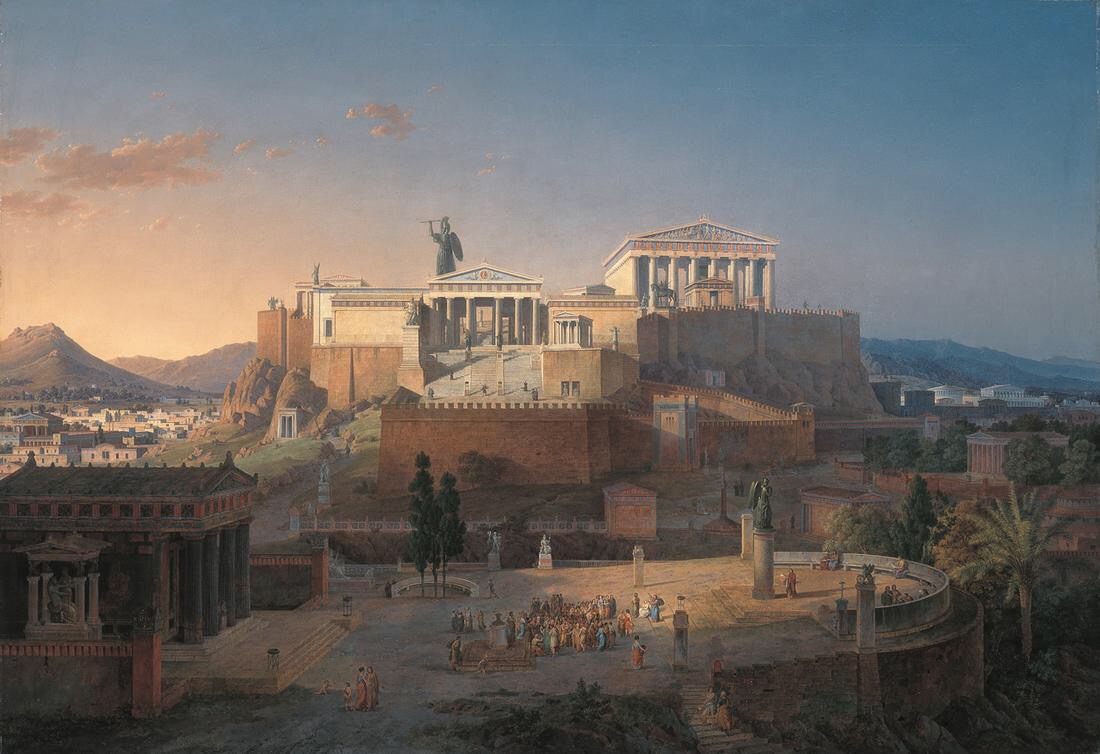
As modern Greece struggles with its economic problems, it’s worth remembering: there isn’t a decent concept for living we don’t have the Greeks to thank for.

With help from Wikipedia, try: 

Prohairesis – προαίρεσις

The ‘moral character’ or prohairesis, was brought to the world by Aristotle in the eminently readable Nicomachean Ethics (which first inspired this blog five years ago). Prohairesis is the capacity to reflect, and not be carried away by what our senses serve up.

For the stoic Epictetus, life is all about prohairesis; separating what we experience from how we choose to feel about it:

“Remember that what is insulting is not the person who abuses or hits you, but the judgment that these things are insulting.”

“So when someone irritates you, realise that it is your own opinion that has irritated you. Try, therefore, in the first place, not to be carried away by the impression; for if you once gain time and respite, you will find it easier to control yourself.”

Prosoche – προσοχή

In the Platonic Academy, prosoche referred to the discipline of “attention” – noticing the judgements that we make about ourselves and the world. 

Once observed, the next step is observing whether or not these judgements are in ‘conformity’ with the reality of our situation; and correcting them as needed so as to maintain appropriate behaviour and equilibrium (ataraxia). 

Prosoche is broadly equivalent to the Buddhist disciplines of ‘mindfulness’ as developed through meditation.

A Greek ‘prosoche’ poem sums it up: 

Give me the Serenity to accept
the things I cannot change,
the Courage to change the things I can,
and the Wisdom to know the difference.

Areté – αρετή

For Aristotle, bravery is the first virtue. It came up at work this week. 

It is, quite simply, consciously choosing to walk the difficult tightrope between fear and courage:

“A brave man is one who faces and fears what he should for the right reason, in the right manner and at the right time. A brave man performs his actions for the sake of what is noble. Those who err by excess with regard to this virtue are called rash, but one who is exceedingly fearful is called a coward.”

“Men who show courage because they are optimistic and they think they will win are not brave, because they do not act for the right reasons, and when the situation does not turn out well, they end up being cowards.”

“Men who are ignorant of danger are also not brave, but only appear to be so because they have no knowledge of the danger.”

Prohairesis, Prosoche and Areté: character, consciousness and choice, all come together in sophia σοφία; the title above, and Greek for ‘wisdom’ – the root of philosophy φιλοσοφία philo-sophia.

Whatever the state of their οἰκονομία (economy), Greeks deserve our enduring thanks; for all they invented in the life of the mind.

I am a Londoner


I’m not from London, so I’ve never felt a real Londoner. Still, I’ve lived here on and off nearly half my life; my family is here, my life is here, both my kids were born here.

On Friday, I found myself walking across one of London’s bridges by night and took a photo (above). The people I walked past were from many different places, indeed many different countries; all enjoying a beautiful London evening.

Of course it’s not all fantastic. Too busy, too expensive, often choked with people and traffic. And you see people struggling: sleeping rough, struggling with booze, drugs, crime and poverty; people who are really up against it. 

But London is a great city. Of all the great capitals I’ve visited, only central Paris beats it for beauty – and maybe New York for chutzpah. There are places of antiquity with stunning sights and history – amazing Istanbul or Rome. There are places I’ve lived with more steel and glass: Hong Kong the most obvious. But London has pretty much everything you could ever want or need.

But why London is so special came home to me the other week; on the tenth anniversary of the 7/7 London bombings. 

July 7th 2005 was a terrible day. One I will certainly never forget, and was followed by anxious weeks for everyone in this city. Ken Livingstone, then London Mayor (and whatever you think of him, a true Londoner) said this at the time: 

“In the days that follow look at our airports, look at our sea ports and look at our railway stations and, even after your cowardly attack, you will see that people from the rest of Britain, people from around the world will arrive in London to become Londoners and to fulfil their dreams and achieve their potential.”

“They choose to come to London, as so many have come before because they come to be free, they come to live the life they choose, they come to be able to be themselves. They flee you because you tell them how they should live. They don’t want that and nothing you do, however many of us you kill, will stop that flight to our city where freedom is strong and where people can live in harmony with one another. Whatever you do, however many you kill, you will fail.”

I arrived in London 25 years ago, and as Ken said, this great city has enabled me to achieve my potential, and fulfil my dreams. Just as he describes, I have been free to live the life I have chosen, and to be myself.  

I’m proud that this city – my city – finds a place for all sorts of people, and lets them be who they want to be. Ken Livingstone’s words from ten years ago made me realise; although I wasn’t born here – I am a Londoner.

Stop Hoovering

  
I knew this (or at least I kind of did) but a line in a book has recently kept it on my mind… ‘Mood’ is more a matter of biochemistry than anything else.

In the right mood everything is possible: ingenuity, problem-solving, creativity and joy. In the wrong mood, it’s all too much; all too hard and nothing can be done.

Win the lottery, lose your job, whatever happens most people’s underlying ‘mood’ ticks along remarkably unaffected; so long as you let it. Apparently only bereavement really affects mood for extended periods. It seems we can’t short circuit grief.

So ‘mood’ in fact, is not really about how happy, fulfilled, successful, busy or creative we are. It’s about noradrenaline, serotonin, cortisol and melatonin. These operate in an internal chemistry set, controlled by the limbic system – which is pretty much the same as in a bear, a monkey, a cat or a dog.

The limbic system is very resilient, very effective and very old – crocodiles have one. But it needs looking after. Apparently if you stress it to much, it chemically crashes and puts you into a state of hibernation. Literally. 

My book says the physiological symptoms of stress-related depressive illness are best understood, as exactly what happens in a bear’s body when it prepares for hibernation…
  

Why? Because the limbic system interprets the signals from the environment as too ‘hostile’, and that same old system kicks in: which enables a crocodile to lie dormant in mud for months; or a bear to hole up in a cave. We shut down; to wait for better days.

And here’s where the Hoover comes in. Because if you’re working yourself to the point your limbic system is about to blow a fuse – you have to stop; however exhilarating is the sense of achievement of getting more things done, or however great the pressure to do even more.

The test for hard-working diligent people is this; literally and metaphorically can you sometimes ‘leave the Hoover in the middle of the room’..? That is, can you visibly leave half-finished a task, you and people around you expect you to finish? 

Ouch, guilt and fear of humiliation – that hurts…

Because if you can’t – and you don’t listen to your body and look after your mood, there’s only one place you’ll end up…. shattered, flat and feeling like hibernating. 

This much I have learned in the past few weeks – if you want to avoid becoming a very grizzly bear, sometimes you have to leave the Hoover in the middle of the room.

Black Cat


Apparently human beings are easily fooled by coincidence – we are tuned for life in a Stone Age village, where not that much happened.

The maths of probability are skewed by the everyday experience of everything happening to us. As the precocious footballer Mario Balotelli is wont to say ‘why always me?’

Lady Luck is our constant companion, as we try to fit random events into a sensible narrative of what the blazes is happening to us. Studies suggest the gods (although not God) first sprang from here.

So how much of life is luck, how much is the luck you made – for better and for worse? Who knows. It all seems to makes sense looking back; but at the time…

Was it me, others, chance, caprice – or the hand of gods or God? Whatever and wherever you ascribe the credit or blame, like the handsome black cat who once stalked me for a fortnight, I have landed firmly on all four paws this week. 

Happy days.