Blue Footed Boobys

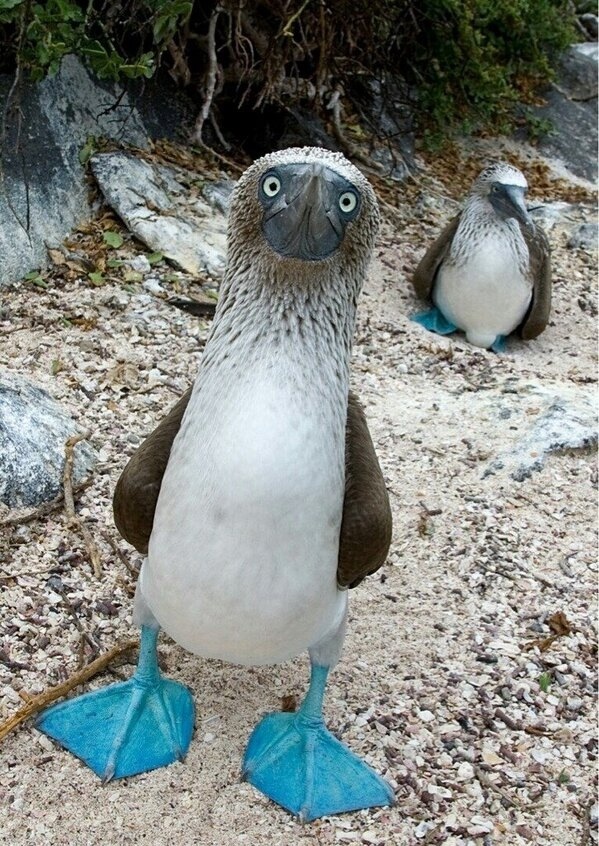
One of the jokes I share with ‘er indoors, is that I think of us as Blue Footed Boobys.

Said bird seeks his mate by placing shiny pebbles on the foot of she he would woo – only to have her flick them away with disdain. Until, he wins her heart with his persistence.

Apt then that my beloved should stumble across this splendid photo on Valentines Day, which she sent with the comedy line: “That’s you, that is.”

And indeed it is. A perfect likeness. And, it appears, with her ladyship sat on her behind, behind.

20130214-215431.jpg

Brain Cocktail

20130210-090053.jpg

Shaken but not stirred, I spotted this fascinating diagram yesterday. It describes moods, mental states and conditions in test tube form.

So which comes first – the chemical state or the state of mind? Are we in love or just hydrogen bonded. Are we low or just low on the right hormones.

It’s complex chemistry – but it is chemistry. The brain is a wet sugary computer – but that I think is why it’s so different from silicon chips and solid state physics. Hormones diffuse and dissipate they don’t switch on and off.

Computers are yes/no. Brains are a constantly changing cocktail of ‘maybe’.

It’s not all about you

20130202-092722.jpg

The slightly otherworldly quality of my son – combined with his regular backing track of strafing and explosions (as he imagines himself Iron Man, Luke Skywalker, Hulk etc), has sometimes made us wonder if he’s here at all or permanently off in his daydreams.

But the Boy Wonder was sharp as a tack the other morning. As I was holding forth about my experience of learning French and the read across to my daughter’s times tables homework, he chipped in:

“It’s not all about you Dad.” he offered in his piping five year old voice. I suspect he will outsmart us all.

Writing

20130127-130029.jpg

Is there a better thing than writing? While I’m not with the 20th century British philosophers who said language is all there is, I am with Aquinas. He’d say that, along with body and soul, language is a defining part of the human experience.

20th century norms made writing a minority sport – one for the professional. The rise of social media in the 21st century means we can all have a go.

I find if I don’t get the chance to write something, the day feels unfulfilled. And if (rarely) I’ve a moment with nothing I have to do, writing – or reading someone else’s writing – is the first thing I want to do.

For twenty years – from university to my 42nd year – I didn’t write anything for my own pleasure at all. Thank goodness for the invention of iPhone as my carry along notebook. I couldn’t be happier than when tapping out a bit of text with my right thumb.

Complex Pleasures

20130120-164003.jpg

Talking last night with friends about ‘pleasure’, we recognised it’s a complex beast. One of our party admitted she was happy with her life but generally not happy as she lived it. How could this be?

I listened again to Thomas Hurka on Philosophy Bites today to remind me. Hurka identifies four types of pleasure in two categories: ‘felt’ and ‘thought’.

The two ‘felt’ pleasures are: first, ‘simple pleasures’ i.e. specific immediate sensations: “mmm tasty” or “ahh comfortable.” And second, moods – which are a general and last for a duration.

The two ‘thought’ pleasures are specific: “I’m happy that… my daughter is in the school play” or “my football team won” and general: “overall I’m happy with how my life is going”, aka Aristotle’s flourishing.

Of course they are all intertwined. A life of physical pleasures – pure hedonism – might come up short on achievement. Or get cut short by a heart attack. But a life of too much ‘thought’ might lack passions and pleasures and the achievements of love and family.

Apparently, most parents say that the thing which has given them most pleasure in their lives has been the raising of children.

But also, apparently, if you give parents of young children an electronic ‘clicker’ to register every time they feel a sensation of pleasure during their day, they register fewest clicks of personal pleasure when they are actually with their kids. Probably haven’t got time to click…

So Hurka’s four pleasures explain how our friend can think “I am happy with how my life is going” whilst feeling in a permanent bad mood – they have three kids who run them ragged. Doesn’t sound great. But she’s happy, at least on one level.

Sleep’s the big one for me. Now I’m getting my sleep and enjoying my work – as well as enjoying time with my kids – I’m in a pretty permanent good mood. Feeling good is a great addition to my life. Simple to feel, complex to achieve.