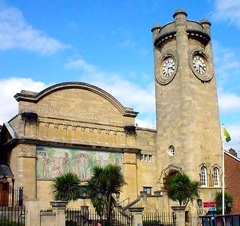
Museum Trip
Victorian storehouse
Cup of coffee
Massive Walrus
Bobbing seahorse
Trumpets and cornets
Finished off with
Shop and toilets
Clipboard questionnaire
Assures the curators
That three generations
Found Sunday enjoyment.
Philosophy for life
Museum Trip
Victorian storehouse
Cup of coffee
Massive Walrus
Bobbing seahorse
Trumpets and cornets
Finished off with
Shop and toilets
Clipboard questionnaire
Assures the curators
That three generations
Found Sunday enjoyment.
 As I’ve written before, the job of the poet is to say something transcendent and universal about the human condition – in no fewer or more words than are needed. It’s the liberating, inclusive and motivating definition of poetry from Aristotle.
And I think it applies to the other arts too – no fewer or more brushstrokes, musical notes, dance steps and now maybe pixels.That’s why I like s[edition]art the new digital art marketplace.
I bought a Damien Hirst (a piece is to the left) on Thursday. Number 54 of a limited edition of 10,000. I have a digital certificate of ownership which says so. Talking about it to an expert in visual arts on Friday, she asked me why? Why bother, why pay, what’s the attraction, what’s to stop people copying them, is it just a scam?
I think it’s similar to the way Aristotle has changed my views on charity. It’s not about being ‘seen’ to give – that’s Aristotle’s virtue of magnificence. Charity is the entirely personal internal feeling of doing the right thing – connecting with a cause and doing something about it, however small.
I think that’s why digital art works for me. It involves some appreciation, some choosing, some discernment, connecting and empathising with the artist and personally recognising – in a small way – the value of their art.
As I said to another arts expert on Friday, I think the ‘art of life’ lies in developing and exploring ‘relevant complexity’ – intricacies which embroider existence, refine judgement and develop character. For art, walking a gallery is one way. Browsing and buying in a virtual one is another.
£7.50 is a small price to pay in recognition of an artist’s attempt at a statement on the human condition. I think Digital art – along with digital poetry – is here to stay.

Yorkshire Pud
God’s own food
From his very own county
Filled with gravy
Really tasty
Kids a bit doubtful
Until their first mouthful
Get through a plateful
And for once are grateful
Can we have them again?
Next time can you do a tray full?
A morning of baking and cooking rounded off with sausages, Yorkshire pudding and gravy. Perfect. And an unusually appreciative audience.
 Why is an octopus smarter than a snail? Same family, same squishy body. Yet one is entirely predictable, the other spookily individual. Is it ‘in’ their bodies?
Having reflected on the ’embodied intelligence’ in a strawberry last week, I read that some Roboticists are moving on from the clever brain/dumb body ‘central processor’ model. Powerful chip-sets and nuts and bolts are being pushed aside by inherently ‘clever’ squishy limbs and appendages better adapted to their task.
Why pick up a fragile glass with a big clunky metal hand, when a rubber bag filled with coffee grounds, attached to a vacuum pump, morphs perfectly to the job?
Embodied intelligence is an interesting thought. Millions of years of evolution mean my leg swings naturally forward and lands in front of the other when I walk. The brain has very little to do. The ‘intelligence’ is largely designed in. Aquinas would recognise this – for him our bodies, like our emotions, are a full part of our ‘reason’.
The matter arising is, are octopuses smart because they evolved a big brain – for the joy of contemplation, communication, complex waving and changing colour? Or does an eight legged body (actually two ‘arms’ and six ‘legs’) mean high intelligence ’emerges’ as a bigger brain develops in response to increasing bodily complexity?
It’s all a bit simpler for a snail – A to B at a foot per minute. Perhaps that’s why they’re a bit simple. The surest predictor of animal brain size is body size. I wonder whether complexity of motor skills and sensory apparatus isn’t a big driver too.

What does it mean for us? First our intelligence is ’embodied’ in quick fingers, rapid eyes and sharp ears. Perhaps also what it means, is we aren’t Cartesian ‘ghosts in machines’. We aren’t software and hardware. We are completely integrated ‘wetware’ – like an octopus, as much arms and legs as big brains.
So if we want to build smarter tools and helpers, and understand ourselves better, inspiration from nature – not Fritz Lang – is the answer.
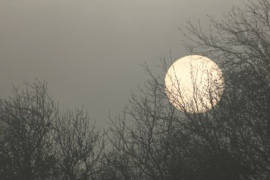
On a misty morning
With the kids in the car
Turning left
The surprise of a huge sun
Low in the sky
A silver gold blob
Just too bright to stare at
Not too bright to blind
Heralds
An emergent phenomenon
Not easily had
Coming into being
In my busy head
Happiness
More than a brain state
A life lived instead
Myriad things
In work at home at play
To bring together
Before it is found
Easily lost
A single moment can confound
But in simple pleasures
Doing the right things
Caring for people
About things
And oneself
Happiness shines
At times
Just too bright to stare at
Not too bright to blind.
I talked to a taxi driver today – an old man and a nice one. He revealed he studied art a good many years ago. Very much against the odds on a scholarship, he went to the art school at the bottom of our road – near where he was taking me.
He said other cabbies sometimes mock when he says he paints, but it brings him great peace and satisfaction. I owned up that I’ve started writing poetry too. We found ourselves kindred spirits. It’s not always the winning, it’s often the taking part with art. This poem refers to yesterday, but some of the warm glow spilled into today’s conversation.
 Achilles & Aristotle