The Forth Bridge

Twice in the last two weeks I’ve cited the Forth Rail Bridge to describe what I increasingly recognise as a not uncommon challenge – being called upon, like Sisyphus, to do the same thing again and again.

Famously, but perhaps apocryphally, the Forth Bridge offered a couple of hardy Scots lifelong employment in the rain, wind and sleet of the Firth of Forth painting and repainting it. A masterpiece of cantilevered Victorian design, it needs constant painting to keep it from corroding. I remember being told as a child that it took the two men five years to do from end to end. Then they had a day off. Then they started again.

At times organisational life is not unlike painting the Forth Bridge. Any organisation worth its salt divides opinion. Putting your best foot forward, making the case and explaining the strategy to the world, outside and in, is a Sisyphean task of care and maintenance.

I’ve started thinking about work as a bit like our busy family home. Something always needs fixing. It can be a bit untidy. There are shelves to put up and occasionally walls to knock down. Just when you have it looking ship-shape the shower leaks or a roof tile falls off. And then there’s that plan for the loft conversion or a new fridge. You live with – not just in – a house. And so it is at work.

I found myself getting frustrated about a misfiring corporate function the other day. But then I thought it’s a bit like an old chest freezer – burns a lot of electricity, some frozen leftovers in the bottom, but still doing a job. Sure a swanky new one would be nice, but there are other things which need fixing, upgrading, repainting first.

The best you can do with a family home is live well in it, keep it structurally sound and leave it in better shape than you found it. I think that’s a lot of what leading an organisation is about too. As Aristotle might say, the job of the bridge painter is to paint bridges, and of the good bridge painter to paint bridges well. There is satisfaction to be found in painting my Forth Bridge well.

Shower

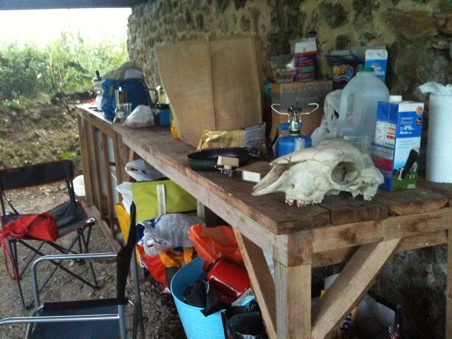
20110718-105113.jpgMan – and woman – in the state of nature is not a pretty sight. Obsessed with feeding and drinking, scavenging for firewood, alternately soaked then sweating. Feral children career about, bumping and thumping each other. Sleep snatched fitfully as the elements do their worst. Not much contemplation here.

What, I ask myself, is the purpose of camping? I may never know. Csikszentmihalyi might posit a ‘rude’ form of ‘flow’. But I’m pretty sure Aristotle wouldn’t have rated it. Certainly not in England’s all too green, and, for much of this weekend, not very pleasant lands. Apparently there was a moment where the entire land surface of Great Britain was simultaneously being rained on. Certainly we were.

I found myself short of temper and shorter of humour. Only Dionysius with his warming grapes and a crackling campfire lifted my spirits. An extra thick sleeping bag and two angelic faces snoring next to me helped too. The family unit held together.

The high point was packing the tent. Both for the manly ‘flow’ I achieved as I dismantled, folded and rolled it and the several nods of recognition for getting it into its bag in one go. More though for what it signified – going home to civilisation.

Cosmos

20110714-090550.jpgToday I spent an hour, at the unveiling of a statue to Yuri Gagarin, with the man who has spent more time in space than any other – the Cosmonaut Sergei Krikalev.

Poised, distinguished and himself chipped from granite, he is definitely the man you would want in the space capsule with you if something went wrong. He’s ten years older than me and found himself circling the earth when the USSR imploded leaving him temporarily stranded in outer space. Having met him, I expect he took it in his stride.

I talked to him about fitness loss in space, cosmic rays causing flashes in your eyes (a dozen per half hour or thereabouts in his experience) and experiments to test what snails had in common with dinosaurs (inconclusive).

As you might expect, given the things he’s seen, he had some reasonably profound things to say about international collaboration, friendship and what humanity has and can achieve.

My summary of his wise words:

While the ancients thought the world was infinite – and perhaps bourne on the back of elephants – when you see it from orbit you see it is big, but really not that big – and above all you see it is finite.

That the international friendships he has made are his greatest treasure and that international collaboration in science and space has always transcended the politics in his time in space.

Space is unbelievably hostile. And when all that separates you from it is a few millilitres of aluminium – which you could easily puncture with a kitchen knife – you recognise how fragile your existence is.

To say that ‘going into space has been done’ and ‘there’s nothing more to do’, is like saying the Romans built roads so why bother building a train.

Finally – and his eyes lit up on this one – the future is always exciting, we will go further and we will always reach for the stars.

A ramrod straight, decent and good man I concluded, with the quiet bravery of a modern day Achilles.

Equals and Similars

Aristotle has some interesting things to say about society and man as a social animal. In summary, man is by nature social. Intelligence and virtue are our best qualities. And, justice is the minimum common bond which keeps us from savagery.

The state is by nature clearly prior to the family and to the individual, since the whole is of necessity prior to the part; for example, if the whole body be destroyed, there will be no foot or hand.

The proof that the state is a creation of nature and prior to the individual is that the individual, when isolated, is not self-sufficing; and therefore he is like a part in relation to the whole. He who is unable to live in society, or who has no need because he is sufficient for himself, must be either a beast or a god: he is no part of a state.

A social instinct is implanted in all men by nature. For man, when perfected, is the best of animals, but, when separated from law and justice, he is the worst of all; since he is equipped at birth with arms, meant to be used by intelligence and virtue, which he may use for the worst ends.

Wherefore, if he have not virtue, he is the most unholy and the most savage of animals, and the most full of lust and gluttony. Justice is the bond of men in states, for the administration of justice, which is the determination of what is just, is the principle of order in political society.

Aristotle also makes the same case for moderation and the ‘golden mean’ in social structures which he makes at the personal level in his Nicomanichean Ethics. In Book IV Part XI of ‘Politics the unlikely heroes of the Aristotelian state are the oft underappreciated middle classes.

In all states there are three elements: one class is very rich, another very poor and a third in a mean. Moderation and the mean are best, and therefore it will clearly be best to possess the gifts of fortune in moderation. But he who greatly excels in beauty, strength, birth, or wealth, or on the other hand who is very poor, or very weak, or very much disgraced, finds it difficult to follow rational principle.

Those who have too much of the goods of fortune, strength, wealth, friends, and the like, are neither willing nor able to submit to authority. The evil begins at home; for when they are boys, by reason of the luxury in which they are brought up, they never learn, even at school, the habit of obedience. On the other hand, the very poor, who are in the opposite extreme, are too degraded. So that the one class cannot obey, and can only rule despotically; the other knows not how to command and must be ruled like slaves.

Thus arises a city, not of freemen, but of masters and slaves, the one despising, the other envying; and nothing can be more fatal to friendship and good fellowship in states than this: for good fellowship springs from friendship; when men are at enmity with one another, they would rather not even share the same path. But a city ought to be composed, as far as possible, of equals and similars; and these are generally the middle classes.

It is manifest that the best political community is formed by citizens of the middle class, and that those states are likely to be well administered in which the middle class is large, and stronger if possible than both the other classes, or at any rate than either singly; for the addition of a middle class turns the scale, and prevents either of the extremes from being dominant. Great then is the good fortune of a state in which the citizens have a moderate and sufficient property.

The case for fairness and equality at the heart of good governance in 350BC. We can lament the absence of women, the somewhat florid descriptors and the injunction that the ‘degraded’ poor can only be ruled like slaves. But… justice, more ‘equals and similars’, citizens bound by ‘good fellowship’ and fewer rich and poor strikes me as a pretty good prescription for the city, the state and the workplace.

A pious hope maybe, and Aristotle explores a book full of less ideal alternatives. But just because it’s idealistic doesn’t mean it’s wrong. As Herbert McCabe points out in ‘On Aquinas: ‘There is a fashion at the moment among those who believe in the market economy for what Aristotle would regard as treating citizens as though they were foreigners’.

I’m all for the market. If democracy is the least worst form of rule, then the market is the least worst form of resource allocation. But some social justice, humanity, fellow-feeling and friendship is part of any flourishing person, workplace or state.

Perhaps if we were fractionally less worried about conspicuous consumption, salary and status we might get closer to Aristotle’s ideal polis. But fellow-feeling is more than sharing the spoils. It’s also a state of mind. Citizenship, like friendship, requires us to think of other people as fellow ‘ends’, not just means to our own ends. Here’s to more ‘equals and similars’.

Guilt

I was reminded of one of my own ‘mottos at work’ this week – don’t start with an apology. We often start an encounter by excusing ourselves for things that aren’t really our fault. That, or making an unduly self-deprecating comment. Why?

Well when it comes to a big ballsy idea you can’t beat Nietzsche. What say you to this: all our animal instincts that don’t get let out into the real world get turned inside. This is Nietzsche’s idea that our ‘will to power’ is either expressed externally or turned in our ourselves – often as guilt.

Nietzsche is an interesting chap. Unashamedly elitist, cultured, a fine writer. But also discomforting and highly speculative. His punt – based on no particular evidence it must be said – is that there was a time when we were cruel but cheerful. Guilt didn’t exist. Just debts to repay and retribution to enact.

Depending on whether you were owed to or in debt, you were either cheerfully duffing someone up or being duffed up. But there were no hard feelings – even if it was painful and cruel. The nobly savage, jolly, barbarian life.

This reminds me of the Viking laws someone gave me a copy of a couple of years ago:

Be direct, brave and aggressive, grab all opportunities, use varying methods of attack, be versatile and agile, attack one target at a time, don’t plan everything in detail, use top quality weapons, keep weapons in good shape, keep yourself in good shape, find good battle comrades, agree on important points, choose one chief.

Not much introspection there. Sensible organisation, plenty of ‘flow’ potential and a good deal of what we would consider cruelty. I also suspect not much guilt… And by the sounds of it a fair bit of cheerfulness.

And this is what I find interesting in Nietzsche’s thesis. The barbarism and cruelty of dominance and power led to vivid, guilt free lives – nasty brutish and short no doubt, but vivid and guilt free. For Nietzsche, guilt is simply energy we can’t expend elsewhere. So why do we all feel guilty all the time?

Because we can never do enough (Kierkegaard) if anyone could view what we’re doing as wrong then it is wrong (Kant) and even when we do do the ‘right’ things they may turn out wrong (Mill).

Nietzsche asks a perfectly good question; why do we feel so guilty for everything? These days I’m feeling less guilty about spending that energy better elsewhere.