Immersion

Concentrating on boiling a ham on the hob yesterday, I was reminded of a key aspect of ‘flow’ – immersion. ‘Flow’ is ceasing to be self-conscious or unduly conscious of others and becoming thoroughly immersed in the task or activity.

When you look at it this way, a number of things we usually consider important in enjoyable achievement turn out not to be – notably the immediate judgement and appreciation of others. Also, a variety of things we consider dull can suddenly become a joy.

Take hoovering the house. Usually a chore, and one I resent. I enter into it – if at all – with little a priori enthusiasm. I have, however, discovered it passes more easily with an iPod, headphones and music.

Surprising then to discover last weekend during a particularly energetic and virtuoso vacuum – as I removed the ‘T head’ to more precisely target the skirting boards in the kitchen – I was in full ‘flow’. It was an absorbing task, in which my goal was evident, feedback clear (disappearing crumbs and detritus) and my mental energy was fully absorbed (in music and coordinated physical effort). Stone me, it’s that simple I realised.

I was talking to another parent yesterday about how this applies to kids, sports and music. The art is perhaps in helping a child to become completely immersed in the ‘process’ of playing football or the piano to the point they cease to be self-conscious or unduly conscious of you and your anxiety/impatience/projection of your own hopes and fears (delete as applicable).

A lot of what we do with children and activities is the opposite. We make them concentrate on us, keep pushing them on – before they’ve had time to master or enjoy developing skills – and most of all we distract them with incentives and threats. The art of ‘flow’ is to let them lose themselves in what they are doing and forget we’re there – not focus them on extrinsic rewards or punishments.

More immersion perhaps means less coercion. And letting go a bit and getting lost in what they’re doing makes parenting ‘flow’ more easily too.

Kisses

As my other half left the house for work one morning this week, my daughter was a bit sad.

My daughter and son were perched with me on the back of the sofa. My partner waved to us through the bay window – in the nice way she often does. She waved through the first pane coming out of the door. She waved through the roses as she passed in front of the central sash. Finally, she turned back for a final wave through the third pane, as she disappeared out of view down the hill. But my daughter still looked sad.

I said to her ‘Your kisses will have reached her’. She shook her head and held her hands apart like my Grandad sized a fish and said ‘They can only travel this far’. I said ‘Much further if you blow them’. She still looked sad. ‘Only about as far as the bookcase to the wall’ she said.

And then my four year old son chimed in with his piping voice – and winning smile – and said confidently ‘A kiss can go all the way round the world’. We all smiled and felt better.

The Daffodil

The Daffodil, or more classically and correctly the Narcissus, perfectly captures my week. 

First my daughter. Three years ago when she started school, I sometimes thought of her as a little snowdrop, a tiny beautiful flower, but gently bowed and diffident. She cried all the way through her first school play, reached out to me with beseeching arms in her second, slightly self-consciously danced a solo in the third; and belted out a song, whilst whipping others into line, in this year’s Christmas special. 

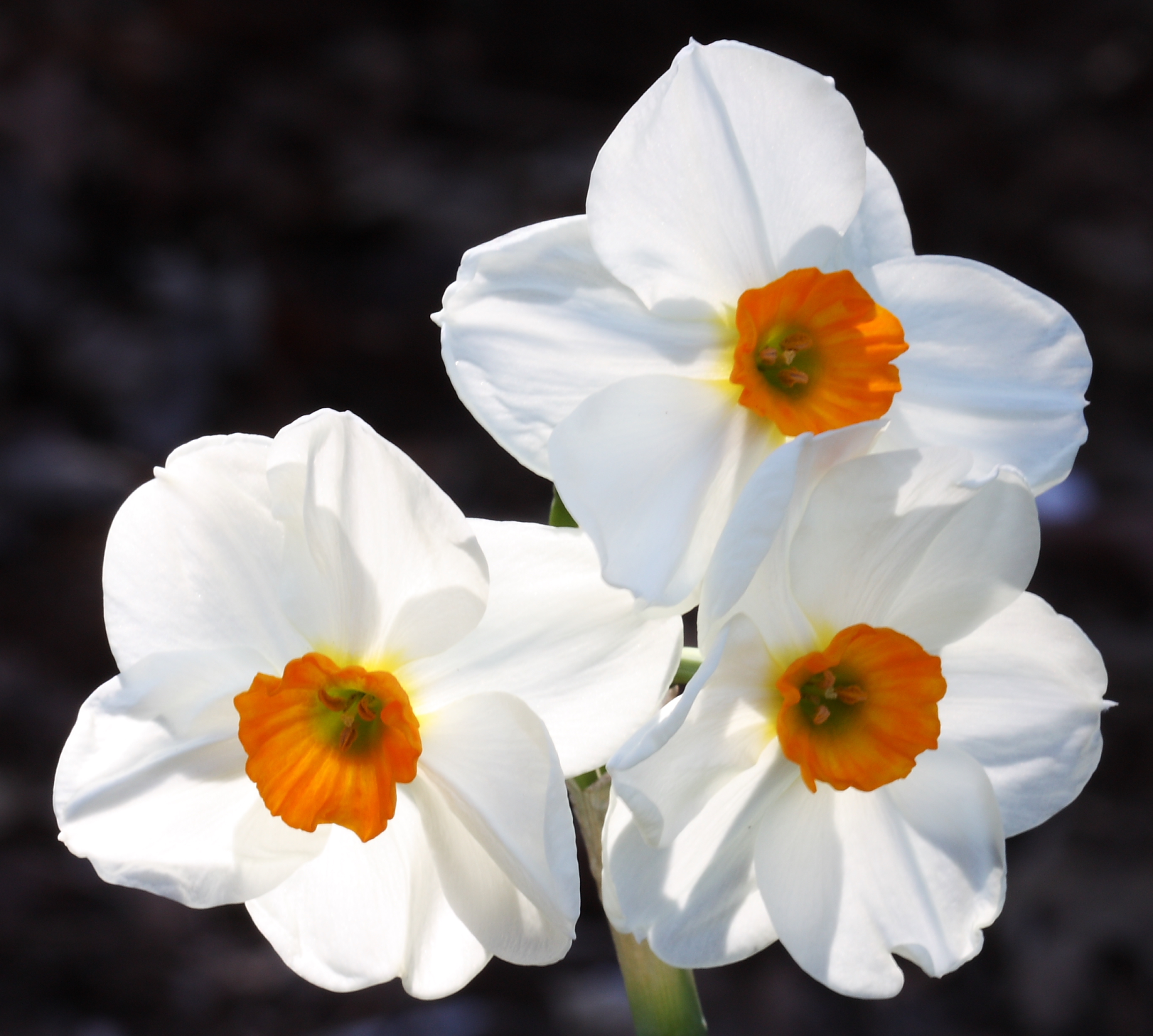
Caring teachers and a lovely little school have straightened her stem, burst open her petals and encouraged a more confident little trumpet in the middle. In recognition, and ending months of parental anxiety, this week she won a place at a super new school. Like the picture above she now has more of the ‘Narcissus Geranium’ about her than the original snowdrop. It’s lovely to see.

The second set of flowers came at work. I found myself talking to a roomful of our people from Alexandria and Cairo (despite the unrest at home), Abuja, Beirut, Abu Dhabi, Lahore, Recife and the UK about our Prime Minister’s recent speech on Multiculturalism. I said I think it’s all about how petals and centre – or stigma – relate in the national flower. I drew three flowers. One with petals and no centre, one with a huge centre and ‘teddy bear’s ears’ petals and the last with daffodil-like proportions.

I said, in my view, if there is no shared centre, just independent and separate ‘petals’ of separate cultures who never mix, a society will have tensions. Similarly if the centre is so large that the central culture dominates and excludes ‘outsider’ cultures, beleaguered, excluded groups will live unhappily. What’s needed – and substantially what I believe we have in the UK – is a good balance of centre and petals; things in common and things on which we live with and benefit from difference. 

What was interesting for me was when the woman from Brazil stood up and said, for her, there was a fourth option. Her picture was petals within a circle. That’s how she feels about Brazil, their culture is the sum of their petals. I guess a lot depends on the balance of ‘new’ and ‘old’, ‘migrant’ and ‘indigenous’, ‘history’ and ‘present’. A daffodil culture works for me.

My final Narcissus blossomed in a rich conversation over fish, chips and peas on the balance of Kierkegaardian ‘ethical roles’ and the central self. My interlocutor has impressively re-asserted her central self, to rebalance her life and lessen the competing and narcissistic demands of all those making a claim on her.

This set me thinking, and, as I said, once again the daffodil strikes me as the ideal flower. The ‘daffodil life’ wins over everyone with its ramrod straight ethical stalk, a healthy petal spread of life roles. But, it’s the vivid central trumpet of the self that ‘makes’ the flower – just like my little girl. 

Passing a florist today, me and my boy bought our first daffodils of the year after his Birthday lunch. They are a joyous symbol of spring. A wonderful thing the daffodil.