AirPods or Albatrosses

They’re kinda wonderful; but as vice.com point out

They’re plastic, made of some combination of carbon, hydrogen, oxygen, nitrogen, chlorine, and sulfur. They’re tungsten, tin, tantalum, lithium, and cobalt.

The particles that make up these elements were created 13.8 billion years ago, during the Big Bang. Humans extract these elements from the earth, heat them, refine them. As they work, humans breathe in airborne particles, which deposit in their lungs. The materials are shipped from places like Vietnam, South Africa, Kazakhstan, Peru, Mexico, Indonesia, and India, to factories in China. A literal city of workers creates four tiny computing chips and assembles them into a logic board. Sensors, microphones, grilles, and an antenna are glued together and packaged into a white, strange-looking plastic exoskeleton.

These are AirPods. They’re a collection of atoms born at the dawn of the universe, churned beneath the surface of the earth, and condensed in an anthropogenic parallel to the Big Crunch—a proposed version of the death of the universe where all matter shrinks and condenses together. Workers are paid unlivable wages in more than a dozen countries to make this product possible. Then it’s sold by Apple, the world’s first trillion-dollar company, for $159 USD. 

For roughly 18 months, AirPods play music, or podcasts, or make phone calls. Then the lithium-ion batteries will stop holding much of a charge, and the AirPods will slowly become unusable. They can’t be repaired because they’re glued together. They can’t be thrown out, or else the lithium-ion battery may start a fire in the garbage compactor. They can’t be easily recycled, because there’s no safe way to separatethe lithium-ion battery from the plastic shell. Instead, the AirPods sit in your drawer forever.

But more than a pair of headphones, AirPods are an un-erasable product of culture and class. People in working or impoverished economic classes are responsible for the life-threatening, exhaustive, violent work of removing their parts from the ground and assembling them. Meanwhile, people in the global upper class design and purchase AirPods.

Even if you only own AirPods for a few years, the earth owns them forever. When you die, your bones will decompose in less than a century, but the plastic shell of AirPods won’t decompose for at least a millennia. Thousands of years in the future, if human life or sentient beings exist on earth, maybe archaeologists will find AirPods in the forgotten corners of homes. They’ll probably wonder why they were ever made, and why so many people bought them. But we can also ask ourselves those same questions right now.

Why did we make technology that will live for 18 months, die, and never rot?

I have mixed feelings about Extinction Rebellion; but thanks to Sir David Attenborough, having seen albatrosses feeding plastic to their chicks – you have to think we need to change our ways.

FIDO

I recommended them to a work colleague as ‘among the very best £4s I’ve ever spent’; all round top banana Chris Croft’s ‘Assertiveness MP3s‘ are pure gold.

So I wrote to Chris to tell him:

At my grand age it’s kind of embarrassing to lack the conceptual apparatus to fix one of your deep-seated weaknesses; but as you say these things are improved by understanding, application, repetition and changing your internal narratives. Your Assertiveness tape is a revelation! Thank you for what you do Chris – it’s terrific.

He kindly wrote back

What a great message – thanks John!

One of Chris’s top tips is when you get something wrong or make a mistake (which we all do, all the time) then FIDO is your new best friend.

Not the famous Italian dog but the simple acronym:

Forget It and Drive On.

As Chris himself points out, ‘Learn from it’ might be better than ‘Forget it’ but LIDO isn’t quite as good as FIDO. For my part I thought I might like ‘Move On’ more than ‘Drive On’ – a bit less ‘bulldozing’ – but LIMO is hopeless…

But the pièce de résistance fell into place this week, thanks to my belated opening of a Christmas gift from a very great friend…

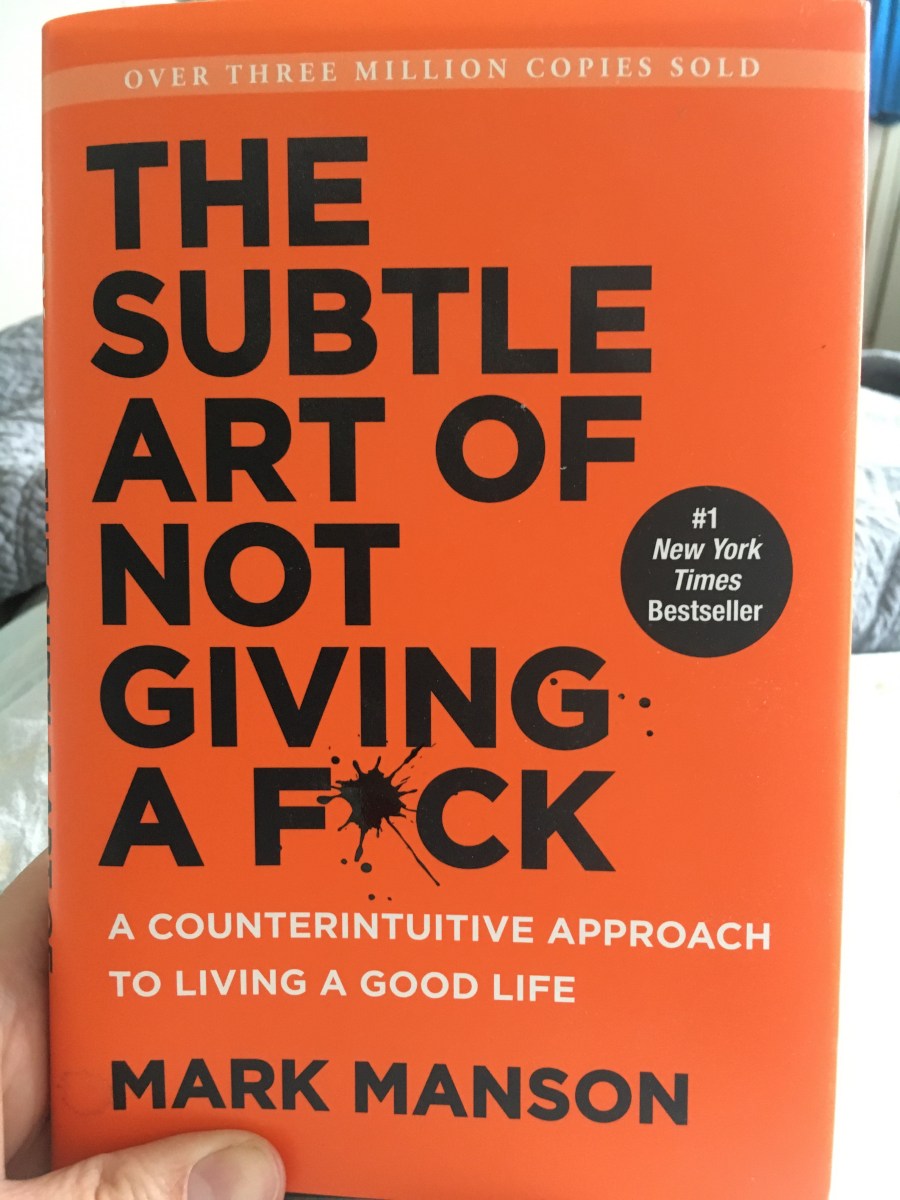
It’s a bit sweary as the title suggests, but Mark Manson is certainly onto something… in a nutshell if we give a f#ck about too many things then we’re not giving enough of a f#ck about the things that matter. Simple.

So now, I have the version of FIDO which works for me. Forget ‘learning from it’ – I think about stuff to much already… The mongrel version of FIDO which has become my trusty companion this week, is the one which plays to my Northern roots and stops rumination dead in its tracks:

F#ck It and Drive On.

Conceptually nudging ‘drive’ into the cheery form of ‘barrelling’ or ‘bowling along’ through life – it’s working like a charm!

P.S.

Here are some of Chris’s very handy ‘mantras’ which he sent through last month:

“During my assertiveness training day I have various catch-phrases, or mantras, and I hope that people will pick up on at least one of them and keep it in mind when they are dealing with difficult situations. Here is a list of all of the ones that I personally use (with brief explanations):

“Nobody can push me into the ‘not OK’ box”

We all have a tendency to move from being OK about ourselves to being not OK, and if you are not OK about yourself then you will find it more difficult to interact productively with others. Being OK doesn’t mean “better than the other person” – just OK with yourself. And other people will sometimes try to push you into the not OK box, when they try to make you feel guilty or accuse you of being selfish when you are standing up for yourself and your own rights. Or if you’ve made a mistake, it doesn’t mean you’re a bad person. And it’s not up to anyone else to decide whether you are a good person, it’s up to you.

“We teach people how to treat us”

If you let people treat you badly they will keep on doing it. And even in small cases, for example the boss who can’t delegate or who solves people’s problems for them, will be brought more and more problems to solve. So if you keep on being treated badly, especially if it’s by more than one person, then ask yourself if there is something you are doing to encourage them.

“It’s never too late to go back”

If you are taken by surprise, maybe by a verbal attack or perhaps a request for something, and you give in, and you are kicking yourself afterwards thining “I should never agreed to that” or “I should never have let him get away with that” or “I know what I should have said, if only I’d been a bit quicker” then remember, you can always go back and say “I’ve been thinking about what you said earlier, and I’m not happy with it / I’m going to change my mind etc”. It’s great to know that you have as long as you need in order to think of a suitable reply.

“I don’t have to justify how I feel”

I joke that I regret teaching my wife this one, but the truth is that I think everyone should use this phrase. If you don’t want to do something and you are being pressure with “But why not??” then this can be a good response. You are entitled to your feelings, and that’s an end to it.”

Of Kings

Man or woman, royal or republican, political or organisational – anyone who leads or seeks to should reflect on this…

Josef Pieper once again makes the truth limpid – in order for there to be justice, there must be authority; but when that authority is vested in a person, if they are bad there is nothing that can stop injustice.

This perhaps explains the state of the world today – there aren’t too many ‘just rulers’ about…

Of course it’s not easy:

The lesson here is: political nous and worldly wisdom i.e. ‘prudentia‘ and ‘temperantia‘ (self management) might get you there; but if you take a position of responsibility ‘guarding justice’ is your job.

Cardiac Coherence

I’d forgotten all about cardiac coherence having first read (and written) about it in 2010. But finding it again is a wonderful thing…

As I put it to someone at work: what’s not to like about about a regular feeling of ‘lightness, warmth and expansion in your chest?’

Even better when it becomes something you sometimes default to; as I found listening to Happy Tracks on a busy bus into work this week.

Here’s what it is and how you do it from David Servan-Schreiber’s wonderful ‘Healing without Freud or Prozac’:

Enjoy.

: )

Cathedral or Cave II

Whew, I’ve been hard at it recently. And as so often: intractable problems, helping people who are struggling and taking on more than I should; all of which have taken their toll.

But also – as increasingly often these last ten years – I’ve caught myself just in time…

Flagging, tired and increasingly irascible, I had the good sense to book this Friday off and as I texted to a great friend, here’s what I did with it:

For my part I walked the hound and then slept from 9.30am to 11.40am with the dog by my side, and then again from 2.30pm to 5.50pm similarly. I feel a deep basin of fatigue has been considerably drained. My biggest problem in life has always been that I need more sleep than most people.

I also coughed the other truth about myself last weekend – I like people; but they tire me out. And very very helpfully, I have been excused some social outings subsequently.

Which reminded me of this – written eight years ago…

I’m more cave than cathedral I increasingly think. I need more sleep and more time alone than most people:

Cathedral or Cave?

I imagine Aristotle, like the Acropolis, as more Cathedral. The reclusive poet Emily Dickinson would be more cave. Montaigne, perhaps old Paris; earthy rumbustious streets and deep reflective catacombs. 

I’ve been toying with Nietzsche’s idea that our ‘will to power’ is either expressed in the real world or forcibly turned in.

For him, we create a complex inner life in proportion to the scale of our drive we cannot express externally. It’s an interesting thought.

Complex interesting people tend to have a good deal of both – rich inner lives and fulfilling outer ones. But not always. Nietzsche credits civilisation with curbing the capacity to express our animal instincts externally – driving them inwards. This unexpressed energy drives our inner lives – our conscience, guilt and creativity.

I think regularly about the balance of inner and external. I don’t feel I have the ‘will to power’ for a full ‘Cathedral’ in the external world. Too much competition, conflict, one-upmanship and strife in seeking grandeur. I fear I’d lose my health, precious time with my family and my happiness if I allowed a ‘grand projet’ or personal aggrandisement to consume me. 

Talking to a friend – who is a decade older than me – this week, I felt a bit guilty. He has real fire in his belly for systemic reform, transformational change and the great debates of public policy. I said I’m just not attracted to any of that right now. 

We talked about using our talents and our responsibility to improve the lot of others…

He started his career as a lone residential social worker – on a tough housing estate. Beer bottles bounced off the cage that surrounded his outpost all night.

That’s where his fire still comes from. It drives him to want to improve the scaffolding and superstructure of the nation’s health and social care system.

I don’t have that. I’m more a family chapel with a good sized intellectual cellar. My projects are more local and small scale – my family, the people around me.

But never say never. The world is an unpredictable place. Gaudi started with lamp posts and squat schoolhouses, so I suppose you never really know what you might build one brick at a time.