Cosmos

20110714-090550.jpgToday I spent an hour, at the unveiling of a statue to Yuri Gagarin, with the man who has spent more time in space than any other – the Cosmonaut Sergei Krikalev.

Poised, distinguished and himself chipped from granite, he is definitely the man you would want in the space capsule with you if something went wrong. He’s ten years older than me and found himself circling the earth when the USSR imploded leaving him temporarily stranded in outer space. Having met him, I expect he took it in his stride.

I talked to him about fitness loss in space, cosmic rays causing flashes in your eyes (a dozen per half hour or thereabouts in his experience) and experiments to test what snails had in common with dinosaurs (inconclusive).

As you might expect, given the things he’s seen, he had some reasonably profound things to say about international collaboration, friendship and what humanity has and can achieve.

My summary of his wise words:

While the ancients thought the world was infinite – and perhaps bourne on the back of elephants – when you see it from orbit you see it is big, but really not that big – and above all you see it is finite.

That the international friendships he has made are his greatest treasure and that international collaboration in science and space has always transcended the politics in his time in space.

Space is unbelievably hostile. And when all that separates you from it is a few millilitres of aluminium – which you could easily puncture with a kitchen knife – you recognise how fragile your existence is.

To say that ‘going into space has been done’ and ‘there’s nothing more to do’, is like saying the Romans built roads so why bother building a train.

Finally – and his eyes lit up on this one – the future is always exciting, we will go further and we will always reach for the stars.

A ramrod straight, decent and good man I concluded, with the quiet bravery of a modern day Achilles.

Incandescence

This week, I advanced my new theory – to a gently sceptical friend – that the brain works (at least partly) like the electronic ink screen of an Amazon Kindle. Blending in the philosophy of St Thomas Aquinas, my sweeping conclusion was he should get angry more. Here’s why.

Since buying a Kindle, I’ve been impressed that the screen, when you switch it off, maintains a complex picture – a person, a constellation, a painting etc – using no energy at all. It’s simple but impressive. Like a screensaver, but without power. Information and knowledge are thus available to be viewed, at any time, at no energy or processing cost. My theory is the brain has the same capacity.

A few years ago I read that neurones aren’t permanently ‘charged’ like little lightbulbs or LCD pixels but store information passively – more like a physical switch or dial. Energy is used to ‘charge’ them with information, but once they have been ‘set’ with information they store it passively until changed. Good job too, or, given the number of neurones we have, we’d need a nuclear generator to power our heads.

So my emerging thesis is we can ‘poll’ in computer lingo, or rapidly access a snapshot our entire accumulated summary of knowledge and experience in an instant. And in that instant we can act or react subconsciously informed by that summary.

My guess is that none of this requires much in the way of conscious cognitive processes. Like a finger recoiling from a nail or a smile drawing a return smile, we can immediately and effectively respond to people and situations against this dataset. I’m not saying it is innate or preloaded. We are constantly checking, updating and rearranging our vast neuronal data-set. But at any instant, my thesis is, it lies latently ‘there’ encrypted in neurones like the patterns which make a rich picture, or a page of words, out of electronic ink.

Of course we can intervene, ignore, debate or challenge our accumulated data. Any instant ‘gut’ reaction, or action, it may recommend can be overruled. In complex or nuanced circumstances the higher cognitive functions kick in – at least most of the time.

And this connects to my ongoing conversation with my friend on Aquinas’ support for ‘ira’, and the set of passions which include anger. Like Aristotle – in fact far more than him – Aquinas was pro anger in the right circumstances. Surprising for a theologian.

He thought the passions were intrinsic parts of who we are. He thought they were forms of reason, not lower ‘animal’ or ‘bodily’ sensations to be suppressed by our purer ‘mind’ or ‘soul’. Thus, our passions come from our instincts, blended with our default ‘Kindle screen’ summary of experiences, beliefs and our lifetime of accumulated and refined knowledge. They all inform each other.

I’m with Aristotle that we are what we repeatedly do. So we are constantly refining and tuning our passions, our experience dataset and our virtues through action – only some of that helped by conscious reflection. I’m increasingly with Aquinas too, that it all comes together in complex single holistic system – an ‘anima’, aka a person, not a dumb body and a smart, reasonable mind.

As Herbert McCabe points out: for Aquinas the good life is a passionate life; not achieved by the repression of passions, but by passions guided by virtues. Perhaps there’s more to be said for trusting our ‘gut’, allowing moments of ‘ira’ and the occasional incandescence of righteous anger. Once you’ve lived a few decades and developed a bit of virtue, it’s pretty well informed.

Xerxes

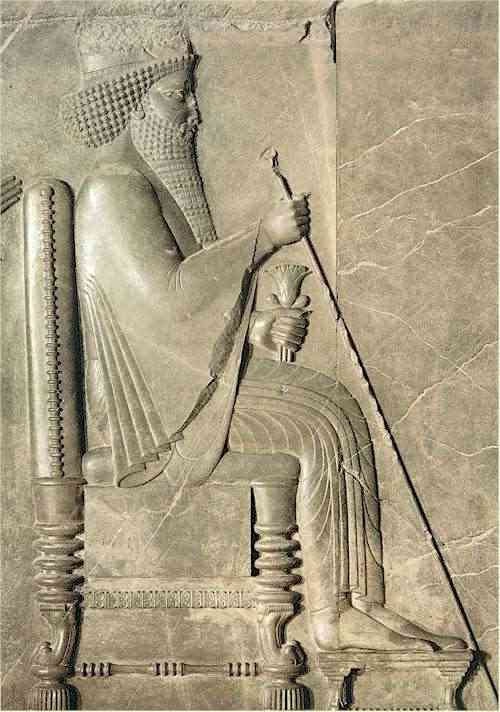
Xerxes – controversially portrayed as a narcissistic androgynous giant in the blood-spattered film 300 – broke with Persian tradition and laid waste to allies and enemies with enormous forces, before losing interest, losing ground and retiring to lotus eating and luxury. Or so some say.

His patina of invincibility was chipped by Leonidas’s legendary 300 Spartans’ suicidal defiance at the ‘hot gates’ of Thermopylae. A Persian General said of them: “Ye Gods, Mardonius, what men have you brought us to fight against? Men that fight not for gold, but for glory.” Spartans sought their immortality in glorious death.

In film and folklore Xerxes was a god amongst men before succumbing to human frailties. Is Xerxes a myth, a legend or history? Probably a bit of all three. A reading of Robert Graves’ Greek Myths suggests most ancient history, legend and mythology is in fact a bit of all three.

But a tale from Montaigne’s suggests that even as Xerxes set out to conquer all, he saw, in the same instant, the limits to his dominance:

Montaigne XXXVII

Artabanus coming by surprise once upon his nephew Xerxes, chid him for the sudden alteration of his countenance. He was considering the immeasurable greatness of his forces passing over the Hellespont for the Grecian expedition: he was first seized with a palpitation of joy, to see so many millions of men under his command, and this appeared in the gaiety of his looks: but his thoughts at the same instant suggesting to him that of so many lives, within a century at most, there would not be one left, he presently knit his brows and grew sad, even to tears.

Greek myths tell us that power and glory are always transient. Even the most powerful among us are mayflies in historical, let alone geological time. Xerxes is a reminder that men cannot be gods. We have at best three score and ten, whether we are millions or 300 men. It behoves us to use our time well.

Tragedies

I thoroughly enjoyed reading Simon Armitage’s updating of The Odyssey this week – a rattling good read, in my view. Our hero Odysseus, helped by Athene – and in spite of Poseidon and the only sometimes benign neglect of Zeus – overcomes a decade of trials and torments to return to the arms of his long-suffering Penelope.

Serendipitously, I also heard a Philosophy Bites about Nietzsche’s The Birth of Tragedy. Nietzsche argued Greek Tragedies were the perfect human and artistic response to the balance of ‘Dionysian’ chaos and ‘Apollonian’ order in life. The world is chaos and disorder (fickle gods) but humans can briefly rise above that to create pockets and moments of order (depending on the goodwill of the gods).

This tension of chaos and order, it is suggested, energises, drives virtue, excellence and courage and guards us against hubris and vanity. For Nietzsche, tragedies and myths enriched and invigorated Athenian culture, fuelling its dynamism, optimism and creativity – a latter day ‘Yes we can’ despite all evidence to the contrary.

I think he’s onto something. Planet Earth is an extraordinarily delicate life-boat in a cosmos of nothingness occasionally punctuated by ice, fire and crushing gravity. And our world wasn’t always so benign. On hols in France – watching an improbably large stork fly overhead – I was reminded of massive raptors bouyed by high levels of atmospheric oxygen, avoiding the constant vulcanism and raging forest fires which were the Carboniferous era. Pretty Dionysian. As The Odyssey teaches we can be heroic and stoic, but we are mere mortals against primal forces.

Enter Socrates – everything can be learned, mastered and understood by unrelenting reasoned debate and dialogue. The human mind can penetrate the deepest mysteries and bring order to nature’s chaos. And indeed we can to some degree – with a bit of observation and Aristotle’s scientific method thrown in. But like Odysseus, Achilles or Icarus we can all be raised up and brought low by the fates, with only chaos and chance as explanations.

For Nietzsche the pre-Socratic Greeks had it right. Tragedy and myths were the spiritual batteries of their culture – their way of coping with an unpredictable and inhospitable mother nature. But they could, through luck, bravery and virtue, enjoy moments of truimph and joy. Art lifted their spirits and their culture.

But then along came Socrates who badgered us into believing the world was rational. I like the Socratic method – stepping outside your own beliefs to examine them and debate them with others – but not his unintended consequence. Nietzsche accuses Socrates of killing art with reason and, with it, art’s ability to help us live with and laugh in the face of chaos.

I’ve cited Armitage’s Odysseus three times at work this week. It helped me and others understand and deal with our workplace fates and some all too human failings. It made us reflect, laugh a bit and cope better. Art imitating life or life imitating art? Either way, stepping outside our local tragedies to reflect on ancient ones seemed to help.

Poetry in Motion

I’ve just finished Csikszentmihalyi’s ‘Flow’. There are things to criticise. Some points – the time we waste in front of TV notably – are right but he makes them repetitively. His style occasionally grates. But, in my humble opinion, it is an outstanding book. My Bayesian brain infers he is likely a pretty outstanding man.

There are many themes to pull out, ideas to take forward, good advice and thought provoking evidence. My simple summary is – just read it. I’ve given ‘Flow’ its own link in the sidebar to the right.

Two personal things I’ll draw out. First Csikszentmihilyi’s advice to read a piece of poetry every day. I’ve never much cared for poetry. But, as he says, I’ve discovered a poem is a simple and rewarding pleasure. It doesn’t take much. Just five minutes and two or three poems at bedtime and mood and life are subtlety and magically enhanced. I told my partner. She’s taken with it too. And now we both have books of poetry on the go. My advice – just do it.

The second personal thing was my curious desire to get the book over with. Mainly, I think, so I could get on with all the things I now want to read as a result of reading the book. But also because I ever-so-slightly feared Csikszentmihalyi might barrel off the rails and disappoint me at the end.

Many potentially great books have been marred by a lame ending. I worried about this one. Tantalisingly the penultimate chapter was pretty good – synthesis, some emergent structure and integration of themes. So, as I said to to a particular friend, I was anxious that the last chapter would be a major disappointment. He said ‘Don’t read it, write your own final chapter’. Good advice, but a somewhat daunting challenge, so I read it instead, and I’m glad I did.

No easy answers therein, but a validation of my own thesis, that the good life requires both thought and action – Aristotle and Achilles. Csikszentmihilyi also recommends the thinkers and writers of history and antiquity as invaluable guides. I increasingly agree. But his final challenge is a tough one: to learn to master oneself and then get beyond the self to find an overarching meaning for our lives and tune into and live vividly in the full ‘flow’ of the real world. Easy then.

Discussing this on Monday with another friend, we concluded life takes the balance of a Nureyev: to balance internal with external, self with others, the world within with the world without, skill with challenge, what we achieve in life with what we would want to be remembered for.

Stoic, Sceptic, Epicurean, Existentialist, pick your school of philosophy, they are all scratching the same basic itch: how much to stick your neck out and risk your mental and physical health in the hurly burly of the real world.

Finding ‘meaning’ for Csikszentmihalyi or a ‘telos’ for Aristotle is the tough one. For Aristotle’s harp player it’s playing the harp well. For me the meaning of life is getting clearer, but it’s reassuring to know there are philosophers and poets to help me on my way.