Happy Christmas

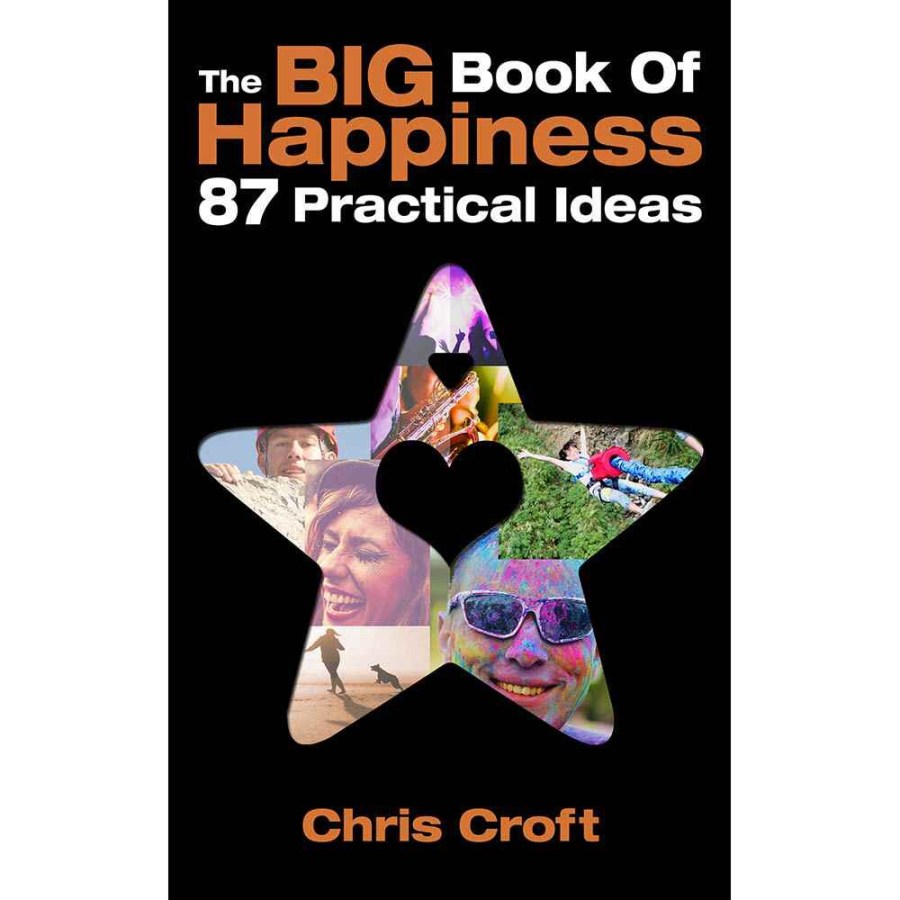
I’ve had a Happy Christmas and a joyful start to 2017; not thanks to Santa, but a dead sensible British bloke who has written a book I’d recommend to anyone.

‘The Big Book of Happiness 87 Practical Ideas’ is a no-nonsense guide to how to live.

The point of it all, self limiting beliefs and behaviours, getting organised, writing down and pursuing your goals – and the value of dabbling in things. It’s a cracker.

If you read nothing else this year read this… If Aristotle were around today, it’s the book he’d write.

Public Virtue

By temperament I’d probably prefer an Epicurean life. As Wikipedia has it:

For Epicurus, the purpose of philosophy was to attain the happy, tranquil life, characterized by ataraxia: peace and freedom from fear and aponia: the absence of pain and by living a self-sufficient life surrounded by friends. 

Following Alain de Botton’s lead, I think of this as seeking ‘The Garden’; an idealised  Mediterranean retreat surrounded by carefully selected friends, passing days in contemplation -with occasional breaks for olives, bread, jamon y queso and other light delights… 

But working and family life – especially the middle years – aren’t quite like that are they.

And given I’ve taken Aristotle as my guide, his ‘good life’ comes with a much higher bar; what I’ve come to think of as a life of ‘public virtue’.

Here’s a list of 11 things an Aristotelian life of public virtue requires, in a blend of my words and his; re-found last week looking at those ‘to do’ lists from 2010:

A life of Public Virtue

Courage: does my courage suitably balance fear and confidence?

Temperance: am I self-indulgent or unduly ascetic?

Liberality: am I generous, profligate or mean?

Magnificence: do I visibly give my time and money to good causes?

Pride: am I vain or unduly humble; do I step forward or stand back from noble actions and undertakings?

Honour: am I sufficiently ambitious or am I too unambitious?

Good Temper: am I good tempered, irascible or too meek?

Friendliness: am I friendly, obsequious, a flatterer or quarrelsome?

Truthfulness: am I boastful or mock-modest about my achievements?

Wit: do I sparkle or am I dull?

Friendship: am I generous in my friendship, a loner or spreading myself too thinly?

Tough tests these. 

Based on this higher Aristotelian standard, I’ve pushed myself this week: more courage, less obsequiousness and ‘mock-modesty’ – and a spot of irascibility too; telling a couple of people to b#%%€r off. 

In sum: standing for, standing against; and not just standing by on some things which need to be better.

Public virtue requires a bit of courage and a bit of oomph; a public life can’t always be a peaceful one free of fear and pain.

Good also to remember, this week of all weeks, what US ‘Founding Father’ John Adams had to say on the importance of public virtue:

Concrete or Casuistry?

img_1472

casuistry (kazjʊɪstri) noun: the resolving of moral problems by the application of theoretical rules.

As I continue my voyage through Dietrich Bonhoeffer’s Ethics, I also continue to be astonished by the man. Limpid paragraphs of dense and pure meaning, sweeping historical context – and tub thumping Christianity. A heady mix.

But the page which stuck with me this week describes the challenges of Christian ethics; but also the constant challenge of modern organisational life:

“The attempt to define that which is good once and for all has always ended in failure. Either the proposition was asserted in such general and formal terms that it retained no significance as regards its contents, or else one tried to include in it and elaborate the whole immense range of conceivable contents, and thus say in advance what would be good in every single case; this led to a casuistic system so unmanageable that it could satisfy the demands neither of general validity nor of concreteness.”

Pretty much every strategy exercise or major organisational change programme I’ve ever worked on has wrestled with this. As Bonhoeffer puts it, the conflict between the ‘good’ and the ‘real’.

Bonhoeffer argues for concrete not casuistry. Not a bad place to go, not least given how bad things were in his times. But I go with Aristotle’s ‘golden mean’; the ‘good’ is always somewhere in the difficult and constantly contested place in between.


Habit Forming

  
Is the great Greek wrong on this one… 

I stumbled across  an interesting article in Time – (it quoted an academic from my place of work) which suggests he might be:


So what are habits, really? According to Dr. Benjamin Gardner, a psychologist focusing on habit research at King’s College London, “habit works by generating an impulse to do a behaviour with little or no conscious thought.” Habits are simply how the brain learns to do things without deliberation. These impulses can be put to good use, but only certain behaviors can become habits.

Building a habit is relatively simple — just harness the impulse. For new habits to take hold, provide a clear trigger, make the behavior easy to do, and ensure it occurs frequently. For example, by completely removing unhealthy food from my home and eating the same thing every morning, my diet became a healthy habit. I extracted the decision making process out of what I eat at home.

However, if the behavior requires a high degree of intentionality, effort, or deliberation, it is not a habit. Although proponents of habits tout them as miracle cures for doing things we’d rather not do, I’m sorry to say that’s snake oil. All sorts of tasks aren’t habits and never will be. By definition, doing things that are effortful aren’t habits.

Unfortunately, this means behaviors that require hard work and deliberate practice aren’t good candidates for habit-formation. For example, although I make time for it every day, writing is not a habit. Writing is hard work. If I waited for an “impulse” to write, I’d never do it. To get better at writing requires concentration and directed effort to make sense of the words as they go from the research to my head and then to the screen. Similarly, lifting weights isn’t a habit because getting stronger requires working harder.

So if these type of behaviors aren’t habits, what are they? They’re routines. A routine is a series of behaviors regularly practiced. Routines don’t care if you feel an urge or not, they just need to get done. When I finally realized I would never succeed at making going to the gym a habit, I began looking for how to establish a routine instead.

This makes sense, when you think about it. I’ve read elsewhere that as much of 40% of the time we are doing things which have become habitual and have no conscious deliberation – we are on Autopilot.

This suggests three things – all of which I’m trying… Make boring but useful things a habit (taking my vitamin D for example); make things which take some effort but are good for me into a routine (write a blog every Saturday); and more counterintuitively – make sure things which are supposed to be enjoyable, don’t become a habit. 

Why? Because once you stop thinking about them, you’re no longer consciously enjoying them. Not having a drink on Monday or Tuesday has become a habit (good). So sometimes sharing a bottle of prosecco with my other half on a Wednesday, has become a treat (need to be careful it doesn’t become a habit though…)

It’s worth reflecting on what you want to do without thinking, what you can’t do without thinking and what you enjoy doing – and need to think about to consciously enjoy. 

Habits aren’t conscious. They may help to make us excellent; but our best and most enjoyable work and experiences require conscious effort. 

I’m sure Aristotle would buy that.

Office 2016


Further proof this week (were it needed) that not thinking about things, actually helps you think about things…

After ten days off for Christmas; scarcely thinking at all about work, I arrived in the office on Monday a little dazed and confused. A colleague asked with a smile if I had any blinding new insights to share? I could only answer slightly sheepishly “Nope”

But then, thanks to the miracle of the empty mind, I scribbled with a scratchy pen, on a couple of discarded misprinted sheets of A3 off the printer: the entire scope of my job; and the purpose for me at work for 2016. 

It had all became clear, because I hadn’t been thinking about it…

Later that same day (at bedtime to be precise) the few remaining work-related knots in my head, were smoothed out by a simple but super article in ‘Philosopy Now‘ by Peter Adamson. 

Adamson reminds us that Aristotle gave us the clinching argument against “the proposition that the good life lies acquisition of wealth.” 

He continues: 

Whatever else we say about the happy life, happiness is surely something we deserve for its own sake. You don’t seek to become happy for some further goal. 

Money by contrast, is not something that can sensibly be desired simply for itself. It is valued only for what we can acquire with it, such as security, pleasures and the opportunity to show virtue. 

Therefore a life that seeks to pile up wealth with no other end in view is incoherent.

He continues 

Aristotle has a similarly persuasive case to make against the life devoted to honor: we wish to be honored not just for any old reason, but because we deserve to be honored. 

At most, then, honour comes as a kind of bonus on top of what we really want, which is to be or to have achieved something worthy of the honour.  

Out of the contenders for a happy life, that leaves the life of virtue. And virtue is complemented by pleasure, because the virtuous person takes pleasure in being virtuous; and by honor too, at least if one’s fellow citizens apportion honor rightly.

Of course Aristotle was nothing if not also practical: 

Although Aristotle insisted that the good life is the virtuous life, he cautioned that we need money as well. You can hardly hope to be virtuous without money, if only because generosity is a virtue: you need wealth to give it away.

Common sense also tells you that such things as health, a flourishing family, and friends, belong to the good life, and Aristotle wasn’t against common sense on this score. 

But it’s Adamson’s conclusion which is the clincher:

In these days, when whole countries are faced by economic disaster, ancient advice remains useful: accept money and use it wisely when it comes, but do not sacrifice virtue to get it – and remember that there are things in life compared to which money, in any currency, has zero value.

In sum, don’t seek money or honour for their own sakes; and if they come as a by-product of hard work and a good character, use them wisely.

A timely reminder for 2016 from Adamson that Aristotle’s Ethics are a more than decent guide to working (as well as wider) life.