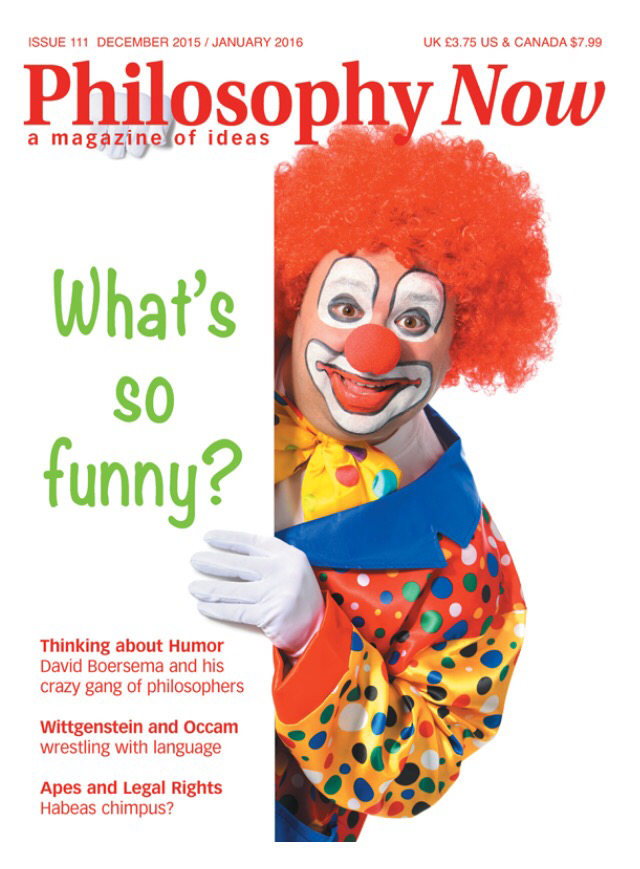
Laughter; the best medicine 


I’m more a man for observational humour than for jokes; but perhaps the joke has been on me…

British humour tends to the downbeat. Ironic, sarcastic and even cynical – there’s always the risk of us talking everything down. With my new optimistic élan, I’m doing my best to avoid all that. 

But if you can’t ‘bitch and moan’, where are the laughs at work? Our place is dead clever, but also dead earnest. I realised the other day I hadn’t laughed all week…

Thank goodness Philosophy Now spurred me into action with their humour edition!

Two strong explanations of humour are the ‘Superiority’ and the ‘Incongruity’ theories.

Anya Steinbeck explains the first:

“The so-called superiority theory is prominent among explanations of humour. In fact, so prominent that it has been championed by philosophical heavyweights such as Plato, Aristotle, Hobbes and Bergson

Thomas Hobbes’ formulation of the superiority theory is this: “Laughter is nothing else but sudden glory arising from some sudden conception of some eminency in ourselves, by comparison with the infirmity of others, or with our own, formerly.” 

If Hobbes is right, humour becomes a tool for making ourselves feel better by thinking of others or our own past selves as inferior. So if Ted is a terrible golfer he can overcome the pain of this truth by making fun of Fred who is an even worse golfer. 

Plato believes this kind of humour to be damaging: “Taken generally the ridiculous is a certain kind of evil, specifically a vice.” It counts as a vice because it is symptomatic of a lack of critical self-awareness as we ridicule others. 

I would suggest that the two most serious problems with hierarchical jokes are these: 

1) Firstly, as Plato says, the aesthetic form of a joke form is just so attractive and appealing that we may not pay enough critical attention to the moral content. 

2) Secondly, far from having a dialogue function, jokes can be conversation stoppers. As Theodor Adorno says: “He who has laughter on his side has no need of proof.” 

In other words, humour is, next to its wonderful properties, also a great potential tool for manipulation. Dress them up as a joke and you can get away with outrageous statements. 

So what of the ‘Incongruity’ theory? The Stanford Dictionary of Philosophy gives us this:

“The first philosopher to use the word incongruous to analyze humor was James Beattie (1779). Our laughter “seems to arise from the view of things incongruous united in the same assemblage.” The cause of humorous laughter is “two or more inconsistent, unsuitable, or incongruous parts or circumstances, considered as united in one complex object or assemblage, as acquiring a sort of mutual relation from the peculiar manner in which the mind takes notice of them.”

Beattie may be right but he’s not exactly got us rolling in the aisles with that description.

And it gets worse… Given his well deserved reputation for seriousness, perhaps not surprising that Kant is stronger on theory than gags…

20120512-111900.jpg

“In everything that is to excite a lively convulsive laugh there must be something absurd (in which the understanding, therefore, can find no satisfaction).”

“Laughter is an affection arising from the sudden transformation of a strained expectation into nothing. This transformation, which is certainly not enjoyable to the understanding, yet indirectly gives it very active enjoyment for a moment. Therefore its cause must consist in the influence of the representation upon the body, and the reflex effect of this upon the mind.”

Kant illustrates with this story:

“An Indian at the table of an Englishman in Surat, when he saw a bottle of ale opened and all the beer turned into froth and overflowing, testified his great astonishment with many exclamations. When the Englishman asked him, “What is there in this to astonish you so much?” he answered, “I am not at all astonished that it should flow out, but I do wonder how you ever got it in.”

Following that cracker he serves up another:

“The heir of a rich relative wished to arrange for an imposing funeral, but he lamented that he could not properly succeed; ‘for’ (said he) ‘the more money I give my mourners to look sad, the more cheerful they look!’”

Whilst I wouldn’t recommend he gives up his day job, I’m with Kant. When it comes to making people laugh, I like incongruity. 

Superiority all too easily leads to the worst type of humour – arrogance, trashing others and talking people down. Now I know what I’m looking for, I realise I’ve seen plenty of ‘superiority’ humour about. It’s not pretty. 

Keep it incongruous I say. As my boy did with his little joke in the car this morning; it made me laugh out loud:

“What did one rebel sausage say to the other?”

“May the fork be in you!”


Peace in our time

After some months of high emotion, major change, turbulence and anxiety; this morning I woke up knackered – but at peace.

My other half greeted me, observing I looked like ‘death warmed up’; sleepy, unshaven and generally out of it as I staggered into kitchen. True, but that wasn’t the point….

Some minutes later: accompanied by a nice piece of classical music, porridge on the boil; duck ramen, a bunch of flowers and a trip to Sainsburys in my plans – normal service has resumed.

Not that ‘change’ is done. More that it’s here to stay and be lived with. There’s a stack on at work, the kids are growing faster than feels comfortable, and we’re none of us getting any younger…

But yesterday for half term, my smart cookie of a daughter and I toured the architectural wonders of my new workplace, two museums, Chinatown, saw Giacometti sculptures, bought books and ate Japanese.

Perhaps that’s what’s fixed me. I don’t feel rattled, restless or anxious – for the first time in weeks. I just am. And she’s nearly finished munching a ham and cheese croissant in front of me now, so back to it.

Rain rain – when you go away…

The wettest holiday ever – well nearly; that was in Biarritz a decade and a bit ago. Still two glorious sunny days in Cornwall fooled us into thinking it was summer… It then rained unremittingly, both there; and then on our French campsite this week. 

Yesterday we called it a day; fighting the family holiday ‘sunk cost fallacy’. This was best captured in an overheard quote, during my own childhood, which became our family standard: 

“We’ve paid for it, so you will enjoy it.”

But we did ok. We all mucked in: cycling in the teeming rain, wedging into a crowded crèperie, feasting on rotisserie chickens, washing pots and pans and squelching through bogs to the bogs. 

But, facing another uninterrupted day of pouring rain, ‘practical reasonableness’ kicked in. Aquinas would have been proud…

We checked out our options, discussed it en famille and concluded, as they say en français: “on se casse” – we’re off. And a mere seventeen hours later: four solid London brick walls, a proper roof and a warm comfy 3am bed…

Family holidays can be memorable for all sorts of reasons. Rain ensured this wasn’t a classic. But sticking together through the soakings, meant, it was a good one all the same.

Aquinas – a life’s work


Some years ago on holiday, we stayed in a French house which had a multi-volume set of philosophy books. Of all the great philosophers of history only Aristotle and Aquinas merited three entire volumes; which was reassuring – I was already reading on Aquinas when we arrived.

Whilst this standing in philosophy is well merited (in my humble opinion), I’ve found Aquinas’s particular method of logical argument, makes his original texts a bit of a struggle.

But, as I dug out from the Stanford Encyclopaedia of Philosophy – for an especial friend – Aquinas’s prescription for the good life is disarmingly straightforward:

The basic human goods:

(i) life, 

(ii) “marriage between man and woman and bringing up of children [coniunctio maris et feminae et educatio liberorum]” (not at all reducible to “procreation”), 

(iii) knowledge, 

(iv) living in fellowship (societas and amicitia) with others, 

(v) practical reasonableness (bonum rationis), and 

(vi) knowing and relating appropriately to the transcendent cause of all being, value, normativity and efficacious action.

You might argue with one or two of them, but it’s not a bad recipe… 

There’s plenty of ‘practical reasonableness’ about Aquinas.

West Side Story

What a belting soundtrack! The number one selling US album of the 1960s; one listen and you know why. I’ve just written about ‘America’ on ‘Relevant Complexity’ but there’s any number of toe-tappers here.

Lovely to see my little Miss today tripping the boards among the ‘Jets’, backed by Bernstein’s punchy soundtrack and some great choreography, dance and fight scenes. A performance to remember and a soundtrack well worth rediscovering.

Leonard Bernstein’s ‘America’

IMG_3456

From the first hand clap to the final crescendo, it sets the hairs on the back of your neck tingling…

The hopes, the fears, the inequality and the immigrant’s fight for the right to the American Dream; Leonard Bernstein’s sprawling, madcap ‘America‘ is his home country’s very embodiment.

Having watched my daughter dance her socks off in her own ‘West Side Story’ today, and unable to shake the melody – I had to find the soundtrack.

Having tried half a dozen versions, for me the remastered Original Motion Picture Soundtrack has it best. Wonderful caterwauling and catcalling; and the most rumbustious, towering orchestral accompaniment.

Ballsy, brash and wonderful – just like the country, ‘America’ has it all.

West Side Story Original Soundtrack Recording

IMG_3457